Classic form
Horse riding waiver with rider weight, height and experience
A horse riding waiver records that a rider understands the inherent risks of riding and has given the details needed to match them with a suitable horse. This one asks a trail ride customer for weight, height and experience first, then a helmet choice, medical details, the risk acknowledgement and a signature.
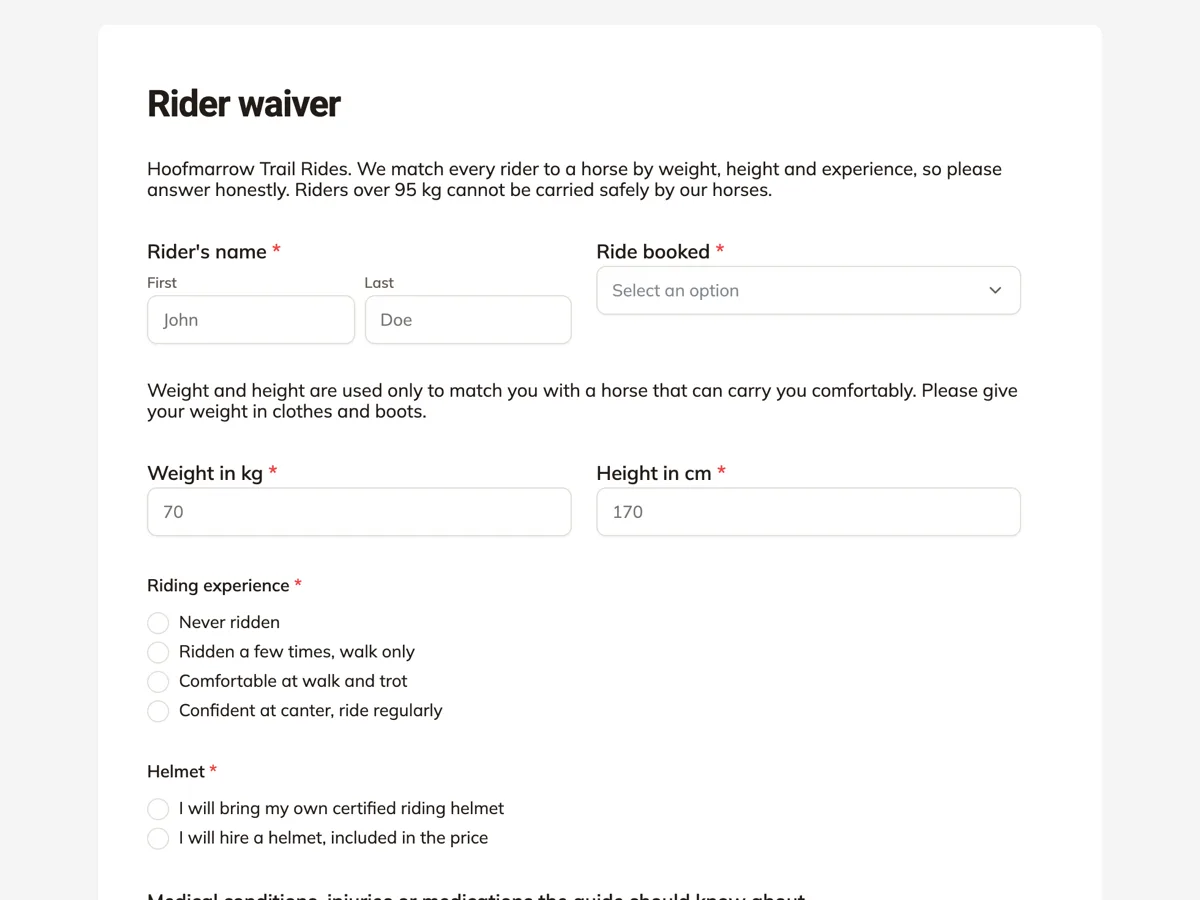
The form itself
A static copy of the finished form, exactly as it renders. Nothing here can be filled in or submitted, so read it as a reference and build your own from the button above.
Every field, and what it collects
The complete field list, in the order respondents meet it.
- Rider's nameNameRequired
- Ride bookedDropdownRequired
- Options: One hour beginner trail · Two hour valley ride · Sunset ride · Half day ride with lunch · Pony walk, under 8s
- Weight in kgNumberRequired
- Height in cmNumberRequired
- Riding experienceSingle choiceRequired
- Options: Never ridden · Ridden a few times, walk only · Comfortable at walk and trot · Confident at canter, ride regularly
- HelmetSingle choiceRequired
- Options: I will bring my own certified riding helmet · I will hire a helmet, included in the price
- Medical conditions, injuries or medications the guide should know aboutLong text
- Inherent risk acknowledgementMultiple choiceRequired
- Options: I understand that horse riding has inherent risks and I choose to ride
- Parent or guardian (under 18s only)Name
- Signature of the rider, or the guardian for under 18sSignatureRequired
What each field on this form collects
The rider's name sits beside a dropdown of five rides, from a one hour beginner trail to a pony walk for under 8s. A paragraph explains why weight and height are asked, and the two number fields share a row: weight in kilograms with a 95 kg maximum, and height in centimetres. Experience has four levels, from never ridden to confident at canter. Helmet is own certified helmet or hire. Medical details are an optional long text. The inherent risk paragraph comes before one acknowledgement tick, then a paragraph explains the optional guardian field and the rider or guardian signs. Eight of the ten fields are required.
Why weight and height come before everything else
Matching a rider to a horse is the most important safety decision a trail ride operator makes, and it happens before anyone mounts. Weight decides which horses can carry the rider comfortably over two hours of hills; height decides stirrup length and whether a rider fits a smaller horse. The intro states the 95 kg limit plainly so a heavier rider learns it from the form, not at the yard in front of a group. The weight field carries the same 95 kg maximum, and the paragraph asks for weight in clothes and boots, which is what the horse actually carries.
How to adapt this form
A riding school taking weekly lessons swaps the ride dropdown for a lesson level and adds the rider's goals. A pony club camp adds the pony's name and its vaccination date. A beach ride operator adds a question on whether the rider is comfortable riding into shallow water.
What makes this form work
The weight limit is stated up front
The intro says riders over 95 kg cannot be carried safely, and the weight field carries the same maximum, so no one learns it at the yard.
Experience in riding terms
Four levels, from never ridden to confident at canter, describe gaits a guide recognises, which makes the horse match faster than a 1 to 5 rating.
Helmets without excuses
Bringing a certified helmet or hiring one free are the only two options, so every rider leaves the yard with a helmet.
Questions people ask
Why do trail ride businesses ask for your weight?
To protect both horse and rider. A horse carrying too much weight tires, stumbles and can be injured, which puts the rider at risk too. Most operators set a maximum and match heavier riders to bigger horses. This form explains the reason in a paragraph above the field, which makes an honest answer more likely.
What does inherent risk mean on a riding waiver?
A risk that cannot be removed by reasonable care because it comes from the activity itself. With horses, that includes shying at a bird, a stumble on uneven ground or a fall at walk. The paragraph names these risks so the rider knows exactly what they accept, separate from risks the operator can control, such as poorly fitted tack.
Do riders have to wear a helmet?
On this ride, yes, at all times when mounted, and the risk paragraph says so. Riders can bring their own certified riding helmet or hire one at no extra cost, which removes the main excuse for riding without. Bicycle helmets are not designed for falls from a horse and should not be used.
Can a beginner go on a two hour ride?
Often, if the trail suits and the horse is quiet, which is why experience and ride booked are separate questions. A guide seeing "never ridden" on a two hour valley ride can call ahead to suggest the one hour beginner trail, or pair the rider with the calmest horse and a place near the front.
Who signs a horse riding waiver for a child?
A parent or guardian, for any rider under 18. The form explains this in a paragraph and provides an optional guardian name above a signature box labelled for rider or guardian. For the pony walk, which is for under 8s, the guardian also leads or walks beside the pony.
Should medical details be required?
No. Most riders have nothing to report, and a required box tends to collect "none" or "n/a". This form leaves it optional with a placeholder showing the level of detail wanted. The guide reads it before the ride, especially for conditions such as asthma, diabetes or a recent back injury.
Build your own in about a minute
The button below opens the generator with this use case already described. Change the wording to match your own, generate, then edit anything you like.
Make one like thisOther form examples
Adventure tour waiver for fitness, medical and evacuation
An adventure tour waiver records that a guest understands the risks of a remote trip, has declared their fitness and health honestly and knows who pays if they need to be evacuated. This one does it for a guided multi day walking company in eleven fields, with a four level fitness rating and an evacuation cost acknowledgement.
Escape room waiver with a player table and a claustrophobia check
An escape room waiver records that the team has read the room rules and told the host about anything that could make a dark, enclosed room unsafe. This one is signed once by the lead player, with a six player table, a conditions checklist and the promise that doors are never locked.
Trampoline park waiver with a jumper table and one guardian
A trampoline park waiver records that a parent or guardian accepts the risks of jumping for each child in the booking and has explained the park rules. This one lists up to four jumpers in a table, asks about the rules video, injuries and grip socks, and takes one guardian signature.
Want the steps in the builder? Read Form builder components, then Design your welcome and thank-you screens. For everything this generator can do, see the form maker.
Sources
Written and checked by the OneCraft team. Last checked .