Conversational form
Interior design client questionnaire that starts with the rooms
An interior design questionnaire is worth filling in when it changes what the designer brings to the first meeting. This one settles the rooms in scope, the budget and what that budget is expected to cover before anybody talks about style, then asks what the client is keeping and who actually signs off.
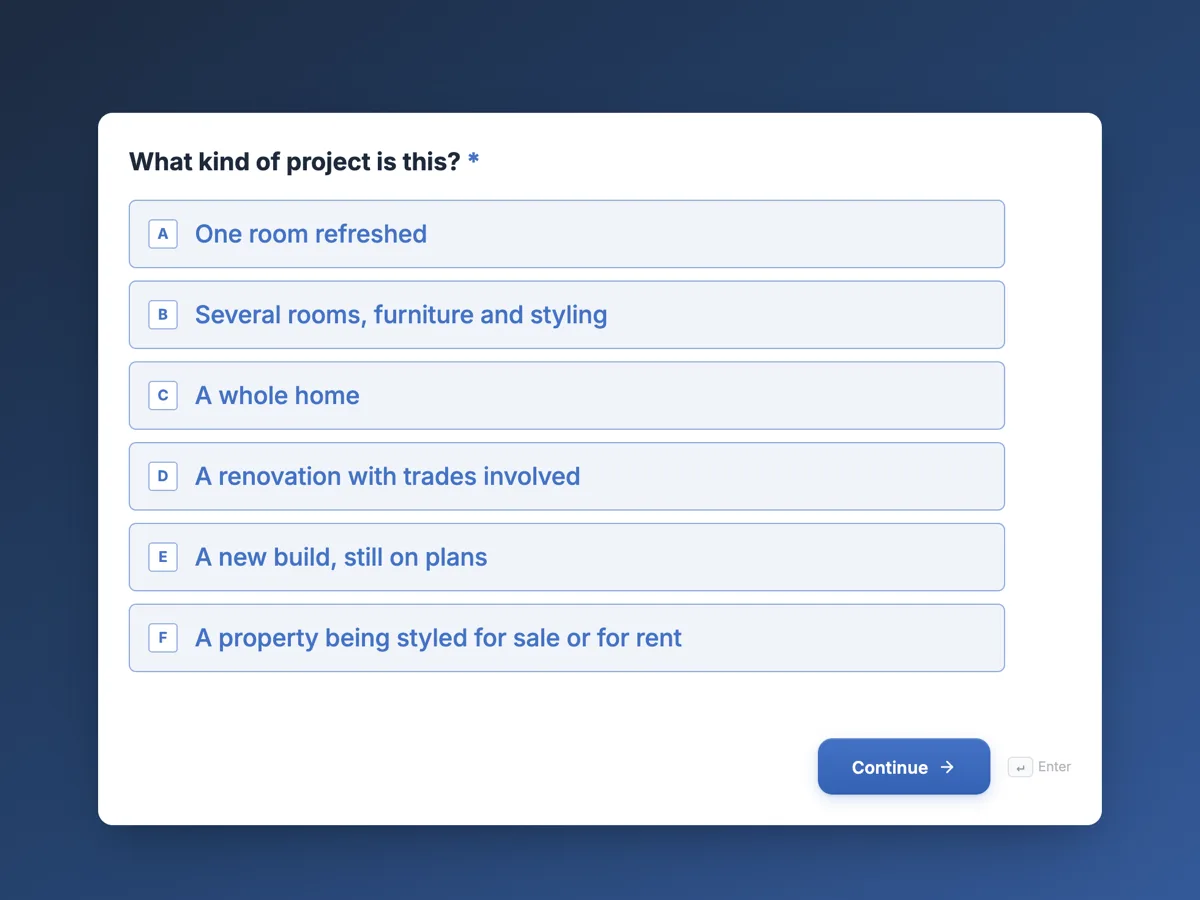
The form itself
The first screen of the form. A conversational form shows one question per screen, so the remaining screens are listed in the field table below. Nothing here can be filled in or submitted, so read it as a reference and build your own from the button above.
Every field, and what it collects
The complete field list, in the order respondents meet it.
- What kind of project is this?Single choiceRequired
- Options: One room refreshed · Several rooms, furniture and styling · A whole home · A renovation with trades involved · A new build, still on plans · A property being styled for sale or for rent
- Which rooms are in scope?Multiple choiceRequired
- Tick what you want us to work on now. Rooms you might do later are better raised in the written screens than ticked here, because scope is what the fee is built from.
- Options: Living room · Kitchen · Dining · Main bedroom · Second or spare bedroom · Children rooms · Bathroom · Ensuite · Study or work space · Laundry · Entry and hallway · Outdoor living
- What sort of home is it?Single choiceRequired
- Heritage controls and strata by laws both limit what can be changed, and it is better to know on the first visit than after a concept is drawn.
- Options: Apartment in a strata building · Terrace or semi · Freestanding house · Heritage listed or in a conservation area · A rental we are allowed to change · A new build not finished yet
- What is the budget for the work?Single choiceRequired
- Everything except our fee. A band is enough. The most useful answer is the one you would be comfortable spending, not the one you hope to spend.
- Options: Under $15,000 · $15,000 to $30,000 · $30,000 to $60,000 · $60,000 to $120,000 · $120,000 to $250,000 · Over $250,000 · Tell us what the rooms we ticked usually cost
- What should the budget cover?Multiple choiceRequired
- Ticking everything at the lower bands is the single most common reason a first concept disappoints. Rank in your head, then tick.
- Options: Loose furniture · Rugs and soft furnishings · Lighting · Window furnishings · Built in joinery · Painting and wall finishes · Flooring · Art and styling pieces · Trade work such as electrical or plumbing
- Upload the images you have been saving, as images or a PDFFile upload
- What are you keeping?Long textRequired
- Pieces that are staying whatever happens, and anything you would like kept if it can be. This list shapes the palette more than any reference image does.
- What is not working in the space now?Long textRequired
- Describe the annoyance rather than the solution. The fix is our job, and a brief that says we need more storage hides the problem it came from.
- Who lives here?TableRequired
- People and animals both. The last column is the one that matters, because it is what a fabric or a finish has to survive.
- Columns: Who · Age group · Anything the space has to handle
- How do you use the main living space on an ordinary night?Single choiceRequired
- Options: Television, most nights, together · Everyone on their own device in the same room · Reading and music, rarely the television · It is where the children play · We eat in there · Almost never used, and that is the problem
- When would you like it finished?Single choiceRequired
- Custom joinery and imported furniture both run on long lead times, so a fixed date changes what can be specified rather than how fast we work.
- Options: Within eight weeks, there is a deadline · Three to six months · Six to twelve months · No deadline, we would rather get it right · Tied to a renovation that has not started
- Who signs off on decisions?Single choiceRequired
- Asked plainly because it is the single biggest cause of delay in a residential project. Two people who both have to agree is a normal answer and changes how we present concepts.
- Options: Me, on my own · Two of us, and we usually agree · Two of us, and we often do not · One of us decides, the other pays · A landlord or a body corporate has to approve
- How do we reach you?ProfileRequired
What each screen of this questionnaire asks, in order
Screen one sorts the project into one of six kinds, from a single room to a new build still on plans. Screen two takes the rooms in scope as a twelve item tick list, and the help text warns that rooms ticked here are rooms the fee is built from. Screen three asks what sort of home it is, which is where strata by laws and heritage controls surface. Screens four and five are the money pair: the budget as a band, then what that budget is expected to cover across nine categories. Screen six takes the reference images as an upload. Screens seven and eight are the written pair, the keep list and what is not working now. Screen nine is a four row table of who lives in the home, including animals, with a column for what the space has to survive. Screen ten asks how the main living space is used on an ordinary night. Screen eleven takes the timeline, screen twelve asks who signs off, and the last screen is a profile block with the property address.
The two screens that decide whether the first concept lands
Budget and coverage are asked as separate screens on purpose. A client who picks the thirty to sixty thousand band and then ticks joinery, flooring, lighting, window furnishings and trade work has told the designer something specific and useful, which is that the expectation and the number do not meet. Catching that on a questionnaire is a five minute conversation. Catching it at concept presentation costs a week of drawing and a certain amount of goodwill. The keep list does similar work from the other direction.
How to adapt this form
A commercial studio replaces the who lives here table with a headcount and use pattern table, swaps the living space question for a screen on how the space is used across a working day, and adds a screen for the lease term, because a fit out for a three year lease is specified differently from one for a ten year lease. A property styling service for sale campaigns cuts the keep list and the sign off screen entirely, since the house will be empty and the agent decides, and adds the campaign launch date and the target buyer. A studio that only sells e design keeps the same questionnaire but adds a screen asking for room dimensions and photographs from each corner, because without a site visit those images are the only survey that exists.
What makes this form work
Budget and what it covers are two screens
A band on one screen, nine coverage categories on the next. The pairing exposes a mismatch that would otherwise surface at concept presentation.
The keep list and the problem list are both required
What is staying is a required written answer because it constrains the palette. What is not working is required too, and asks for the annoyance rather than the solution.
Who signs off is asked out loud
Five answers, including two of us and we often do not agree, and one of us decides while the other pays. It is the screen that changes how concepts get presented, and it is the kind of question a questionnaire can ask far more comfortably than a person can.
Questions people ask
Why ask the budget before asking about style?
Because style is cheap to change and scope is not. A designer who knows the budget and the rooms can bring realistic direction to the first meeting, while one who has only seen reference images arrives with ideas that may be double the number in the client head. Putting the money screens fourth and fifth keeps that conversation early and unembarrassing.
What does the keep list actually change?
The palette. A dining table in a particular timber, a rug that is staying and an inherited armchair set the tone whether a designer plans around them or not. Collecting them before the first concept means the scheme is built to include them, rather than being reworked in week three when the pieces turn up on site.
Can a client upload images through a conversational form?
Yes. File upload is one of the question types that works in a conversational form, and this one takes images or PDF, up to ten files at ten megabytes each. The formats are written into the question label rather than the help text, so nothing is duplicated on the screen.
Why is there a question about who signs off?
Because approval is the most common source of delay in a residential project, and it is rarely discussed until something stalls. Offering an option that says two of us and we often do not agree gives clients permission to be honest, and it changes how a studio presents concepts, usually to two clear options rather than five.
How many rows does the who lives here table show?
Four, and the number is fixed, because a table on this form renders exactly the rows it is configured with and cannot grow. Four covers most households including a pet or two. Larger households use the final column, which is where the real information sits, to note anyone the earlier rows missed.
Is the question about an ordinary night really necessary?
It is one of the more useful screens on the form. A living room where everyone watches television together needs different seating from one where four people sit with separate devices, and the last option, almost never used and that is the problem, is the honest answer that turns a furniture project into a layout project.
Build your own in about a minute
The button below opens the generator with this use case already described. Change the wording to match your own, generate, then edit anything you like.
Make one like thisOther form examples
Wedding planner questionnaire that asks about the budget out loud
A wedding planner questionnaire has one job before the first meeting: work out whether the date, the guest count and the budget can exist in the same room. This one asks all three in the first four screens, then spends the rest of its questions on the things a couple actually argues about, which are the must haves, the vendors already locked in and who is doing the planning.
Buyer enquiry form for a real estate agency, one question at a time
A buyer enquiry form earns its place when it can rank a caller against a listing before anyone picks up the phone. This one asks for the suburbs, the budget band and where the finance is up to, which are the three answers that decide whether a buyer hears about a property early or reads about the sale afterwards.
Mortgage broker fact find a lender can read in one sitting
A fact find is the document a loan application is actually built from, and it falls apart when income, debts and living expenses arrive in three emails a week apart. This one takes all three as tables on a single form, with the loan purpose at the top and the credit consent signed at the bottom.
Want the steps in the builder? Read Create a conversational form with AI, then Every form field and when to use it. For everything this generator can do, see the form maker.
Written and checked by the OneCraft team. Last checked .