Conversational form
Wedding planner questionnaire that asks about the budget out loud
A wedding planner questionnaire has one job before the first meeting: work out whether the date, the guest count and the budget can exist in the same room. This one asks all three in the first four screens, then spends the rest of its questions on the things a couple actually argues about, which are the must haves, the vendors already locked in and who is doing the planning.
The form itself
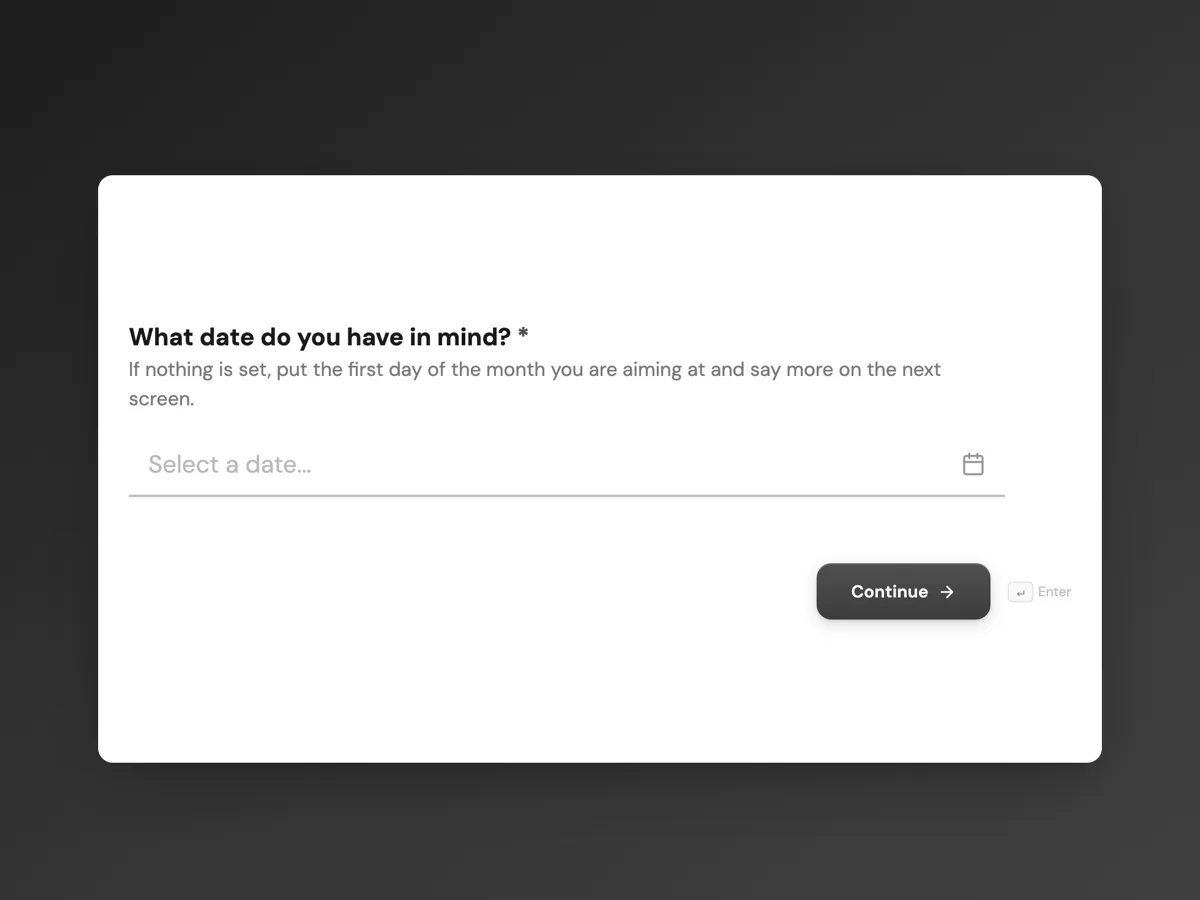
The first screen of the form. A conversational form shows one question per screen, so the remaining screens are listed in the field table below. Nothing here can be filled in or submitted, so read it as a reference and build your own from the button above.
Every field, and what it collects
The complete field list, in the order respondents meet it.
- What date do you have in mind?DateRequired
- If nothing is set, put the first day of the month you are aiming at and say more on the next screen.
- How fixed is that date?Single choiceRequired
- This is the answer that decides whether a venue or a planner is available at all, and flexible couples routinely save a quarter of the venue cost by moving to a Friday or a Sunday.
- Options: Locked in, the venue is booked · Set because of something we cannot move · That weekend, but the day is flexible · That month, nothing fixed · That season, nothing fixed · Whenever we can get the right venue
- Roughly how many guests?NumberRequired
- Your best guess of the number who will actually attend rather than the number on the first list. Guest count moves the budget more than any other single decision.
- What is the total budget for the day?Single choiceRequired
- Everything included: venue, food and drink, styling, photography, attire, music and the planning fee. A band is enough, and nobody is held to it.
- Options: Under $25,000 · $25,000 to $40,000 · $40,000 to $60,000 · $60,000 to $90,000 · $90,000 to $150,000 · Over $150,000 · We genuinely do not know yet
- Where are you up to with the venue?Single choiceRequired
- Options: Booked and the contract is signed · On hold, deposit not paid · Shortlisted two or three · Still looking · Using a family property or a private home · Somewhere we have to travel to
- Is the ceremony in the same place as the reception?Single choiceRequired
- Two locations means transport, a gap in the run sheet and a second set of styling, which is usually the first thing a planner will talk to you about.
- Options: Same place, guests do not move · Same site, different part of it · Two places, a short drive apart · Two places, more than half an hour apart · Not decided
- Pick the words that sound like your dayMultiple choiceRequired
- Up to four. These go to the stylist before the mood board, and four honest words beat a folder of saved images from other people weddings.
- Options: Classic · Modern and pared back · Garden · Coastal · Rustic or barn · Black tie · Bohemian · Industrial · Vintage · Festival, long table, loud
- What time of day?Single choiceRequired
- Options: Morning ceremony, lunch reception · Early afternoon ceremony, evening reception · Late afternoon ceremony, then dinner · Sunset ceremony, night reception · Not decided
- What are the three things that have to be right?Long textRequired
- Write it plainly. A planner protects these three first when something has to give, and vague answers here are the reason couples feel unheard at the end.
- And what do you not want?Long text
- Every couple has a list. Saying it now stops it turning up in a run sheet three months out and being awkward to remove.
- Who have you already booked?Table
- One line each for the suppliers that are locked in. Leave the rest blank; the planner will bring options for what is missing.
- Columns: Vendor type · Name · Deposit paid
- How much planning do you want from us?Single choiceRequired
- These are genuinely different services. On the day coordination starts about six weeks out and cannot rescue a venue contract signed a year earlier.
- Options: Full planning from here to the day · Partial planning, we have made a start · On the day coordination only · Styling and design only · A single planning session to check our plan · Not sure, talk us through it
- Anything here that applies to your guests?Multiple choice
- Each of these changes the run sheet, the seating or the catering brief, and all of them are cheaper to plan for now than to solve in the last fortnight.
- Options: Guests travelling from interstate or overseas · Children attending · Guests with accessibility needs · Significant dietary requirements · Guest transport needed between venues · A cultural or religious element to the ceremony · Divorced parents who need careful seating
- Who are we talking to?ProfileRequired
What each screen of this questionnaire asks, in order
The first two screens take the date and then, separately, how fixed it is, because those are different facts and only the second one tells a planner whether a Friday is on the table. Screen three takes the guest count as the number expected to attend rather than the first list. Screen four takes the total budget as a band with an honest escape option. Screens five and six cover the venue: whether it is booked, on hold or still being looked for, and whether the ceremony and reception share a location. Screen seven takes up to four style words, screen eight the time of day. Screens nine and ten are the two written questions, the three things that have to be right and the things the couple does not want. Screen eleven is a five row table of vendors already booked with the deposit status. Screen twelve asks which planning service is wanted, screen thirteen covers guest circumstances, and the last screen is a profile block with both names, an email and a mobile.
Why the two written screens are worth the extra minute
Every other screen on this questionnaire can be answered with a tap, which is the point of a one question per screen form. The two long text screens break that rhythm deliberately. The first asks for the three things that have to be right, and it is the field a planner returns to when a venue falls through or the budget tightens, because it says what to protect. The second asks what the couple does not want, which is the list that never gets volunteered and always exists.
How to adapt this form
A venue that plans its own weddings can cut screens five and six entirely, since the location is settled, and replace them with a package choice and a ceremony location within the grounds. An elopement or micro wedding service drops the guest logistics screen and the vendor table, keeps the two written screens, and adds a witnesses question and a legal paperwork screen, which is the part small weddings forget. A stylist who does not plan the whole day can keep screens seven, nine and ten, drop the planning service screen, and add a screen for the spaces being styled, ceremony, reception, and anywhere guests wait in between, since that is what a styling quote is actually built from.
What makes this form work
Date and flexibility are two screens, not one
The second screen offers six answers from locked in with a signed venue contract through to whenever the right venue is free. That answer decides which venues are worth calling at all.
The must have screen is what gets protected later
Three things that have to be right, written in the couple own words, with a placeholder showing what a real answer looks like.
Planning service is asked as six real products
Full planning, partial, on the day coordination, styling only, a single session and not sure. The help text notes that coordination starts about six weeks out, which quietly prevents the most common mismatch between what a couple books and what they expected to receive.
Questions people ask
Why ask how fixed the date is as a separate question?
Because a date and the freedom to move it are two different facts. A couple locked to a Saturday in March is shopping in the most expensive part of the calendar, while a couple who only need that month can often move to a Friday and save a meaningful share of the venue cost. One tap surfaces that before anybody quotes.
Is a budget band enough to work from?
It is enough for a first conversation, which is all this form is for. Bands stop the question feeling like a negotiation and still tell a planner whether a hundred guests and a sit down dinner can coexist. The last option exists because couples who genuinely do not know should not guess a number they will later feel bound by.
How many vendor rows does the table show?
Five, and it cannot grow, because a table on this form renders exactly the rows it is configured with. Five covers the suppliers most couples have locked in before they call a planner, usually the venue, the photographer, the celebrant and one or two more. Anything else is added during the first meeting.
Why does the style question ask for only four words?
Because a list of ten selected words is not a brief, it is indecision written down. Asking for four forces the couple to choose, and the resulting shortlist is what a stylist actually uses to start a mood board. The help text asks for up to four, and although a tick list cannot stop a fifth tick, most couples pick three.
Should a planner ask about divorced parents on a form?
It is one option in a guest circumstances list, alongside accessibility needs and children, and putting it there is kinder than raising it in a room. Seating is one of the few wedding problems that is genuinely easier to solve six months out, and a tick box lets a couple flag it without having to explain.
What happens after the questionnaire is submitted?
The thank you screen commits to a reply within three working days with availability for the date and a note on what the budget covers at that guest count. That is deliberately concrete: a questionnaire that promises to be in touch soon gets chased, and a chased enquiry is a bad start to a working relationship.
Build your own in about a minute
The button below opens the generator with this use case already described. Change the wording to match your own, generate, then edit anything you like.
Make one like thisOther form examples
Interior design client questionnaire that starts with the rooms
An interior design questionnaire is worth filling in when it changes what the designer brings to the first meeting. This one settles the rooms in scope, the budget and what that budget is expected to cover before anybody talks about style, then asks what the client is keeping and who actually signs off.
Buyer enquiry form for a real estate agency, one question at a time
A buyer enquiry form earns its place when it can rank a caller against a listing before anyone picks up the phone. This one asks for the suburbs, the budget band and where the finance is up to, which are the three answers that decide whether a buyer hears about a property early or reads about the sale afterwards.
Pilates intake form that asks the postnatal question properly
A reformer is set up per person, so a pilates studio needs the injuries and the pregnancy stage before the class rather than in the doorway of it. This eleven screen intake form asks those one at a time, with a womens health clearance question that leads to a referral rather than a refusal.
Want the steps in the builder? Read Create a conversational form with AI, then Design your welcome and thank-you screens. For everything this generator can do, see the form maker.
Sources
Written and checked by the OneCraft team. Last checked .