Classic form
Tattoo booking request form that gives an artist enough to quote
An artist cannot quote a tattoo from a description of the idea alone, because price follows placement, size and skin rather than sentiment. This booking request asks for the longest side in centimetres, where on the body it goes and whether it sits over existing work, then takes the references as an upload.
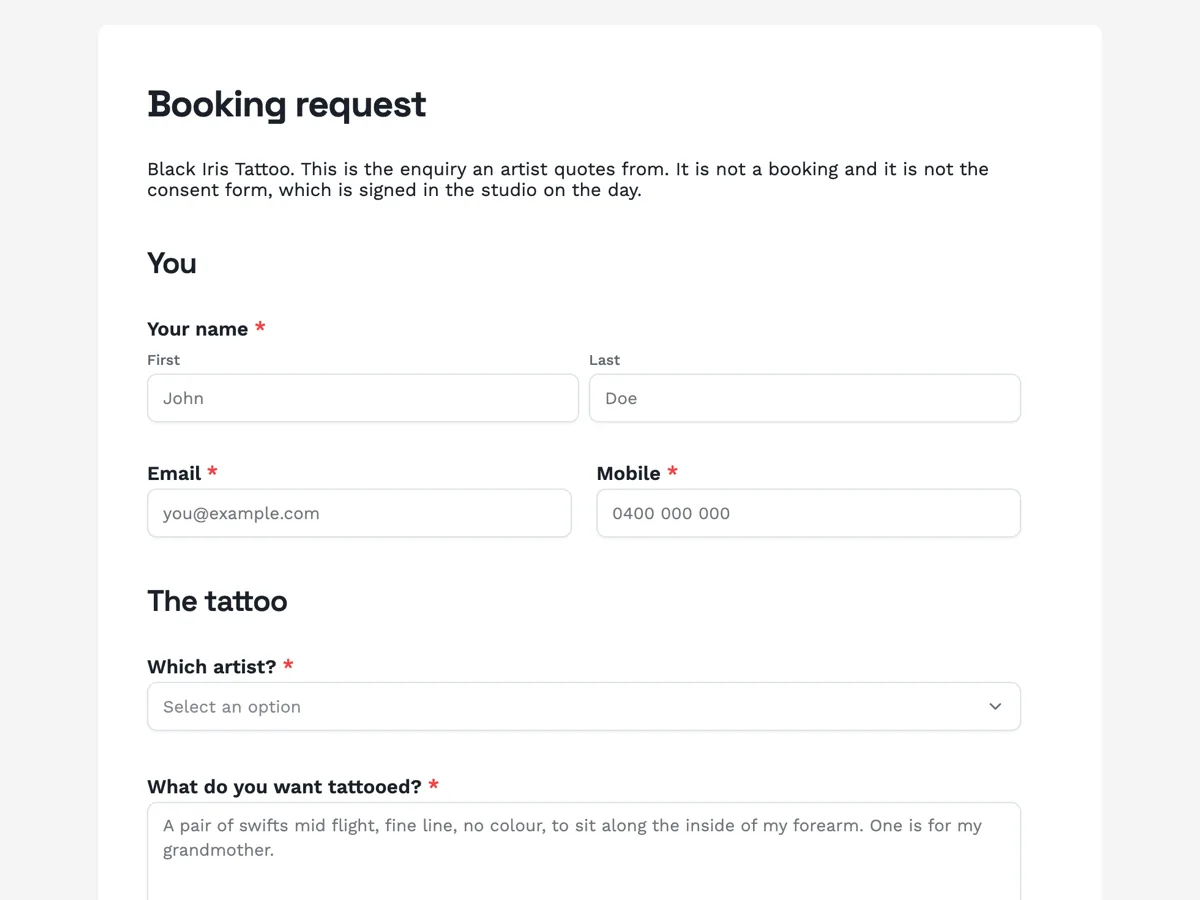
The form itself
A static copy of the finished form, exactly as it renders. Nothing here can be filled in or submitted, so read it as a reference and build your own from the button above.
Every field, and what it collects
The complete field list, in the order respondents meet it.
- Your nameNameRequired
- EmailShort textRequired
- MobileShort textRequired
- Which artist?DropdownRequired
- Options: Wren, fine line and botanical · Ilan, traditional and bold colour · Sable, black and grey realism · Nikau, geometric and blackwork · No preference, match me to whoever suits the idea
- What do you want tattooed?Long textRequired
- Where on your body?DropdownRequired
- Options: Inner forearm · Outer forearm · Upper arm or bicep · Shoulder · Full sleeve or part sleeve · Chest · Upper back · Lower back · Ribs or side · Thigh · Calf · Ankle or foot · Hand, neck or face
- Longest side, in centimetresNumberRequired
- StyleMultiple choiceRequired
- Options: Fine line · Traditional · Neo traditional · Black and grey realism · Colour realism · Blackwork · Geometric · Illustrative · Lettering · Not sure, guide me
- Reference images and a photo of the place it goesFile upload
- Two kinds of image help: the references that show the feel you want, and one photo of the actual area of skin, which tells the artist about existing work, scarring and how the space curves. Images or PDF, up to 8 files, 10 MB each.
- Does it go over or near existing work?Single choiceRequired
- Options: No, the skin is bare · Next to existing work, needs to sit with it · A cover up of an old tattoo · Reworking or finishing something unfinished · Over a scar · Over stretch marks or a skin condition
- What budget do you have in mind?Single choiceRequired
- Options: Under $300, studio minimum applies · $300 to $600 · $600 to $1,200 · $1,200 to $2,500 · Over $2,500, happy to book multiple sessions · Tell me what it should cost
- The first date that would suit youDateRequired
You
The tattoo
Budget and timing
What each field on this form collects
The first block takes the name, email and mobile in two rows. The tattoo block opens with the artist dropdown, which names four artists with what each one does plus a no preference option that asks the studio to match the idea. The written field asks what the client wants tattooed, with a placeholder showing the level of detail that actually helps. Placement is a dropdown of thirteen body areas, from inner forearm to hand, neck or face. A paragraph then explains why size drives the price, followed by a single number field for the longest side in centimetres. Style is a ten item tick list closing with not sure, guide me. The upload takes both reference images and a photo of the skin itself. The existing work radio covers bare skin, work alongside, cover ups, reworks, scars and stretch marks. The last block takes a budget band and the first suitable date, above a paragraph explaining what happens next.
Why this is not the consent form
A studio needs two documents and they do different jobs. This one is the enquiry: it exists so an artist can quote, judge whether the idea suits their hand and work out how many sessions it needs. The consent and aftercare form is the one signed in the studio on the day, after identification has been checked and after the artist has talked through the risks, the aftercare and what cannot be changed later. Keeping them separate matters.
How to adapt this form
A single artist studio drops the artist dropdown and replaces it with a screen asking whether the client has seen the portfolio and which pieces they liked, which is the same qualifying question in a form that suits one hand. A studio that also does cosmetic tattooing needs a separate form entirely, since brows and lips carry a patch test and a medical history that this enquiry deliberately does not collect. A studio running guest artists adds a date range field for the guest spot and turns the budget band into a full day or half day choice, because guest bookings are usually sold by the session rather than by the piece, and the deposit conversation changes with it.
What makes this form work
Size is one number, in centimetres
A single required number for the longest side, under a paragraph explaining that it drives the price more than the detail does. It is the field that turns a description into something quotable, and the instruction to measure rather than guess is why the number is usually close.
The upload asks for two different pictures
References for the feel, and one photo of the actual skin. The second is the one artists rarely get and always want, because it shows existing work, scarring and how the area curves, and it is described in the field description, which does render on an upload field.
Existing work is a six option question
Bare skin, work alongside, a cover up, a rework, over a scar, over stretch marks. Each one changes the session count and sometimes the design entirely, and asking it separately from the written description means it never gets lost in a paragraph.
Questions people ask
Why ask for the size in centimetres rather than small, medium or large?
Because small means something different to every person and nothing to a price list. A number in centimetres can be compared to the reference image and to the body area, which is how an artist estimates hours. The paragraph above the field asks people to measure the space with a tape rather than guess, which is worth the thirty seconds.
What should the photo of the skin show?
The actual area where the tattoo would go, in daylight, with nothing covering it. It shows existing work, scarring, how the space curves and how much room there really is, all of which change the design. The upload takes both these and the reference pictures, up to eight files, because the two kinds of image answer different questions.
Does this form book an appointment?
No. The closing paragraph and the thank you screen both say the artist replies with a quote and a deposit, and that the date is held once the deposit is paid. A form collects answers; it cannot take a payment or hold a slot, so saying so plainly is the difference between a managed expectation and a disappointed client.
Why is there a budget question at all?
Because a client with three hundred dollars and a full sleeve in mind should find that out in an email rather than in the studio. The bands are wide, the lowest one names the studio minimum, and the last option invites the artist to price it instead, which is the answer most people actually want to give.
Should hand, neck and face be on the placement list?
Yes, because people ask for them and a studio needs to know before it quotes. Many artists decline those placements for clients without existing work, and having it as an explicit option means that conversation happens in the reply rather than on the day, which is far kinder than a surprise refusal.
Is a cover up quoted the same way as fresh work?
Rarely. A cover up is constrained by what is already there, often needs a larger or darker design than the client imagined, and can take more sessions. Making it one of six options on its own question, alongside reworks, scars and stretch marks, means the artist sees the constraint before they read the idea.
Build your own in about a minute
The button below opens the generator with this use case already described. Change the wording to match your own, generate, then edit anything you like.
Make one like thisOther form examples
Hotel booking form for a direct reservation request
A direct hotel booking form has to do what a booking site does, minus the payment page, and it has to be clear that the stay is not confirmed until somebody replies. This one takes the dates, the room type with the nightly rate on each option, the bed configuration and the requests, and says plainly that no card number belongs in a web form.
Airport transfer booking form with the flight and the luggage
An airport transfer booking form has to tell a driver which flight to track, how many people and suitcases are coming, and which car fits them. This one does it in eleven fields, with the vehicle choice written as passenger and suitcase limits so the customer picks a car that will actually close.
DJ booking form with set times and a must play list
A DJ booking form has to settle the date, the venue and exactly when the music starts and stops, then what the night should sound like. This one adds a five row must play table of songs and artists, a do not play list, and a checklist of the equipment the venue already has, so the DJ packs the right van.
Want the steps in the builder? Read Create a form with AI, then Every form field and when to use it. For everything this generator can do, see the form maker.
Sources
Written and checked by the OneCraft team. Last checked .