Conversational form
Tour booking form that asks about fitness before the date
A day tour is ruined for everybody when one person is on a walk that is two grades harder than they expected, and no booking system catches that. This tour booking form names the distance, the climb and the grading in every option, then asks the group to describe the least fit person coming, in words that make the honest answer easy to give.
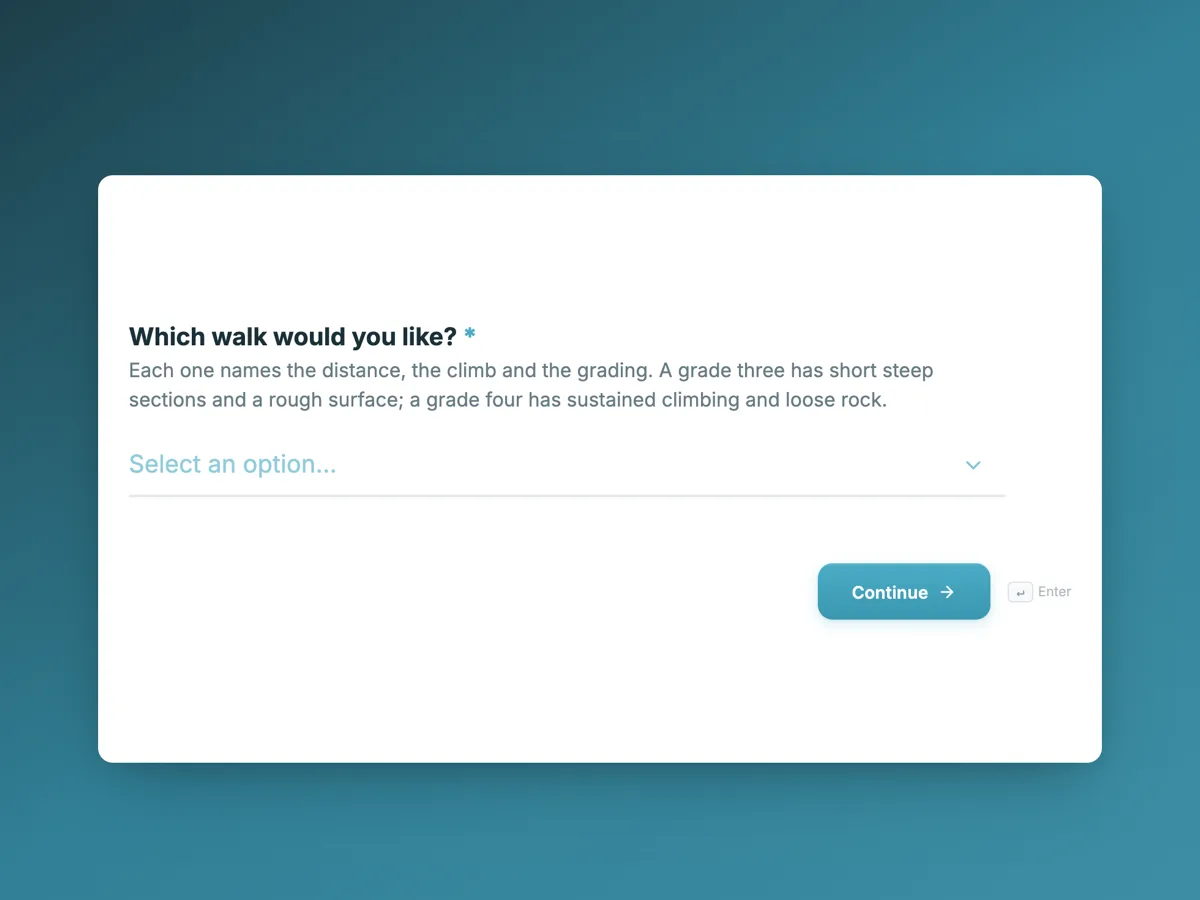
The form itself
The first screen of the form. A conversational form shows one question per screen, so the remaining screens are listed in the field table below. Nothing here can be filled in or submitted, so read it as a reference and build your own from the button above.
Every field, and what it collects
The complete field list, in the order respondents meet it.
- Which walk would you like?DropdownRequired
- Each one names the distance, the climb and the grading. A grade three has short steep sections and a rough surface; a grade four has sustained climbing and loose rock.
- Options: Gorge rim circuit, 6 km, 180 m climb, grade 2, half day · Waterfall track, 9 km, 350 m climb, grade 3, full day · Summit and saddle, 14 km, 780 m climb, grade 4, full day · Rainforest and river, 7 km, 120 m climb, grade 2, half day · Sunrise ridge, 5 km, 300 m climb, grade 3, early start · Two day traverse with a hut night, 22 km, grade 4
- What date?DateRequired
- Tours run Wednesday to Sunday. Summit walks do not run when the forecast maximum is above thirty two degrees, and the guide will offer the nearest suitable day.
- How many adults?NumberRequired
- Groups are capped at eight walkers per guide. A group of nine or more goes out with two guides and is quoted separately.
- And how many children between 8 and 15?Number
- Under eights are welcome on the two grade two walks only, and there is no charge for them. Write zero if there are none.
- Where would you like to be picked up?Single choiceRequired
- The bus does one loop, so the pickup order is fixed. The first stop leaves about fifty minutes before the trailhead briefing.
- Options: Town centre bus bay · The caravan park on the highway · The lodge at the top of the hill · The visitor centre car park · We will drive ourselves and meet you at the trailhead
- How would you describe the fittest and the least fit person coming?Single choiceRequired
- Answer for the least fit person, because that is who sets the pace. Nobody is judged and no tour has ever been refused for this answer. It decides which walk suits, and guides move people to a better fitting tour all the time.
- Options: Everyone walks regularly, hills included · Everyone is active but not on hills · Mixed, one or two would find a long climb hard · Mostly unfit, this is a day out rather than a workout · Somebody has a knee, hip or back that limits them · Not sure, please tell me what the walk really involves
- What do you already have?Multiple choiceRequired
- Anything you tick nothing for gets brought by the guide, within reason. Boots are the one thing nobody can lend you, so say now if you only have runners.
- Options: Proper walking boots or trail shoes · Only runners or sandshoes · A day pack · A rain jacket · Two litres of water capacity per person · A sun hat and sunscreen · Walking poles · None of this, we are starting from scratch
- Any dietary requirements for the lunch?Multiple choiceRequired
- Lunch is packed by a local cafe. Tick anything that applies and the guide will confirm what can be done, because a packed lunch in a rucksack has limits a kitchen does not.
- Options: Vegetarian · Vegan · Gluten free, coeliac · Gluten free, preference · Dairy free · Nut allergy · Shellfish allergy · Halal · No dairy or meat together · Nothing, we eat anything
- Is there anything medical the guide should know?Long text
- Only what matters on a track hours from a road: allergies that need an autoinjector, asthma, a heart condition, epilepsy, diabetes, a recent injury. It is read by the guide taking your tour and by nobody else, and it is deleted from the booking record after the season.
- Who is the booking for?ProfileRequired
What each screen of this booking asks, in order
Screen one is the walk, and every option names the distance, the climb and the track grading rather than a marketing adjective. Screen two takes the date, with help text on which days tours run and the temperature rule for summit walks. Screens three and four split the group into adults and children between eight and fifteen, each with a note about the guide ratio and the under eight rule. Screen five takes the pickup point, including the option of driving to the trailhead. Screen six is the fitness question, asked as a description of the least fit person coming. Screen seven takes the gear the party already has, including an option that admits to runners rather than boots. Screen eight covers dietary requirements for the packed lunch. Screen nine is the medical question with a note on who reads it and how long it is kept. The last screen takes the name, email and a mobile for the morning.
Why the fitness question is written the way it is
Ask how fit are you and everybody says reasonably fit, because the question sounds like a test. Ask people to describe the least fit person coming, and say in the help text that nobody is judged, that no tour has ever been refused for the answer and that guides move people to a better fitting walk all the time, and the answers become usable. The six options are written as behaviour rather than as levels: everyone walks regularly, hills included, sits at one end, and somebody has a knee, hip or back that limits them sits near the other, with an explicit not sure option that asks the guide to explain what the walk really involves.
How to adapt this form
A cycling tour operator swaps the gear screen for a bike and helmet question and adds a screen for rider height, since hire bikes come in frame sizes and the fit conversation is the equivalent of the boots one. A food and wine day tour drops the fitness and gear screens entirely, keeps the dietary and medical screens, and adds a screen about whether anyone in the party is not drinking, which changes the tasting arrangements and the vehicle. An operator running multi day trips keeps all ten screens and adds an accommodation preference screen and a travel insurance acknowledgement, because on a trip with a hut night the cancellation terms and the insurance question become the two things people ask about most.
What makes this form work
Every walk names its distance, climb and grade
Six options from a six kilometre grade two circuit to a twenty two kilometre grade four traverse with a hut night.
The fitness screen asks about the least fit person
Six behaviour based answers, help text saying nobody is judged and that no tour has been refused for it, and an explicit not sure option that asks the guide to explain the walk.
The medical screen says who reads it
It names what is relevant on a track hours from a road, says the guide taking the tour reads it and nobody else, and says it is deleted after the season.
Questions people ask
What does a track grading mean on a booking form?
It is a shorthand for what the surface and the gradient are like. Australian walking track grading describes a grade two as suitable for most people on a formed track, a grade three as having short steep sections and a rougher surface, and a grade four as sustained climbing on loose ground.
Why ask about boots specifically?
Because it is the one piece of gear a guide cannot lend. Packs, jackets and poles can be carried spare in a vehicle; footwear cannot, and a day on loose rock in sandshoes is how ankles get rolled. The gear screen includes an explicit only runners or sandshoes option so people say it rather than hoping it will be fine.
How is the medical answer handled?
The help text says it is read by the guide taking the tour and by nobody else, and that it is deleted from the booking record after the season. The question also says what is relevant, being the things that matter hours from a road, so people write two useful lines instead of a medical history or nothing at all.
Does the adults field stop somebody booking twelve people?
No. A conversational number question renders without a minimum or a maximum, so nothing is blocked as it is typed and the value is only checked on submission. The help text carries the real rule instead, which is that groups are capped at eight walkers per guide and larger parties go out with two guides and a separate quote.
Why is dietary a required question when most people have nothing?
Because the last option says nothing, we eat anything, which takes one tap and gives a definite answer. A skipped optional question is ambiguous to the cafe packing the lunches, while an explicit nothing is not, and an allergy that goes unmentioned on a track hours from a road is a serious problem rather than an inconvenience.
What happens if the weather turns?
The thank you screen says tours run in light rain and are cancelled only for lightning, extreme heat or a park closure, and that a cancellation means a new date or a refund. Saying which conditions do not cancel a tour is as useful as saying which ones do, because it sets what people pack rather than what they worry about.
Build your own in about a minute
The button below opens the generator with this use case already described. Change the wording to match your own, generate, then edit anything you like.
Make one like thisOther form examples
Tutoring session booking form with subject, format and free times
A tutoring session booking form has to match a student to a tutor who teaches the subject at that year level, in the right format, at a time both are free. This one asks each of those on its own screen, uses a weekly grid for availability, and asks what the first session should cover so it starts on real work.
Band booking enquiry form with the line up and the stage
A band booking enquiry form has to match three things: the line up the client wants, the space and power the venue has, and the budget. This one gives each line up its stage size in metres, asks what the venue offers, from separate power circuits to a sound limiter, and takes a budget band so the quote is pitched right.
Massage booking form for a mobile therapist
A mobile massage booking is a logistics problem before it is a wellbeing one, because somebody has to carry a table from a car to a room. This booking form settles where the session happens, what the parking is like and how long it runs, then asks about style and pressure in words a client can actually answer.
Want the steps in the builder? Read Create a conversational form with AI, then Design your welcome and thank-you screens. For everything this generator can do, see the form maker.
Written and checked by the OneCraft team. Last checked .