Conversational form
Vet appointment booking form with the reason and the urgency
A vet appointment booking form has to tell reception what the visit is for and how soon the animal must be seen, because those two set the consult length and the place in the queue. This one asks both on their own screens, sends real emergencies to the phone before the first question, and flags new clients.
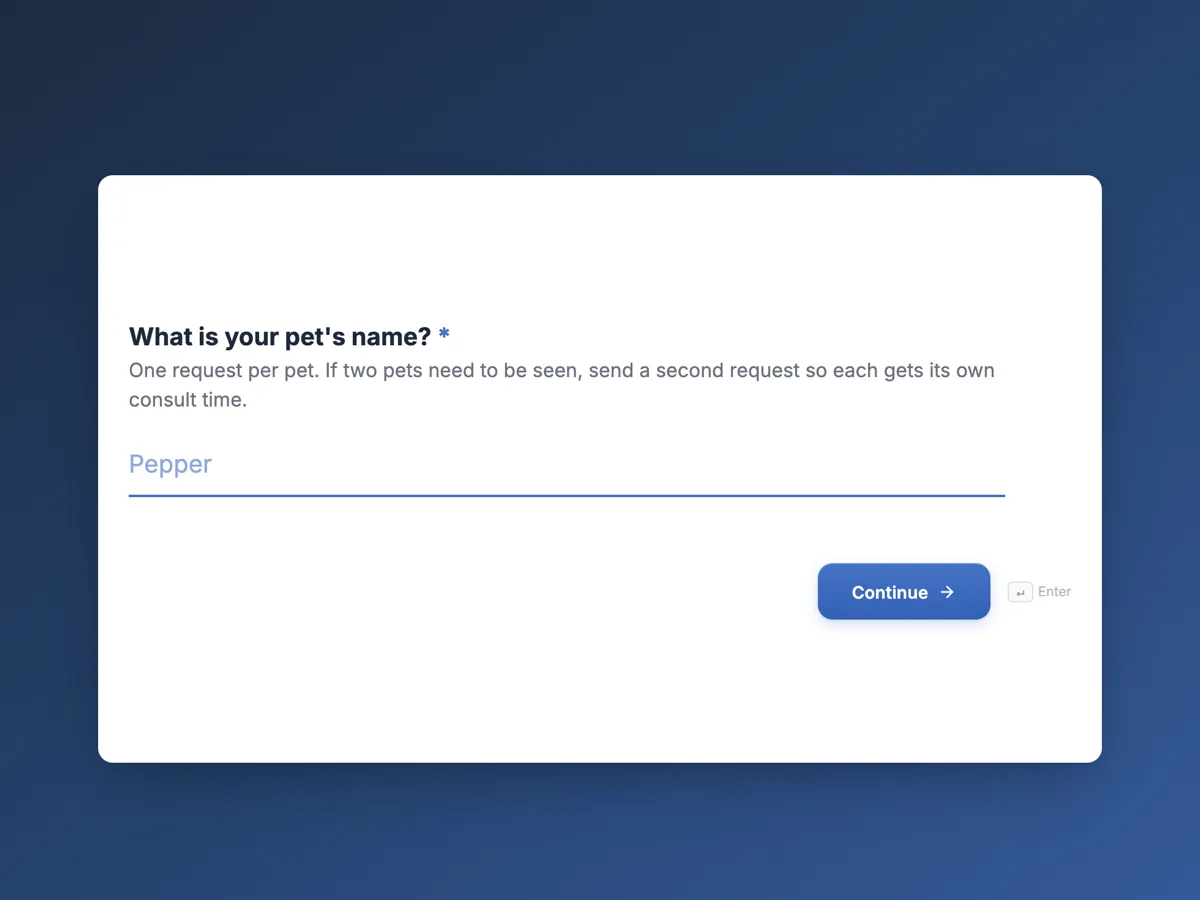
The form itself
The first screen of the form. A conversational form shows one question per screen, so the remaining screens are listed in the field table below. Nothing here can be filled in or submitted, so read it as a reference and build your own from the button above.
Every field, and what it collects
The complete field list, in the order respondents meet it.
- What is your pet's name?Short textRequired
- One request per pet. If two pets need to be seen, send a second request so each gets its own consult time.
- What kind of animal?Single choiceRequired
- Options: Dog · Cat · Rabbit · Guinea pig · Bird · Reptile · Other small pet
- What is the visit for?DropdownRequired
- This sets the length of the consult. A check up is 15 minutes; a new problem or a second opinion is 30.
- Options: Vaccination or annual check up · A new illness or injury · Skin, ears or itching · Vomiting or diarrhoea · Limping or pain · Follow up on an earlier visit · Desexing or dental consult · Behaviour concern · Second opinion
- How soon does your pet need to be seen?Single choiceRequired
- Anything you would describe as an emergency should be a phone call, not this form.
- Options: Within 24 hours, they are unwell but stable · In the next few days · This week or next is fine · Routine, any time that suits
- Which day suits you best?DateRequired
- Open Monday to Saturday. Saturday consults finish at 1 pm.
- What time of day?Single choiceRequired
- Options: Early, 8 to 10 am · Late morning, 10 am to 12 pm · Afternoon, 1 to 4 pm · After work, 4 to 6.30 pm · Any time
- Has this pet been to Riverside Vets before?Single choiceRequired
- New clients fill in a registration form at the first visit, and records from your previous clinic are requested for you.
- Options: Yes, this pet is a patient here · I am a client, but this pet is new · No, we are new to the clinic
- How do we reach you?ProfileRequired
What each screen of this booking asks, in order
Before the first question, the welcome screen lists the emergencies that need a phone call instead: breathing trouble, collapse, heavy bleeding and poisoning. Screen one takes the pet's name, with help text asking for one request per pet. Screen two is the species as a radio of seven. Screen three is the reason for the visit as a dropdown of nine, with help text saying a check up takes 15 minutes and a new problem 30. Screen four is urgency, from within 24 hours to routine. Screen five is the preferred day and screen six a time of day window. Screen seven asks whether the pet, the owner or both are new to the clinic. Screen eight is a profile block for the name, email and mobile.
How this differs from a new client registration form
A new client form builds the record: owner details, microchip, vaccination history, the previous clinic and the consent to treat. This form books time. It asks only what reception needs to fit a consult into the day, and it asks the new client question so that the full registration can happen at the first visit, ten minutes before the consult. Keeping the two apart means a returning client books in eight taps, and a new client is not faced with twenty questions before getting an appointment for a limping dog.
How to adapt this form
An exotic animal clinic replaces the species radio with a longer list and adds a question on how the animal will be transported, since a bird and a snake travel differently. A mobile vet adds the address and a parking note and drops the clinic hours from the date help text. A large animal practice swaps the pet name for the number of animals, adds the property address and yard access, and turns the time of day screen into a half day window.
What makes this form work
Emergencies are turned away first
The welcome screen names four emergencies that need a phone call before anyone starts the form, and the urgency screen repeats it. The form never becomes the slow route for an animal that needed to be seen an hour ago.
Reason and urgency are separate screens
What the visit is for sets the consult length, 15 or 30 minutes; how soon sets the queue. Asking them apart gives reception two clean answers instead of a sentence like itchy ears, a bit urgent maybe, to interpret.
New clients are flagged in three ways
A patient here, a new pet of an existing client, or a new client altogether. Each answer means a different job at the desk, and the help text tells new clients what to expect before they arrive.
Questions people ask
Should an emergency be booked with a vet appointment form?
No, and this form says so on the welcome screen before the first question: an animal that cannot breathe, has collapsed, is bleeding heavily or has eaten something poisonous needs a phone call and a car trip. The urgency screen repeats it. The form handles everything up to unwell but stable, which can wait for reception to read it.
Why does the reason for the visit set the consult length?
Because a vaccination and a vomiting dog need different amounts of time. The help text on that screen gives the two lengths, 15 and 30 minutes, so reception books the right slot from the answer alone. Picking the reason from nine options rather than typing it also makes the queue easy to sort.
Why is the time a window instead of an exact time?
A clinic's day is built around surgery in the morning and consults around it, and the free gaps move. A window such as late morning lets reception offer the nearest real slot in its reply. An exact time would usually come back as a counter offer, which is the conversation the window avoids.
What happens to a request marked within 24 hours?
The thank-you screen says those requests are read first, from 8 am, and everything else the same day. The form does not reorder anything itself; the urgency answer is a column in the CSV export, which a person working the phones can sort so the stable but unwell animals come before the routine checks.
Why ask whether the pet has been to the clinic before?
It changes what happens at the desk. A patient here has a record. A new pet of an existing client needs a new file under the same account. A new client needs registration and a records request to the previous clinic. Three answers, three different front desk jobs, sorted before the animal arrives.
Can one request book appointments for two pets?
No. The first screen asks for one pet's name and its help text says to send a second request for another animal. Each pet needs its own consult time and its own reason for the visit. Two requests sent a minute apart are easy for reception to book back to back, which most owners prefer anyway.
Build your own in about a minute
The button below opens the generator with this use case already described. Change the wording to match your own, generate, then edit anything you like.
Make one like thisOther form examples
Holiday rental booking form with the house rules accepted up front
Two things ruin the end of a holiday rental stay: a bond deduction the guest did not expect, and a noise complaint from the house next door. This booking form puts both on the page before the dates are held, with the rules written out in full, a guest cap that is stated rather than implied, and a signature under the bond acknowledgement.
Massage booking form for a mobile therapist
A mobile massage booking is a logistics problem before it is a wellbeing one, because somebody has to carry a table from a car to a room. This booking form settles where the session happens, what the parking is like and how long it runs, then asks about style and pressure in words a client can actually answer.
Nail appointment booking form that asks about removal first
A nail appointment overruns for one reason more than any other, which is that the previous set had to come off and nobody booked time for it. This booking form asks about removal on the second screen, before the date is chosen, and takes the saved design as an upload so the technician can say whether it fits the slot.
Want the steps in the builder? Read Create a conversational form with AI, then Design your welcome and thank-you screens. For everything this generator can do, see the form maker.
Sources
Written and checked by the OneCraft team. Last checked .