cmn-CN · Mandarin (Mainland)
Chinese AI voiceover
Choosing Chinese (Simplified) gives you mainland Mandarin, the cmn-CN locale with all eight premium voices, and a director that scripts the video in simplified characters. Traditional script is a separate entry with its own, smaller voice tier.
The Chinese (Simplified) voices, with samples
Each sample reads the same line so you can compare them fairly.
Puck
energetic · male这就是我用正常语速朗读你的脚本时的声音,背后没有任何音乐。
Laomedeia
energetic · female这就是我用正常语速朗读你的脚本时的声音,背后没有任何音乐。
Charon
instructional · male这就是我用正常语速朗读你的脚本时的声音,背后没有任何音乐。
Erinome
instructional · female这就是我用正常语速朗读你的脚本时的声音,背后没有任何音乐。
Umbriel
warm · male这就是我用正常语速朗读你的脚本时的声音,背后没有任何音乐。
Sulafat
warm · female这就是我用正常语速朗读你的脚本时的声音,背后没有任何音乐。
Iapetus
neutral · male这就是我用正常语速朗读你的脚本时的声音,背后没有任何音乐。
Aoede
neutral · female这就是我用正常语速朗读你的脚本时的声音,背后没有任何音乐。
Two Chinese entries, two different tiers
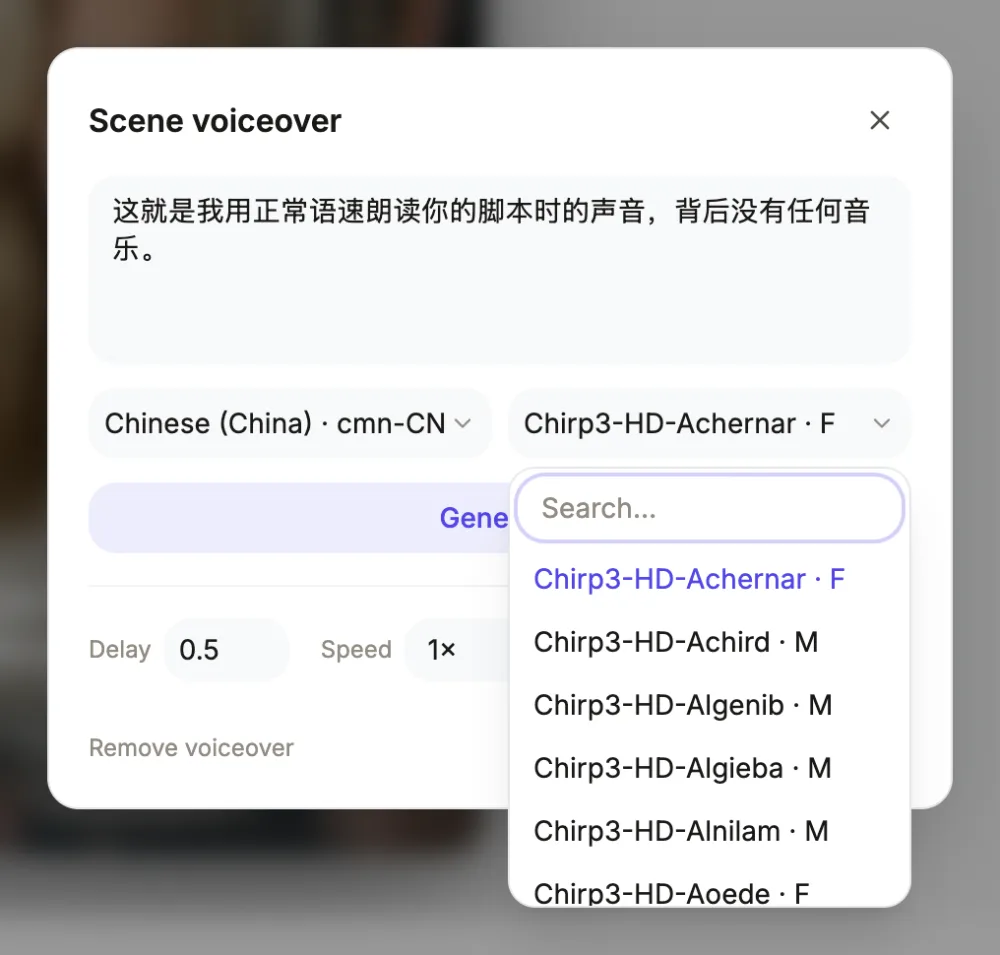
The Language picker lists Chinese twice, and the split is not cosmetic. Simplified maps to cmn-CN with the complete premium cast of eight, the strongest Mandarin offering. Traditional maps to cmn-TW, where the catalogue holds no premium voices at all and two Wavenet voices stand in. So if your market reads simplified characters, this entry gives you both the modern script and the modern voices; the traditional entry, covered on its own page, trades voice quality for the script Taiwan and Hong Kong read. The director writes whichever script the entry names.
Casting Mandarin across four styles
Puck and Laomedeia bring livestream-commerce energy for promos and social spots. Charon and Erinome pace themselves for instruction, with tutorials permanently assigned to them by rule. Umbriel and Sulafat suit testimonial warmth and food storytelling. Iapetus and Aoede read corporate updates plainly. All eight speak standard Mandarin with mainland pronunciation, erhua where standard. Style plus gender is chosen from your brief; any scene re-casts through its voice dialog, and the search there spans the entire live Google catalogue, including other Chinese locales.
Names, tones and the character fix
There is no pinyin input, and none is needed: characters are the pronunciation control. A foreign brand read awkwardly gets a phonetic character transcription in the narration, the way Chinese marketing already writes 星巴克 for Starbucks, and the voice reads those syllables with their tones, about half a credit per regenerated clip. Homograph characters with two readings resolve the same way, choose a synonym or restructure the phrase. Numbers do best written as characters when phrasing matters, 一百五十元 rather than 150元, since digits let the engine pick.
Density, duration and what you pay
Mandarin is compact; a sentence often speaks faster than its English draft, which suits 15 second promos well. Where a line runs long the scene stretches to its clip, and dynamic pace plays the overrun across the next cut. Per scene: delay in seconds, speed steps from 0.85x to 1.25x, and the narration box. Music self-ducks to 22 percent beneath the voice. Synthesis is billed by length, about half a credit for a typical clip, and the export bills its render time, needing at least 1 credit left past 30 seconds or with lines still pending.
Captions in this script
Chinese runs without spaces, so the caption pipeline segments each sentence, cut on 。!? punctuation, into dictionary words and joins them without gaps in the pill; the highlight then follows the voice through those words in order. Unspaced lines wrap on word boundaries at about 22 characters. The characters themselves are drawn by the render host's fallback font, because no catalogue family ships Han glyphs, so caption typography will not match the look's Latin. Short sentences keep each cue small, which flatters both the segmentation and the pill.
Questions people ask
Which Chinese voices do I get?
The simplified entry uses cmn-CN Mandarin with all eight premium characters: Puck, Laomedeia, Charon, Erinome, Umbriel, Sulafat, Iapetus and Aoede. Traditional Chinese uses cmn-TW instead, which has only two Wavenet voices; that difference is why the two scripts are separate pages.
Is this Mandarin or Cantonese?
Mandarin, with mainland pronunciation. Cantonese is a separate thing entirely; the yue-HK locale exists in the voice map, but it is not one of the picker's suggested languages, so treat this entry as Mandarin only and use the per-scene catalogue search if you need to experiment.
How do captions work without spaces?
Each sentence is segmented into dictionary words, joined without gaps in the pill, and the highlight steps through them with the voice; wrapping happens between words, not through characters. The Han glyphs come from a fallback font, since no catalogue family ships them, so render once and check the fit.
Can the brief be in English?
Yes. With Chinese (Simplified) selected, the director writes narration and on-screen copy in simplified characters natively, using the facts from a brief in any language. Chinese wording you quote in the brief, a brand transcription especially, passes through exactly as typed.
What does a Mandarin voiceover cost?
Synthesis is billed by length, about 1 credit per 330 characters with a minimum of half a credit per clip, generally one clip per narrated scene, and editing between generations is free. Exports bill their render time, usually a small amount; longer videos or pending narration need at least 1 credit left to start.
Narrate a video in Chinese (Simplified)
The button opens the video generator with the language already set in the brief. Pick a voice after the scenes are planned.
Make a videoRelated pages
Japanese AI voiceover
Japanese narration draws on the full eight ja-JP voices, with the director writing the script in Japanese natively. Spaceless text is segmented into dictionary words for the captions, and katakana respelling is your pronunciation control.
Traditional Chinese AI voiceover
The traditional script entry maps to cmn-TW, Taiwan Mandarin, where the catalogue offers no premium characters: two Wavenet voices, cmn-TW-Wavenet-B male and cmn-TW-Wavenet-A female, do the reading. The script comes out in traditional characters throughout.
Korean AI voiceover
Korean carries the full eight ko-KR voices, and because Hangul writes with spaces, captions type on word by word like English rather than dumping whole sentences. The glyphs come from a fallback font, the one honest caveat on this page.
Every locale is listed onthe voiceover languages page.