ko-KR · Korean
Korean AI voiceover
Korean carries the full eight ko-KR voices, and because Hangul writes with spaces, captions type on word by word like English rather than dumping whole sentences. The glyphs come from a fallback font, the one honest caveat on this page.
The Korean voices, with samples
Each sample reads the same line so you can compare them fairly.
Puck
energetic · male배경 음악 없이 보통 속도로 대본을 읽으면 제 목소리는 이렇게 들립니다.
Laomedeia
energetic · female배경 음악 없이 보통 속도로 대본을 읽으면 제 목소리는 이렇게 들립니다.
Charon
instructional · male배경 음악 없이 보통 속도로 대본을 읽으면 제 목소리는 이렇게 들립니다.
Erinome
instructional · female배경 음악 없이 보통 속도로 대본을 읽으면 제 목소리는 이렇게 들립니다.
Umbriel
warm · male배경 음악 없이 보통 속도로 대본을 읽으면 제 목소리는 이렇게 들립니다.
Sulafat
warm · female배경 음악 없이 보통 속도로 대본을 읽으면 제 목소리는 이렇게 들립니다.
Iapetus
neutral · male배경 음악 없이 보통 속도로 대본을 읽으면 제 목소리는 이렇게 들립니다.
Aoede
neutral · female배경 음악 없이 보통 속도로 대본을 읽으면 제 목소리는 이렇게 들립니다.
Register is the first casting decision
Korean grammar wears its politeness on every verb, and the director sets it from your brief: haeyo-che friendliness for a cafe promo, hamnida-che formality for corporate work. Say which world your brand lives in and the script follows through consistently, narration and on-screen lines alike. The Language field's Korean entry locks ko-KR for the automatic voices, briefs in any language work, and quoted Korean in the brief, a menu item or slogan in Hangul, survives untouched into the video.
The eight ko-KR voices
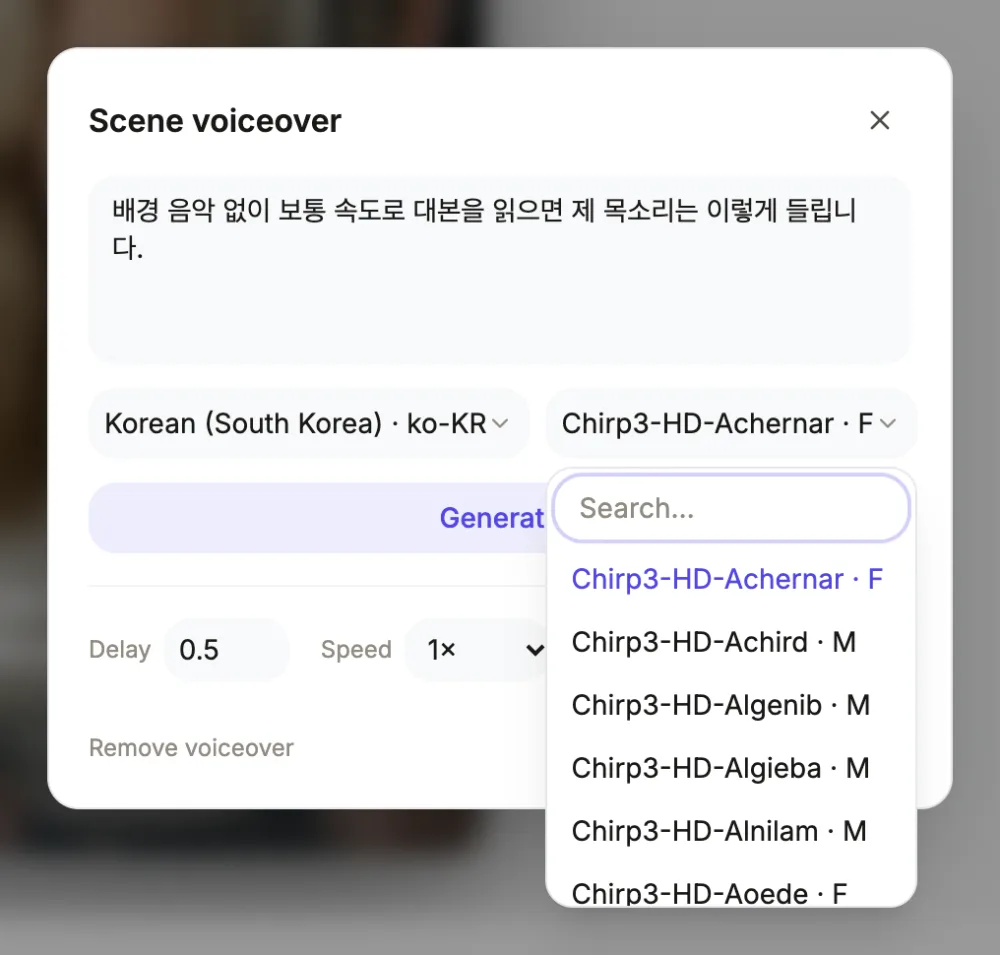
All four style pairs exist here. Puck and Laomedeia serve fast retail and social spots, the register most Korean ad copy occupies anyway. Charon and Erinome read like a calm product tutor, and tutorials are locked to them by the standing rule. Umbriel and Sulafat handle testimonial warmth, right for a neighbourhood bakery or wedding studio. Iapetus and Aoede stay even for IR-style updates. One default voice per video, chosen by style and gender from the brief, with per-scene overrides and a full catalogue search available in each scene's voice dialog.
Konglish, numbers and respelling
English loanwords are everywhere in Korean commerce, and the voices read them with Korean phonology; when a brand must sound closer to its English original, respell it in Hangul that approximates the sound and regenerate, about half a credit per clip. Numbers need care because Korean counts in two systems: write the number as words in the intended system, 만 오천 원 for prices, and the ambiguity disappears. Sentence punctuation cuts the caption cues. Generated narration never carries an em dash by rule; keep manual edits on commas and full stops.
Timing behaviour and the bill
Korean's dense syllable blocks say a lot per second, so lines usually fit their scenes; when one overruns, the scene stretches to hold the clip and dynamic pace lets the tail play over the next cut. Each scene exposes a delay in seconds and speed steps from 0.85x to 1.25x. The soundtrack ducks itself to 22 percent while the voice speaks. Costs are the standard ones: narration billed by length, about half a credit for a typical clip, and an export that bills its render time and needs at least 1 credit left past 30 seconds or when narration remains to generate.
Captions in this script
Korean is the outlier among the CJK scripts because Hangul writes with spaces, so captions type on word by word in step with the voice exactly as English does, no segmenter required. Timing comes from the clip itself. The glyphs, though, come from the render host's fallback font, as no family in the catalogue ships Hangul; the syllable blocks render cleanly but in a typeface unrelated to the look's Latin. Korean particles keep words short, so the pill's 48 character sentence split rarely triggers; when a line does split, the cues cut between spaced words.
Questions people ask
Which Korean voices are available?
Eight in ko-KR: Puck, Laomedeia, Charon, Erinome, Umbriel, Sulafat, Iapetus and Aoede, four styles by two genders. Automatic casting picks one from the brief's tone; scene-level dialogs search the whole Google catalogue for anything beyond them, including other Korean tiers.
Do Hangul captions type on word by word?
Yes. Korean writes with spaces, so the pill highlights each word as the voice reaches it, timed against the actual clip, the same behaviour English gets. No segmenter is involved, unlike Japanese and Chinese. Captions default on and toggle per scene in the voice dialog.
Will Hangul match my look's font?
No catalogue font ships Hangul, so a fallback font draws the syllable blocks, cleanly but in its own style. Captions in the fixed dark pill wear this well; large on-screen Hangul headlines show the mismatch more, so keep them short or carry key text in the voice.
Can I set the politeness level?
Yes, through the brief. Describe your brand as friendly and the script comes out in polite casual haeyo-che; describe it as formal and hamnida-che follows. The register is applied consistently across narration and on-screen text, and you can edit any line afterwards.
What does Korean narration cost?
Narration is billed by length, about half a credit for a typical clip, with all editing between generations free. Exports bill their render time, usually a small amount; longer videos, or exports still owing narration, need at least 1 credit left to start.
Narrate a video in Korean
The button opens the video generator with the language already set in the brief. Pick a voice after the scenes are planned.
Make a videoRelated pages
Japanese AI voiceover
Japanese narration draws on the full eight ja-JP voices, with the director writing the script in Japanese natively. Spaceless text is segmented into dictionary words for the captions, and katakana respelling is your pronunciation control.
Chinese AI voiceover
Choosing Chinese (Simplified) gives you mainland Mandarin, the cmn-CN locale with all eight premium voices, and a director that scripts the video in simplified characters. Traditional script is a separate entry with its own, smaller voice tier.
Traditional Chinese AI voiceover
The traditional script entry maps to cmn-TW, Taiwan Mandarin, where the catalogue offers no premium characters: two Wavenet voices, cmn-TW-Wavenet-B male and cmn-TW-Wavenet-A female, do the reading. The script comes out in traditional characters throughout.
Every locale is listed onthe voiceover languages page.