cmn-TW · Mandarin (Taiwan)
Traditional Chinese AI voiceover
The traditional script entry maps to cmn-TW, Taiwan Mandarin, where the catalogue offers no premium characters: two Wavenet voices, cmn-TW-Wavenet-B male and cmn-TW-Wavenet-A female, do the reading. The script comes out in traditional characters throughout.
The Chinese (Traditional) voices, with samples
Each sample reads the same line so you can compare them fairly.
cmn-TW-Wavenet-B
wavenet · male這就是我用正常語速朗讀你的腳本時的聲音,背後沒有任何音樂。
cmn-TW-Wavenet-A
wavenet · female這就是我用正常語速朗讀你的腳本時的聲音,背後沒有任何音樂。
What splits traditional from simplified here
The two Chinese entries in the picker differ in locale, script and voice tier at once. Traditional resolves to cmn-TW: the director writes every line in traditional characters and the voices carry Taiwan Mandarin pronunciation, the natural pairing for Taiwan and a workable one for Hong Kong Mandarin audiences. The catch is the tier, since cmn-TW ships no premium characters and falls back to two Wavenet voices. Simplified, by contrast, gets eight premium voices on cmn-CN. Script loyalty or voice depth is the actual choice being made.
Working with a two-voice cast
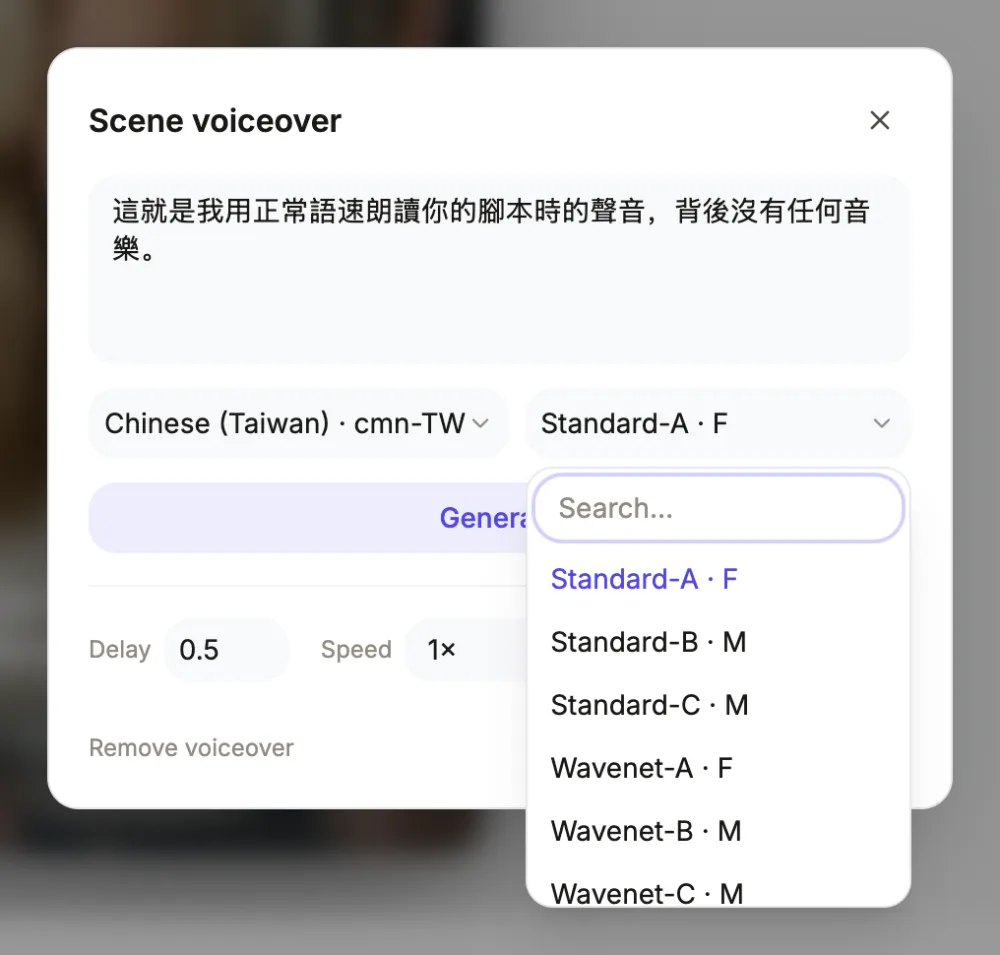
Style requests collapse to gender here: energetic, warm, instructional and neutral all land on Wavenet-B for male or Wavenet-A for female. The register survives in the writing instead, and the director leans into it, promos arriving as short exclamatory bursts, tutorials as numbered even steps. Wavenet's flatter prosody actually suits instructional content decently; it is long emotive passages where the age shows. The per-scene voice dialog searches the full catalogue for cmn-TW's remaining options, and a scene could even borrow a cmn-CN premium voice if mainland pronunciation is acceptable for that line.
The pipeline around the voices
Everything nonvocal runs at full strength. Briefs in any language work, with the Language entry alone deciding script and locale. Scenes stretch to their clips, dynamic pace floats overruns across cuts, and each scene exposes a delay in seconds plus speed steps from 0.85x to 1.25x, the slower end worth trying on dense lines. Music ducks to 22 percent beneath speech automatically. Synthesis is billed by length, about half a credit for a typical clip; the export bills its render time, usually a small amount.
Characters as your pronunciation control
No phonetic input exists, and zhuyin is not accepted either; characters do the work. Transcribe foreign names into phonetic characters in the narration, the convention Chinese copy already uses, and the voice reads those syllables and tones, about half a credit per regenerated clip. Write numbers as characters when their phrasing matters, 兩百五十元 being explicit where 250元 is not, and note Taiwan's 兩 preference the director follows naturally. Sentence punctuation cuts caption cues, and short sentences suit the flatter Wavenet read as much as the pill.
Captions in this script
Traditional Chinese captions behave like simplified ones mechanically: sentences cut on 。!? punctuation are segmented into dictionary words, joined without spaces in the pill, wrapped between words at roughly 22 characters, with the highlight walking the words in time. A Wavenet-specific bonus applies here: these voices honour timing marks directly, so word sync is measured on the exact clip you hear. The traditional glyphs come from the render host's fallback font, no catalogue family shipping Han characters, so expect the caption's typeface to sit apart from the look's Latin type.
Questions people ask
Which voices read traditional Chinese?
Two: cmn-TW-Wavenet-B, male, and cmn-TW-Wavenet-A, female, both Taiwan Mandarin. The cmn-TW locale carries no premium characters in the live catalogue, so these Wavenet voices are the automatic and best pick. The scene-level search shows the locale's other options.
Why does simplified Chinese sound better?
Because it maps to a different locale: cmn-CN has all eight premium characters while cmn-TW has none, so the simplified entry pairs modern voices with simplified script and the traditional entry pairs older Wavenet voices with traditional script. Pick by which trade-off your audience notices more.
Is the script really traditional throughout?
Yes. Selecting Chinese (Traditional) makes the director write narration and on-screen text in traditional characters, and captions render the same text, so the whole video stays in one script. Quoted traditional phrases in your brief pass through exactly as typed.
Can a scene use a premium Mandarin voice?
Yes, manually: any scene's voice dialog searches the whole catalogue, and cmn-CN premium voices will read traditional text with mainland pronunciation. Some productions mix a premium cmn-CN voice on emotive scenes with Wavenet cmn-TW elsewhere; listen for the accent shift before committing.
What does it cost?
The standard rate: narration billed by length, about 1 credit per 330 characters and at least half a credit per clip, regardless of voice tier, free editing between generations, and an export that bills its render time and needs at least 1 credit left for longer videos or those with narration still to generate.
Narrate a video in Chinese (Traditional)
The button opens the video generator with the language already set in the brief. Pick a voice after the scenes are planned.
Make a videoRelated pages
Chinese AI voiceover
Choosing Chinese (Simplified) gives you mainland Mandarin, the cmn-CN locale with all eight premium voices, and a director that scripts the video in simplified characters. Traditional script is a separate entry with its own, smaller voice tier.
Korean AI voiceover
Korean carries the full eight ko-KR voices, and because Hangul writes with spaces, captions type on word by word like English rather than dumping whole sentences. The glyphs come from a fallback font, the one honest caveat on this page.
Japanese AI voiceover
Japanese narration draws on the full eight ja-JP voices, with the director writing the script in Japanese natively. Spaceless text is segmented into dictionary words for the captions, and katakana respelling is your pronunciation control.
Every locale is listed onthe voiceover languages page.