Conversational form
360 feedback form
A 360 round fails when raters score a personality instead of a behaviour, and when there is nowhere honest to say they have not seen something. This form asks fifteen behaviours on a frequency scale with a "not seen" column, then three written questions that between them produce the only part of the report anybody rereads. It is conversational, because a rater who meets one grid at a time writes longer answers than one facing three at once.
The form itself
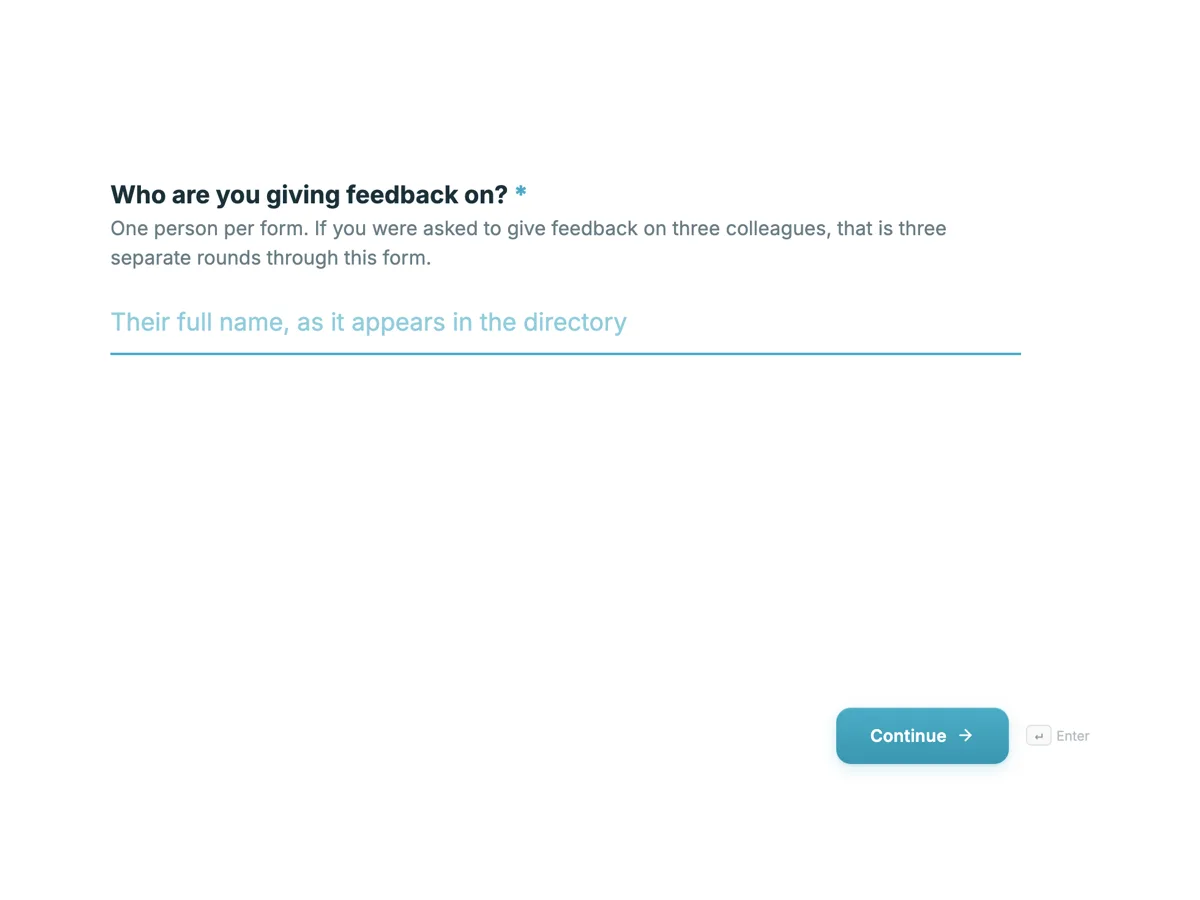
The first screen of the form. A conversational form shows one question per screen, so the remaining screens are listed in the field table below. Nothing here can be filled in or submitted, so read it as a reference and build your own from the button above.
Every field, and what it collects
The complete field list, in the order respondents meet it.
- Who are you giving feedback on?Short textRequired
- One person per form. If you were asked to give feedback on three colleagues, that is three separate rounds through this form.
- How do you work with them?Single choiceRequired
- HR groups answers by relationship when it writes the report, which is why a peer and a direct report are worth telling apart. HR folds a group with fewer than three replies into the others, because a group of one is a name.
- Options: I manage them · They manage me · We are peers in the same team · We are peers in different teams · They do work for me as an internal client
- How long have you worked with them?DropdownRequired
- Options: Under three months · Three to six months · Six to twelve months · One to three years · More than three years
- How often do you see this? Working with other peopleRating gridRequired
- Use the last column honestly. "Not seen" is a real answer, and HR leaves it out of the averages rather than counting it as a low score.
- Statements:
- Listens properly before answering
- Says the difficult thing early rather than late
- Gives credit to the person who actually did the work
- Handles disagreement without making it personal
- Is someone people ask for help
- How often do you see this? Getting the work doneRating gridRequired
- Statements:
- Delivers what they said they would, by when they said
- Tells people early when something is going to slip
- Work is right the first time, and does not need rechecking
- Prioritises the thing that matters over the thing in front of them
- Finishes things rather than leaving them almost done
- How often do you see this? Judgement and communicationRating gridRequired
- Statements:
- Explains a complicated thing so a non specialist follows it
- Says "I do not know" when that is the true answer
- Changes their mind when the evidence changes
- Asks for help before a problem becomes expensive
- Thinks about who else is affected before deciding
- What should they carry on doing exactly as they are?Long textRequired
- What one change would make the biggest difference?Long textRequired
- Reports that list six improvements change nothing. The single change is the question that earns the round.
- Give one example, in enough detail to be recognisableLong text
- An example is what turns a rating into something somebody can picture. Write it knowing they will read it in your words.
- How confident are you in the ratings you just gave?Single choiceRequired
- This is about how much you have seen, not about how well you think they are doing. It weights nothing; it tells the person reading the report how much to lean on your answers.
- Options: Very, I work with them constantly · Reasonably, on the parts I see · Only on a narrow slice of their work · Not very, we overlap rarely
Question banks built on this form
What makes this form work
Every statement is a behaviour somebody could have watched
Says the difficult thing early. Tells people when something will slip. Says "I do not know". None of them is a trait, so none can be answered from a general impression, and a rater who has not seen one has a column to say so.
It asks for one change, and says why
The field explains that reports listing six improvements change nothing. Forcing the choice is what produces a usable report, and the instruction is in the field description, which a conversational form prints under the question where a classic form would drop it.
Rater confidence is collected and its purpose is stated
Four options, and a line saying it weights nothing and is there to tell the reader how much to lean on the answers. It gives a rater who overlaps rarely an honest way to take part instead of quietly inflating the middle of every grid.
Questions people ask
What scale should a 360 feedback form use?
A frequency scale, not an agreement one, and always with a "not seen" column. Rarely to almost always asks about observed behaviour; strongly agree to strongly disagree invites an opinion about the person. The not seen option is what stops a rater guessing on a behaviour they have never watched.
How many behaviours is too many?
Fifteen is about the ceiling for a round people finish. Three grids of five, each with its own heading, read as three short questions rather than one long instrument. Beyond twenty the last grid is answered down the middle column, which is worse than not asking. Five columns is also close to the limit before a phone has to scroll the grid sideways to reach the last one.
Is this form anonymous?
It collects no name for the rater, only a relationship, which is how most rounds work. It is not technically anonymous: a form records a submission time and, if you publish it behind login, the account that answered. Published guidance also sets a floor of about three replies per relationship group before that group is reported separately, which is a reporting rule you apply yourself rather than something the form enforces.
How does a grid come back in the responses?
As one column per grid, with each statement and its answer joined together, rather than as five separate columns. That is fine for reading a single rater and awkward for averaging fifteen behaviours across eight people, so plan on a parsing step if you intend to score the round in a spreadsheet.
Should a 360 form collect written comments as well as ratings?
Yes, and this one gives them three separate boxes. One asks what the person should carry on doing exactly as they are, one asks for the single change that would make the biggest difference, and one asks for a recognisable example. Ratings tell a manager where to look, but only the example tells the person what actually happened.
Why does the last question ask how confident the rater is?
Because a rating from somebody who sees the person twice a year is not the same as one from a daily colleague, and averaging the two hides that. The confidence question sits at the end, after the ratings, so the answer reflects what the rater has just done. Low confidence is a signal to weight the response, not to discard it.
Build your own in about a minute
The button below opens the generator with this use case already described. Change the wording to match your own, generate, then edit anything you like.
Make one like thisOther form examples
Employee pulse survey that can be trended month to month
A pulse survey only works if the questions never change, because the point is the line on the chart, not the answer this month. These six statements are the whole instrument, the team question is the only segment, and the open questions are optional so the six always get answered.
Exit interview form
Exit interviews collect polite nothing when the leaver cannot tell who will read the answers. This one settles that in the first screen, separates the thing that started the search from the thing that finished it, and ends by asking what may be shared and with whom. It is conversational, because fourteen questions asked one at a time get longer written answers than the same fourteen stacked on a page.
Employee engagement survey template: 20 statements in five themes
An employee engagement survey measures how committed and supported people feel at work, across enough themes to show where to act and anonymously enough that people answer honestly. This template groups twenty agreement statements into five grids, direction, manager, growth, recognition and team, then asks the employer recommendation question.
Want the steps in the builder? Read Create a conversational form with AI, then View, export and manage your responses. For everything this generator can do, see the form maker.
Written and checked by the OneCraft team. Last checked .