Conversational form
Exit interview form
Exit interviews collect polite nothing when the leaver cannot tell who will read the answers. This one settles that in the first screen, separates the thing that started the search from the thing that finished it, and ends by asking what may be shared and with whom. It is conversational, because fourteen questions asked one at a time get longer written answers than the same fourteen stacked on a page.
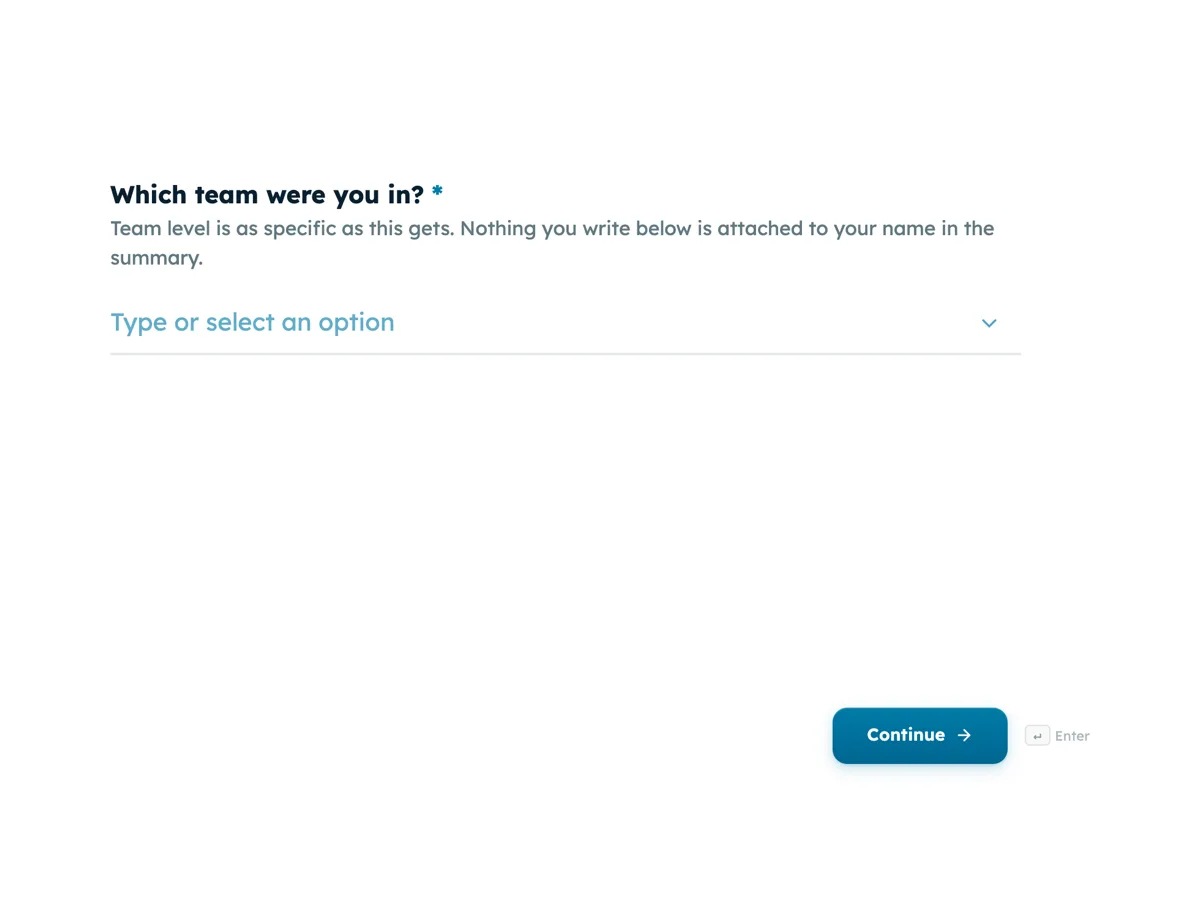
The form itself
The first screen of the form. A conversational form shows one question per screen, so the remaining screens are listed in the field table below. Nothing here can be filled in or submitted, so read it as a reference and build your own from the button above.
Every field, and what it collects
The complete field list, in the order respondents meet it.
- Which team were you in?DropdownRequired
- Team level is as specific as this gets. Nothing you write below is attached to your name in the summary.
- Options: Advisory · Delivery · Client services · Finance and operations · People and culture · Technology · Marketing
- How long were you here?DropdownRequired
- Options: Under six months · Six to twelve months · One to two years · Two to five years · Five to ten years · More than ten years
- What is your last day?DateRequired
- What made you start looking?Single choiceRequired
- The thing that started it, not the thing that finished it. Those are usually different and the first one is the more useful answer.
- Options: Pay · No obvious next step for me here · My manager · How much work there was · The work itself stopped being interesting · Something about the culture · I was approached and it was better · Moving away, or something at home · My contract or role was ending · I was not looking, this came to me
- And what else contributed?Multiple choice
- Tick anything that played a part, including the reason you already chose. People leave for three things at once far more often than for one, and the summary is built from this list rather than from the single answer above.
- Options: Pay · Progression · My manager · Workload · The work itself · Culture · Flexibility, or how much I had to be in the office · Commute or location · How change was handled here · Something at home · Nothing else, the reason above is the whole of it
- And what actually made you accept the other thing?Long textRequired
- This is the question the quarterly summary is built from. Everything else provides the shape and this provides the reason.
- How much do you agree with each of these?Rating gridRequired
- Statements:
- I had the tools and the information I needed to do my job
- My workload was something a person could sustain
- I was paid fairly for the work I actually did
- My manager gave me feedback I could use
- I could see a next step for myself here
- I could raise a concern without it costing me
- Was there a moment when something could have changed your mind?Long text
- This is the only question here that has ever changed how somebody stayed. It is worth two minutes.
- Where are you going?Single choice
- Nobody is offended by a competitor and nobody will chase you about it. It helps to know whether people leave the firm or leave the field.
- Options: Another firm doing similar work · A client, or somewhere in the same industry · A different industry entirely · Working for myself · Study · Taking a break, or not working for now · I would rather not say
- How does the new package compare?Single choice
- No numbers, just the direction. It is the only reliable way to find out whether pay is a story the firm tells itself or a reason people actually go.
- Options: I am paid much less · I am paid a little less · About the same · I am paid a little more · I am paid much more · I would rather not say
- Would you tell a friend to work here?Single choiceRequired
- Options: Yes, without qualifying it · Yes, but I would tell them what to watch for · Only for a particular team · No · I already have
- Would you come back?Single choiceRequired
- Options: Yes · Yes, if the thing I described above had changed · Probably not · No
- What would you tell whoever does your job next?Long text
- May we share your answers with your manager?Single choiceRequired
- A straight no is a normal answer and it changes nothing else. Choose the middle option if you want the substance passed on without the wording.
- Options: Yes, all of it, with my name on it · Yes, but summarised and without my name · No, keep it inside the people team
Question banks built on this form
What makes this form work
The sharing question is asked last, not assumed first
Three options: everything with a name, the substance without one, or nothing beyond the people team. Asking at the end, once the answers exist, gets a more generous choice than asking at the start, and it means every answer above can be written honestly.
The moment question is the one that pays for the form
"Was there a moment when something could have changed your mind" is the only question here whose answer can be acted on for somebody still employed. It is given its own screen and a line saying it is worth two minutes, because it is the question people skip.
Ten options for what started the search, including being approached
Most lists omit "I was not looking, this came to me", which is how a large share of departures actually begin. Leaving it out forces those people into a reason they did not have, and the summary reads as a pay problem the firm does not have.
Questions people ask
What is the one question an exit interview must ask?
What made the person start looking, kept separate from what made them accept. Those are different events, often months apart, and only the first tells you anything you can act on. Published instruments go further and ask for one main reason and then everything else that contributed, because people leave for three things at once and a single answer hides two of them.
How do you get honest answers when the form is not anonymous?
By being exact about who reads it and when, and by asking permission at the end rather than assuming it. This form says two people in the people team, nothing before the last day, and finishes with a three way choice about the manager. Vague promises of confidentiality produce vague answers.
Why use a rating grid as well as open questions?
Because six statements answered on the same scale can be compared across everybody who leaves, and prose cannot. The grid provides the shape and the written answers provide the reason. Reading the six rows together also shows whether one complaint is standing in for several.
When should the form be sent?
After the resignation is accepted and before the last week, not on the final afternoon. The answers on the last day are shorter and warmer than the ones given a fortnight out, and by then the person has usually stopped caring whether anything changes.
Should an exit interview ask where the person is going?
Ask, and let them skip it. This form asks where you are going and how the new package compares, both after the questions about why they started looking. Answers are voluntary in practice, and the pattern across a year of leavers is worth more than any single response, especially when the same competitor keeps appearing.
What is the point of asking whether they would come back?
It is the cheapest measure of how the exit actually went. This form asks it right after whether they would recommend the place to a friend. Somebody who would return is a rehire candidate and a referral source. Somebody who would not, but who liked the work, is telling you the problem was local and fixable.
Build your own in about a minute
The button below opens the generator with this use case already described. Change the wording to match your own, generate, then edit anything you like.
Make one like thisOther form examples
360 feedback form
A 360 round fails when raters score a personality instead of a behaviour, and when there is nowhere honest to say they have not seen something. This form asks fifteen behaviours on a frequency scale with a "not seen" column, then three written questions that between them produce the only part of the report anybody rereads. It is conversational, because a rater who meets one grid at a time writes longer answers than one facing three at once.
Employee pulse survey that can be trended month to month
A pulse survey only works if the questions never change, because the point is the line on the chart, not the answer this month. These six statements are the whole instrument, the team question is the only segment, and the open questions are optional so the six always get answered.
Bug report form that produces reports a developer can reproduce
A bug report is useful when someone else can make the bug happen, and most forms ask for a description and nothing else. This one asks for the steps as a numbered table, the expected and actual result as two fields, the environment as choices, and posts the whole thing to the issue tracker as JSON.
Want the steps in the builder? Read Create a conversational form with AI, then Classic or conversational, and how to choose. For everything this generator can do, see the form maker.
Written and checked by the OneCraft team. Last checked .