Conversational form
Employee engagement survey template: 20 statements in five themes
An employee engagement survey measures how committed and supported people feel at work, across enough themes to show where to act and anonymously enough that people answer honestly. This template groups twenty agreement statements into five grids, direction, manager, growth, recognition and team, then asks the employer recommendation question.
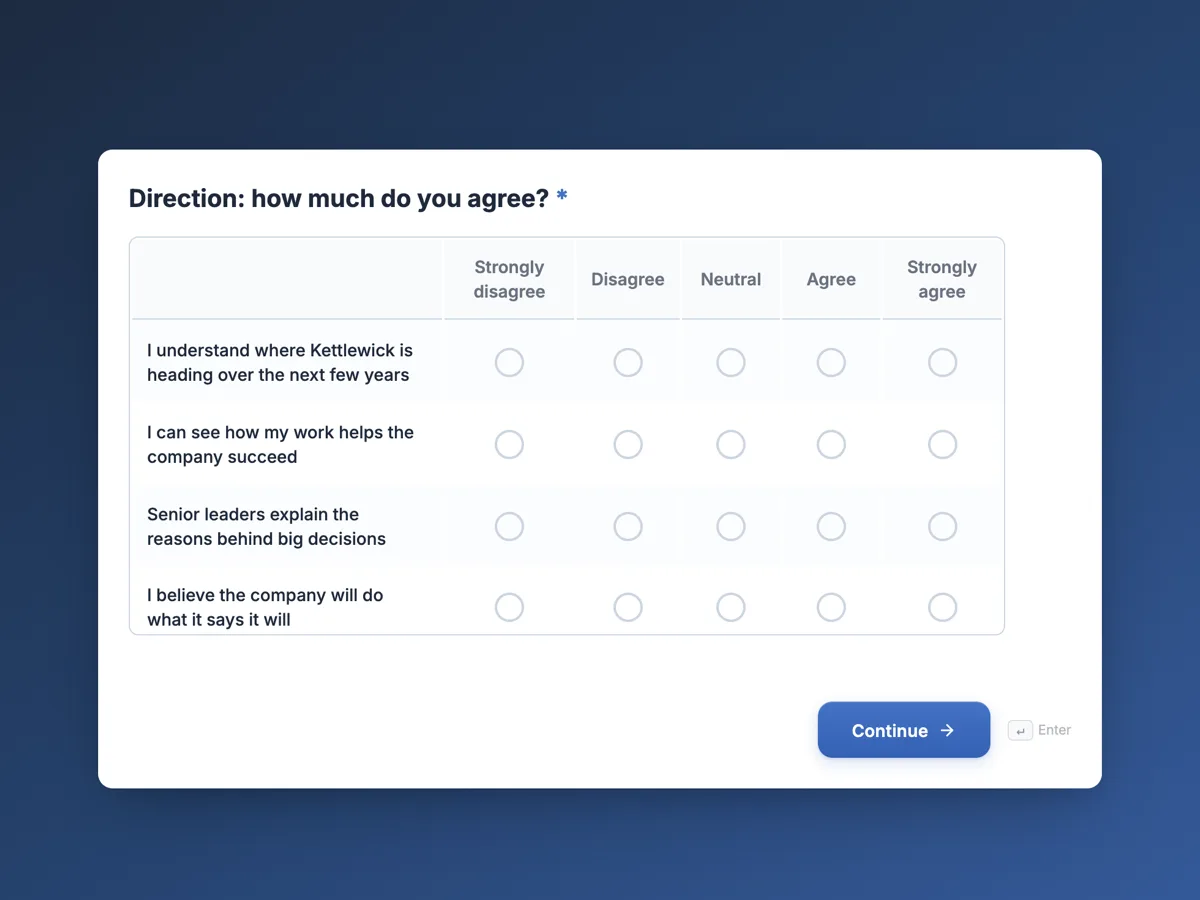
The form itself
The first screen of the form. A conversational form shows one question per screen, so the remaining screens are listed in the field table below. Nothing here can be filled in or submitted, so read it as a reference and build your own from the button above.
Every field, and what it collects
The complete field list, in the order respondents meet it.
- Direction: how much do you agree?Rating gridRequired
- Statements:
- I understand where Kettlewick is heading over the next few years
- I can see how my work helps the company succeed
- Senior leaders explain the reasons behind big decisions
- I believe the company will do what it says it will
- Your manager: how much do you agree?Rating gridRequired
- Statements:
- My manager makes it clear what is expected of me
- My manager talks with me about my work at least monthly
- I can raise a problem with my manager without worrying
- My manager treats everyone in the team fairly
- Growth: how much do you agree?Rating gridRequired
- Statements:
- I have learned something useful at work in the last six months
- I can see a next step for my career here
- I get the training I need to do my job safely and well
- My skills are put to good use
- Recognition and reward: how much do you agree?Rating gridRequired
- Statements:
- Good work is noticed and acknowledged
- My pay is fair for the work I do
- Promotions go to the people who deserve them
- I have received praise for my work in the last month
- Team and wellbeing: how much do you agree?Rating gridRequired
- Statements:
- People in my team help each other out
- My workload is manageable most weeks
- I feel safe at work, physically and in speaking up
- I would still like to be working here in two years
- How likely are you to recommend Kettlewick as a place to work?Single choiceRequired
- 0 is not at all likely, 10 is extremely likely.
- Options: 0 · 1 · 2 · 3 · 4 · 5 · 6 · 7 · 8 · 9 · 10
- Which area do you work in?DropdownRequired
- Results for any area with fewer than eight responses are combined with another area.
- Options: Production, day shift · Production, night shift · Warehouse and dispatch · Quality and food safety · Maintenance and engineering · Sales and customer service · Office and support functions
- How long have you worked at Kettlewick?Single choiceRequired
- Options: Less than a year · One to three years · Three to ten years · More than ten years
- What one change would make Kettlewick a better place to work?Long text
- Please do not name colleagues.
What each screen of this survey collects
Five matrix screens each hold four statements on a five point agreement scale. Direction covers strategy, line of sight and trust in leaders. Manager covers expectations, regular conversations, raising problems and fairness. Growth covers learning, a next step, training and use of skills. Recognition covers acknowledgement, pay, promotion and recent praise. Team and wellbeing covers help, workload, safety in speaking up and intent to stay. The employer recommendation question runs 0 to 10. Area is a dropdown of seven, with a note on the minimum group size. Tenure is a radio of four, and the open question asks for one change. Eight of the nine screens are required.
Why the statements are grouped into themes
Twenty separate screens would feel endless; one grid of twenty would be a wall. Five grids of four keep each screen readable on a phone and let results be reported by theme, so a site can see that growth scores low while manager scores are strong. Each statement describes something the employee has seen, such as a monthly conversation or praise in the last month, rather than a feeling, which makes the answers more consistent between people and more useful to act on. A required grid counts as answered once any one row has a choice, so a person unsure about one statement can leave it and carry on.
How to adapt this survey
An office based company replaces the shift areas with departments and the safety statement with one on flexibility. A small business under fifty people drops the area dropdown, since areas would be too small to stay anonymous. A company running quarterly pulses keeps one statement per theme and the recommendation question.
What makes this form work
Five themes, four statements each
Direction, manager, growth, recognition and team each get one grid of four, so results point at a theme to act on, not a single score.
Statements describe what people see
Items such as a monthly conversation about my work or praise in the last month ask about events, which managers can actually change.
Anonymity is built into the questions
There is no name field, the area dropdown promises to merge groups under eight, and the comment asks staff not to name colleagues.
Questions people ask
What is eNPS?
Employee net promoter score: the share of staff answering 9 or 10 to how likely they are to recommend the company as a place to work, minus the share answering 0 to 6. It ranges from minus 100 to plus 100. It is a quick headline, but the theme grids explain it, so report both.
How anonymous is an engagement survey without a name field?
Anonymous enough if two things hold: the form is published with public access rather than login required, and no group is reported with fewer than about eight answers. The area dropdown is the main risk, so its help text promises small areas will be combined. Comments can still identify someone, which is why they ask not to name colleagues.
Can I use the Gallup Q12 questions?
The Q12 statements are proprietary to Gallup and licensed for use in its own surveys. The twenty statements in this template are written independently, though they cover similar ground: expectations, recognition, development and a manager who cares. If you need benchmarking against a published dataset, a licensed instrument is the way to get it.
How often should an engagement survey run?
A full survey like this once a year, with short pulse surveys of five or six statements each quarter. Running the full survey more often leaves no time to act between rounds, and staff stop answering when nothing changes. The thank-you screen sets out the timeline for results and actions, which helps the next round.
What should managers do with their team results?
Share them with the team, pick no more than three statements to work on, and agree actions together. The statements are written as behaviours, such as a monthly conversation about work, so the action often follows directly. Teams that discuss their results tend to see scores rise the following year even when the actions are small.
Does every statement in a grid have to be answered?
No. The grid is required, but the form treats it as answered once any one statement has a choice, so someone unsure about one statement can leave it blank. That is deliberate in an engagement survey: a forced answer to a statement someone has no view on adds noise. Report each statement from those who answered it.
Build your own in about a minute
The button below opens the generator with this use case already described. Change the wording to match your own, generate, then edit anything you like.
Make one like thisOther form examples
Remote work survey template: setup, focus and connection
A remote work survey has to show how people actually split their week and what each place is good for, before a company sets or changes its hybrid policy. This template asks days remote and commute, checks the home setup, compares focus at home and in the office, and asks what the office is for.
Manager feedback survey with twelve behaviours rated by frequency
A manager feedback survey lets a team tell its manager, anonymously, which everyday behaviours help them work and which get in the way. This one rates twelve observable behaviours by how often they happen, adds one to ones, development and workload, and ends with one thing to keep and one to change.
Diversity and inclusion survey template with optional demographics last
A diversity and inclusion survey has to measure whether people feel they belong and are treated fairly, then check whether those experiences differ between groups, without forcing anyone to disclose who they are. This template asks belonging and fairness first and puts six demographic questions last, each optional with prefer not to say.
Want the steps in the builder? Read Create a conversational form with AI, then Control who can fill in your form. For everything this generator can do, see the form maker.
Written and checked by the OneCraft team. Last checked .