Conversational form
Manager feedback survey with twelve behaviours rated by frequency
A manager feedback survey lets a team tell its manager, anonymously, which everyday behaviours help them work and which get in the way. This one rates twelve observable behaviours by how often they happen, adds one to ones, development and workload, and ends with one thing to keep and one to change.
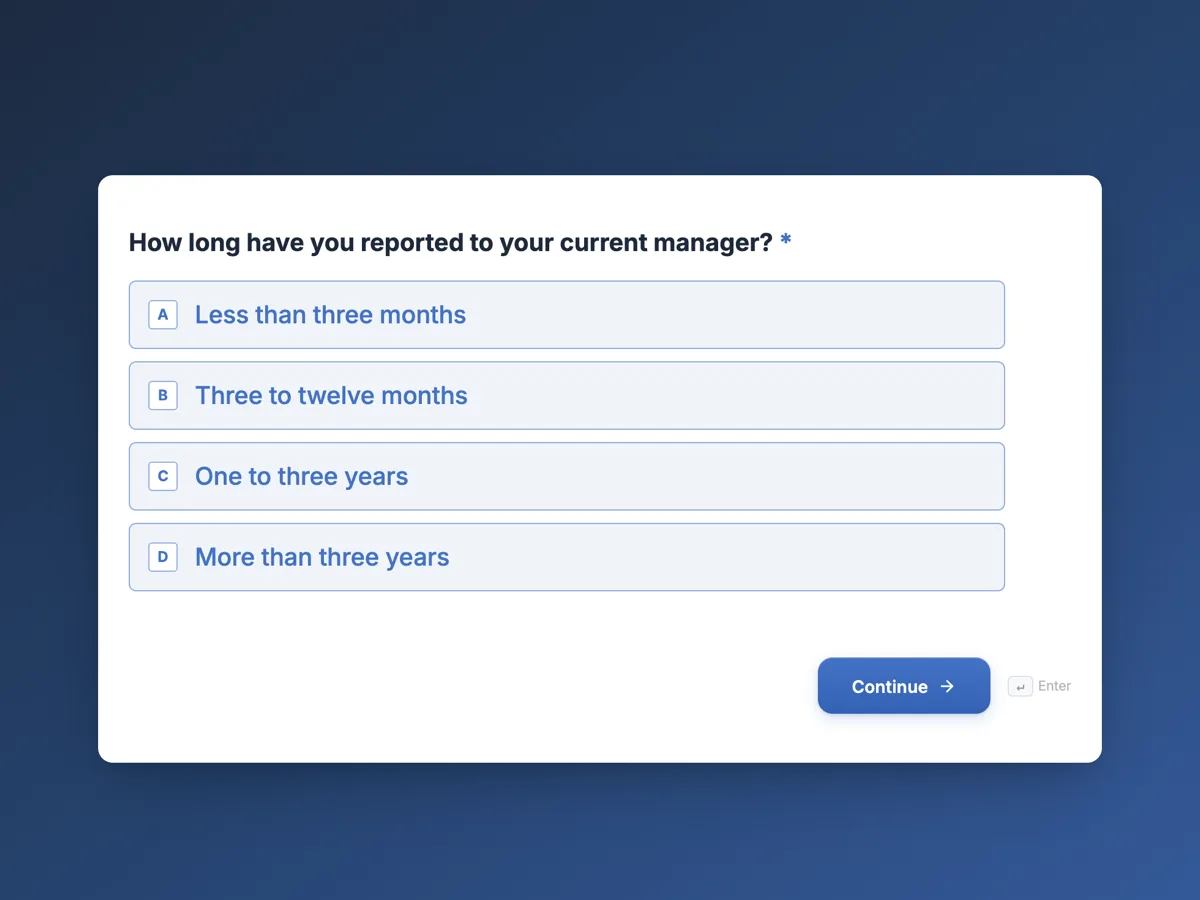
The form itself
The first screen of the form. A conversational form shows one question per screen, so the remaining screens are listed in the field table below. Nothing here can be filled in or submitted, so read it as a reference and build your own from the button above.
Every field, and what it collects
The complete field list, in the order respondents meet it.
- How long have you reported to your current manager?Single choiceRequired
- Options: Less than three months · Three to twelve months · One to three years · More than three years
- Which manager is this feedback about?DropdownRequired
- Only managers with five or more direct reports are listed, so no result can be traced to one or two people.
- Options: Branch manager, Geelong · Branch manager, Ballarat · Branch manager, Bendigo · Warehouse manager, Laverton · Trade counter manager, Laverton · Sales manager, trade accounts · Finance and admin manager
- Direction: how often does your manager do this?Rating gridRequired
- Statements:
- Explains what the team is working towards this month
- Sets clear priorities when everything feels urgent
- Tells you early when plans or targets change
- Makes decisions in time for you to act on them
- Support: how often does your manager do this?Rating gridRequired
- Statements:
- Gives you feedback you can actually use
- Notices and mentions work done well
- Removes blockers you cannot clear yourself
- Backs you up with customers and other teams
- Fairness and openness: how often does your manager do this?Rating gridRequired
- Statements:
- Shares work and overtime fairly across the team
- Listens to a different view before deciding
- Admits a mistake and fixes it
- Treats every person in the team with the same respect
- How often do you have a one to one with your manager?Single choiceRequired
- Options: Weekly · Every two weeks · Monthly · Less than monthly · Never
- Have you talked with your manager about your development in the last six months?Single choiceRequired
- Options: Yes, and we agreed next steps · Yes, but nothing came of it · No
- Is your workload set at a level you can sustain?Single choiceRequired
- Options: Most weeks · Some weeks · Rarely
- Could you give this feedback to your manager face to face?Single choiceRequired
- Options: Yes, comfortably · With some hesitation · No
- Overall, how effective is your manager?Single choiceRequired
- 1 is not effective, 5 is highly effective.
- Options: 1 · 2 · 3 · 4 · 5
- Would you choose to work for this manager again?Single choiceRequired
- Options: Yes · Not sure · No
- How do you mostly work with your manager?Single choiceRequired
- Options: Same site every day · Same site some days · Mostly by phone or video
- What is one thing your manager should keep doing?Long textRequired
- Describe the behaviour, not a person or an event that could identify you.
- What is one thing your manager should change?Long textRequired
- One change is easier to act on than a list.
What each screen of this survey collects
Screen one asks how long the person has reported to this manager, in four bands. Screen two picks the manager from seven roles, with a note that only managers with five or more reports are listed. Screens three to five are grids of four behaviours each, direction, support, and fairness and openness, rated never, rarely, sometimes, often or always. Then come six single choice screens: one to one frequency, a development conversation in the last six months, a sustainable workload, whether the feedback could be given face to face, overall effectiveness from 1 to 5, and whether the person would work for this manager again. Screen twelve asks how they mostly work together. The last two screens are long text: one thing to keep and one thing to change. All fourteen screens are required.
Why frequency, not agreement
An agreement scale asks whether a statement is true, so "my manager gives useful feedback" gets a polite agree from people who have had feedback twice in a year. A frequency scale asks how often, which is what the manager can change. Each of the twelve items is a behaviour someone else could watch: telling the team early when plans change, removing a blocker, admitting a mistake. That keeps the report away from personality and close to Monday morning. The threshold on the welcome screen matters as much as the questions. With five answers as the minimum, a branch of three cannot be reported alone, which is why the dropdown lists roles with larger teams only.
How to adapt this survey
A retail chain swaps the branch roles for store managers and replaces the overtime item with one about fair rostering. A software team adds a fourth grid on technical leadership, such as code review turnaround and protecting focus time. A small business with one manager drops the dropdown entirely and runs the survey through an outside adviser so the threshold still holds.
What makes this form work
Twelve behaviours anyone could observe
Items such as "tells you early when plans or targets change" and "removes blockers you cannot clear yourself" describe actions, so a low score points straight at something the manager can do differently.
A threshold built into the questions
The welcome screen promises results only at five or more answers, and the manager dropdown lists only roles with five or more reports. There is no name field anywhere in the fourteen screens.
One keep, one change
The two closing screens ask for a single behaviour each, with placeholders that show the level of detail wanted. One change per person is a list a manager can act on.
Questions people ask
How many responses does a manager need before seeing results?
Five is a common floor, and it is the one this form promises on its welcome screen. Below five, a manager can often guess who answered from the pattern alone. If a team is smaller, combine it with a sibling team or skip the report for that round rather than lowering the threshold quietly.
Should a manager see the comments word for word?
Usually yes, because paraphrased comments lose the detail that makes them useful. The welcome screen says comments are passed on as written, and both comment screens ask for behaviours rather than events. People and Culture can still remove a comment that names someone before the summary goes out.
Is a required matrix fully enforced row by row?
No. Each behaviour grid is required, but the form accepts it once any one row has an answer. In upward feedback that is acceptable, because a new starter may have no view on whether decisions arrive in time. Report each behaviour from the people who rated it, and show the count beside the score.
How is this different from a 360 degree review?
A 360 gathers ratings from the manager's own manager, peers and reports, usually for one person at a time. Upward feedback asks direct reports only, and it runs across every manager at once. It is cheaper and more anonymous, but it misses how a manager works with peers.
How long should a team wait between rounds of manager feedback?
Twice a year suits most teams: often enough that a manager can see whether a change worked, and far enough apart to make one. Keep the twelve behaviours the same between rounds so movement means something. Rotate the open questions if answers start to repeat themselves.
What should a manager do with the results?
Read the lowest frequency items first, share the summary with the team within a fortnight, and choose one behaviour to work on in public. Naming one change is what the thank-you screen promises. A manager who asks the team what "often" would look like for that behaviour usually gets a practical answer.
Build your own in about a minute
The button below opens the generator with this use case already described. Change the wording to match your own, generate, then edit anything you like.
Make one like thisOther form examples
Employee engagement survey template: 20 statements in five themes
An employee engagement survey measures how committed and supported people feel at work, across enough themes to show where to act and anonymously enough that people answer honestly. This template groups twenty agreement statements into five grids, direction, manager, growth, recognition and team, then asks the employer recommendation question.
Remote work survey template: setup, focus and connection
A remote work survey has to show how people actually split their week and what each place is good for, before a company sets or changes its hybrid policy. This template asks days remote and commute, checks the home setup, compares focus at home and in the office, and asks what the office is for.
New hire onboarding survey at day 90
A new hire onboarding survey asks recent starters what helped and what was missing in their first months, early enough that the answers can fix the process for the next intake. This day 90 version covers role clarity, day one readiness, the buddy, a training grid, manager check ins and whether the person feels part of the team.
Want the steps in the builder? Read Create a conversational form with AI, then Control who can fill in your form. For everything this generator can do, see the form maker.
Written and checked by the OneCraft team. Last checked .