Conversational form
Diversity and inclusion survey template with optional demographics last
A diversity and inclusion survey has to measure whether people feel they belong and are treated fairly, then check whether those experiences differ between groups, without forcing anyone to disclose who they are. This template asks belonging and fairness first and puts six demographic questions last, each optional with prefer not to say.
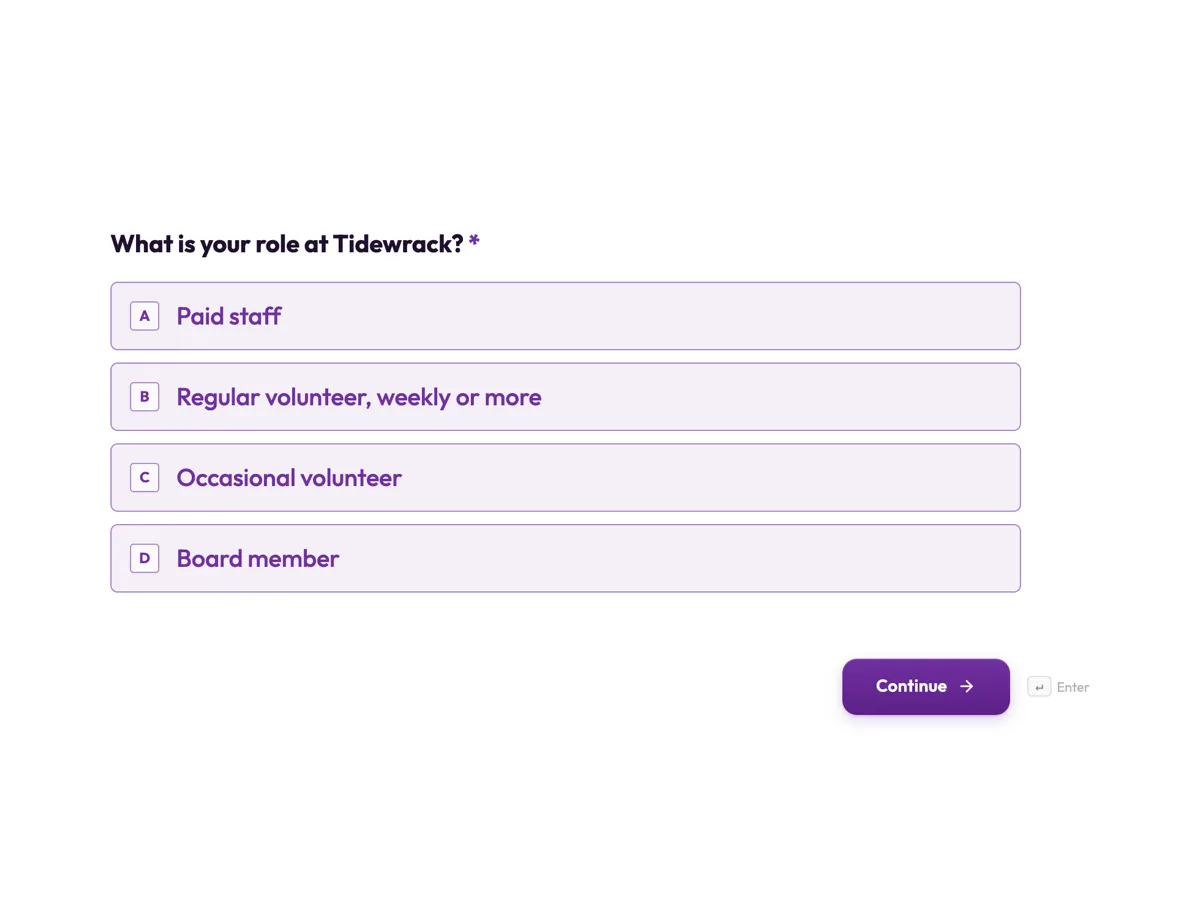
The form itself
The first screen of the form. A conversational form shows one question per screen, so the remaining screens are listed in the field table below. Nothing here can be filled in or submitted, so read it as a reference and build your own from the button above.
Every field, and what it collects
The complete field list, in the order respondents meet it.
- What is your role at Tidewrack?Single choiceRequired
- Options: Paid staff · Regular volunteer, weekly or more · Occasional volunteer · Board member
- Belonging: how much do you agree?Rating gridRequired
- Statements:
- I feel welcome when I arrive for a shift
- I can be myself here
- People like me are represented in this team
- My background and experience are valued
- Fairness: how much do you agree?Rating gridRequired
- Statements:
- Shifts and tasks are shared out fairly
- Everyone has the same chance to take on more responsibility
- Clients are treated with the same respect whoever they are
- Rules are applied the same way to everyone
- In the last year, have you felt able to speak up about something that was wrong?Single choiceRequired
- Options: Yes, and it was handled well · Yes, but nothing changed · No, I did not feel safe to · Nothing has come up
- In the last year, have you seen someone excluded or treated unfairly here?Single choiceRequired
- Options: No · Yes, once · Yes, more than once · Not sure
- Your ageSingle choice
- Options: Under 25 · 25 to 39 · 40 to 54 · 55 to 69 · 70 or over · Prefer not to say
- Your genderSingle choice
- Options: Woman or female · Man or male · Non-binary · I use a different term · Prefer not to say
- Do you see yourself as part of a minority ethnic or cultural group where you live?Single choice
- Options: Yes · No · Not sure · Prefer not to say
- Do you have a disability or long term condition that affects your daily activities?Single choice
- Options: Yes · No · Prefer not to say
- Your sexual orientationSingle choice
- Options: Straight or heterosexual · Gay or lesbian · Bisexual · I use a different term · Prefer not to say
- Do you have caring responsibilities outside Tidewrack?Single choice
- Options: For children · For an adult who needs support · Both · None · Prefer not to say
- What would make Tidewrack more inclusive?Long text
- Please do not name individuals.
What each screen of this survey collects
Role is a radio of four, covering paid staff, regular and occasional volunteers and the board. The belonging grid asks four statements, from feeling welcome on arrival to having one's background valued, on a four point agreement scale. The fairness grid covers shifts, chances to take on responsibility, respect for clients and rules applied equally. Speaking up separates handled well, nothing changed and not safe to. Witnessed exclusion has four answers. Then six optional screens: age, gender, minority ethnic or cultural group, disability, sexual orientation and caring responsibilities, each with prefer not to say. The comment is optional. Five of the twelve screens are required.
Why demographics come last and are optional
Asked first, demographic questions make people wonder whether their answers can be traced, and some leave. Asked last, after the experience questions are already answered, they feel like what they are: a way to see whether belonging or fairness scores differ for people with a disability, carers or people from a minority background. Making each one optional with prefer not to say respects people who do not want to disclose. The gender and orientation lists include I use a different term, so nobody is forced into a category that does not fit. Results by group are only reported above ten responses, as the thank-you screen says.
How to adapt this survey
A company adds a pay and promotion statement to the fairness grid and a department question. A school or club asks about members instead of volunteers. An organisation in one country can replace the minority group question with that country's official ethnicity or cultural background categories so results compare with census data.
What makes this form work
Experience before identity
Belonging, fairness, speaking up and exclusion are all answered before any demographic question appears, so nobody hesitates at the start.
Every demographic can be declined
Six optional questions each offer prefer not to say, and gender and orientation add I use a different term so no one is forced into a box.
Two kinds of silence are separated
The speaking up screen distinguishes not feeling safe from speaking up with no result, which call for different fixes.
Questions people ask
Should demographic questions be required in an inclusion survey?
No. Required demographics push some people to quit and others to give false answers, which damages the data you wanted. Every demographic question in this template is optional and offers prefer not to say. The share choosing that answer is itself useful: if it is high, trust in the survey needs work.
How small can a group be before results are hidden?
A common threshold is around ten responses. Below that, a combination such as board member, over 70 and a carer may describe one person. This survey promises groups of ten or more, which in a small food bank may mean reporting some groups only for the whole organisation, or combining two years of results.
Why ask whether someone witnessed exclusion?
People often see unfair treatment of others more readily than they report their own. The question measures how common exclusion is without anyone having to describe themselves as a target. It does not replace a reporting process, so the thank-you screen points to the coordinator and the board chair for specific incidents.
Is this survey collecting sensitive information?
Disability, sexual orientation and ethnic background are sensitive information under privacy laws in many countries, even when optional. Keep the survey anonymous, collect no names or emails, publish it with public access, store results securely and report only in groups. Tell people why each optional question is asked, as the paragraph before them does.
What does the speaking up question show?
Two separate problems. People who did not feel safe to speak up point at culture and trust. People who spoke up but saw nothing change point at process: concerns were raised and then dropped. The second is often easier to fix, with a named person to receive concerns and a promise to report back.
How should a volunteer organisation act on the results?
Share them openly, as promised at the volunteer meeting, then pick one or two changes. If carers score lower on belonging, look at shift times. If fairness scores differ between regular and occasional volunteers, look at how tasks are allocated. Repeat the survey a year later with the same questions to see whether the gaps closed.
Build your own in about a minute
The button below opens the generator with this use case already described. Change the wording to match your own, generate, then edit anything you like.
Make one like thisOther form examples
Volunteer survey on role fit, training and recognition
A volunteer survey asks the people who give their time whether the role suited them, whether they were trained and valued, and what would bring them back. This one does it in eight screens for a wetlands charity, from the role they held to the barriers that make volunteering harder.
Training feedback form: objectives met and what staff will apply at work
A training feedback form has to show whether a session did its job, not only whether people enjoyed it, which means asking if the objectives were met and what will change at work. This one rates the trainer in a grid, checks pace and confidence, and requires one specific thing each person will do differently.
Community consultation survey for a council park upgrade
A community consultation survey asks residents how they use a place, what matters to them and which option they prefer before a council decides. This one does it for an Australian shire park upgrade in ten screens, with a seven item priorities grid and a choice between two concept plans.
Want the steps in the builder? Read Create a conversational form with AI, then Control who can fill in your form. For everything this generator can do, see the form maker.
Written and checked by the OneCraft team. Last checked .