Conversational form
Volunteer survey on role fit, training and recognition
A volunteer survey asks the people who give their time whether the role suited them, whether they were trained and valued, and what would bring them back. This one does it in eight screens for a wetlands charity, from the role they held to the barriers that make volunteering harder.
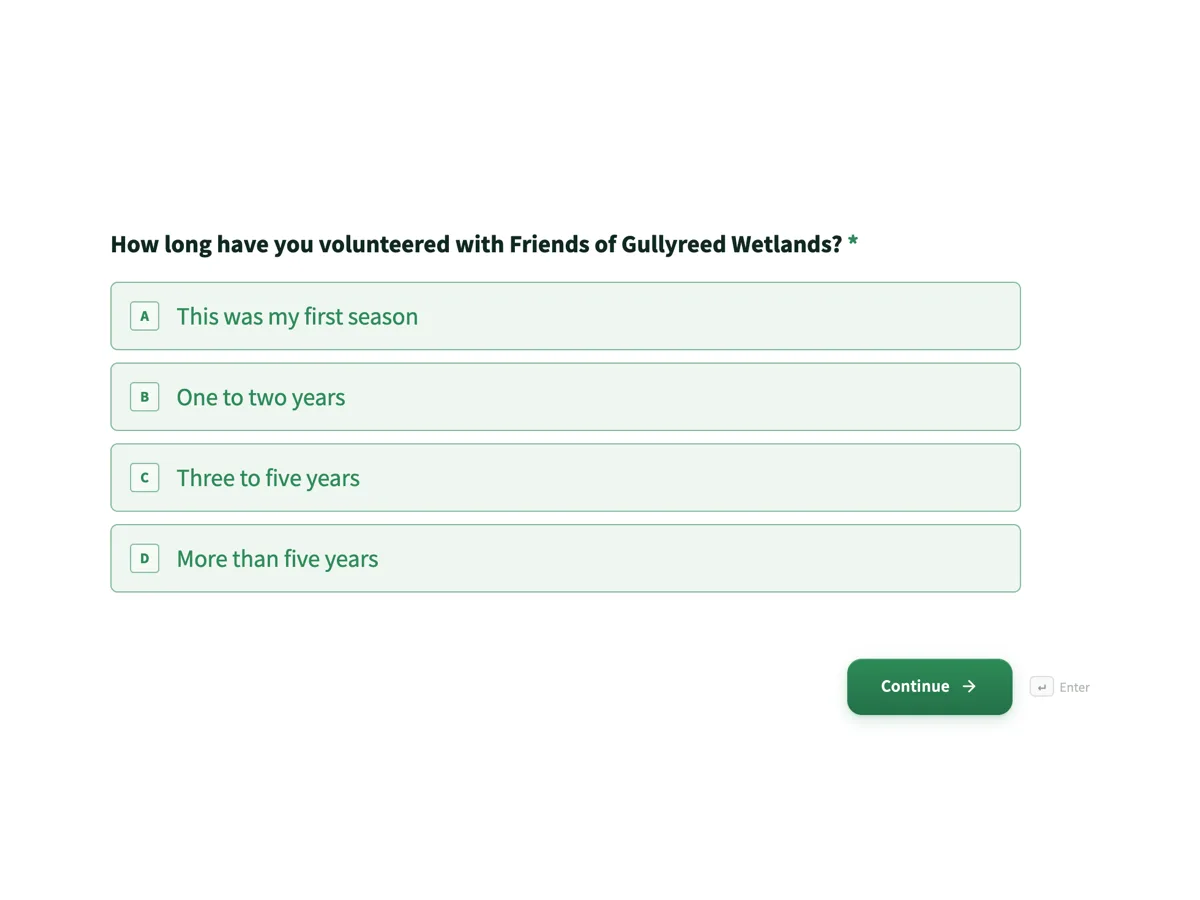
The form itself
The first screen of the form. A conversational form shows one question per screen, so the remaining screens are listed in the field table below. Nothing here can be filled in or submitted, so read it as a reference and build your own from the button above.
Every field, and what it collects
The complete field list, in the order respondents meet it.
- How long have you volunteered with Friends of Gullyreed Wetlands?Single choiceRequired
- Options: This was my first season · One to two years · Three to five years · More than five years
- What was your main role this season?DropdownRequired
- Options: Course marshal on walk day · Drinks and first aid station · Registration desk · Planting and weeding crew · Bird count and water testing · Office, mail outs and data entry · Fundraising and sponsor visits
- About how many hours a month do you volunteer?Single choiceRequired
- Options: Under 4 hours · 4 to 8 hours · 9 to 16 hours · More than 16 hours
- Was the training you received enough to do your role well?Single choiceRequired
- Options: Yes, I felt ready · Mostly, I learned the rest on the day · No, I needed more
- Did you feel your time was valued?Single choiceRequired
- Options: Yes, often · Sometimes · Rarely · Not at all
- Will you volunteer with us again next season?Single choiceRequired
- Options: Yes, in the same role · Yes, in a different role · Not sure yet · No
- What makes it harder to volunteer? Tick any that apply.Multiple choiceRequired
- Options: Shift times clash with work or study · Travel to the wetlands · Not knowing what is coming up · Out of pocket costs · Physical demands of the role · Not enough people on my shift · Nothing gets in the way
- One suggestion for next season?Long text
What each screen of this survey collects
Screen one sets tenure in four bands, from first season to more than five years. Screen two is the main role, a dropdown of seven covering walk day roles, planting, bird counts, office work and fundraising. Hours a month comes in four bands. Training asks whether the volunteer felt ready, learned on the day, or needed more. Feeling valued runs from often to not at all. Returning offers the same role, a different role, not sure or no. Barriers is a checkbox of six real obstacles plus "nothing gets in the way". The last screen takes one optional suggestion. Seven of the eight screens are required.
Why role and tenure come first
A single satisfaction score for every volunteer hides the pattern a coordinator needs. A first season marshal who stood alone at a turn for four hours and a ten year bird counter answer the same question very differently, and the fix for each is different. Asking role and tenure first means every later answer can be read by group: whether drinks station volunteers felt underprepared, or whether newer people are less likely to return. The "different role" option on the return question matters too, because a volunteer who is leaving a role is not always leaving the cause.
How to adapt this survey
An op shop or food relief service replaces the walk day roles with shop floor, sorting and delivery driver, and adds a question about shift length. A sports club adds coaching and canteen roles and asks whether volunteers would accept a committee position. An event run once a year moves the survey to the week after the event and swaps hours a month for hours on the day.
What makes this form work
Role first, so answers read by group
The dropdown of seven roles, from course marshal to bird count and water testing, lets every later answer be split by what the volunteer actually did that season.
Leaving a role is not leaving the cause
The return question separates "yes, in the same role" from "yes, in a different role", so the charity can move a tired marshal to planting instead of losing them.
Barriers a charity can act on
Six obstacles, including shift times, travel and out of pocket costs, sit in one checkbox with "nothing gets in the way" as the honest exit, so the question can be required.
Questions people ask
Should a volunteer survey be anonymous?
Usually, because volunteers are reluctant to criticise a coordinator they like or a committee they belong to. This form asks no name, and role plus tenure are broad enough not to identify most people. In a small group of under twenty, merge rare roles in the report so no single answer stands out.
When is the best time to send a volunteer survey?
Within two weeks of the season or event ending, while the experience is fresh and before people commit to anything else. Sending it with the thank-you message works well. A second short check partway through a long season can catch training problems early, while there is still time to fix them.
What does "felt valued" actually measure?
Whether thanks and recognition reached the person, which is one of the strongest predictors of a volunteer returning. Recognition does not have to cost money: being greeted by name, told what the shift achieved and asked for an opinion all count. Low scores in one role usually point to a coordinator who is stretched thin.
Why ask about out of pocket costs?
Fuel, parking, protective gear and lunch add up, and they quietly push out volunteers on lower incomes. If the box is ticked often, a charity can look at reimbursing travel, providing gear or moving shifts closer to public transport. It is one of the few barriers an organisation can remove with a modest budget.
How should the results be shared with volunteers?
Briefly and with actions attached. The thank-you screen promises a report in the volunteer newsletter on what the committee changed. Three changes with the reason for each, such as rosters sent a fortnight ahead because many people asked for it, show volunteers that answering was worth their time.
Can the survey be filled in on a phone at the event?
Yes. Each screen holds one question, sized for a phone, so volunteers can answer on the bus home or at the final debrief. A printed link or code at the sign out table works well. Answers are only stored when the last screen is submitted, so a half finished survey is not recorded.
Build your own in about a minute
The button below opens the generator with this use case already described. Change the wording to match your own, generate, then edit anything you like.
Make one like thisOther form examples
Restaurant feedback form with a course by course rating grid
A restaurant feedback form has to tell the kitchen and the floor team which part of a visit worked and which did not, without making diners write an essay. This one puts every course plus service, ambience and value into one rating grid, then asks for the server, the best dish and whether they would return.
Community consultation survey for a council park upgrade
A community consultation survey asks residents how they use a place, what matters to them and which option they prefer before a council decides. This one does it for an Australian shire park upgrade in ten screens, with a seven item priorities grid and a choice between two concept plans.
Website feedback survey template: task, success and one fix
A website feedback survey should ask what the visitor came to do and whether they managed it, before asking how they feel about the site. This template does exactly that in seven screens, then asks how easy it was, the one thing that got in the way, the device and whether they would return.
Want the steps in the builder? Read Create a conversational form with AI, then Design your welcome and thank-you screens. For everything this generator can do, see the form maker.
Written and checked by the OneCraft team. Last checked .