Conversational form
Community consultation survey for a council park upgrade
A community consultation survey asks residents how they use a place, what matters to them and which option they prefer before a council decides. This one does it for an Australian shire park upgrade in ten screens, with a seven item priorities grid and a choice between two concept plans.
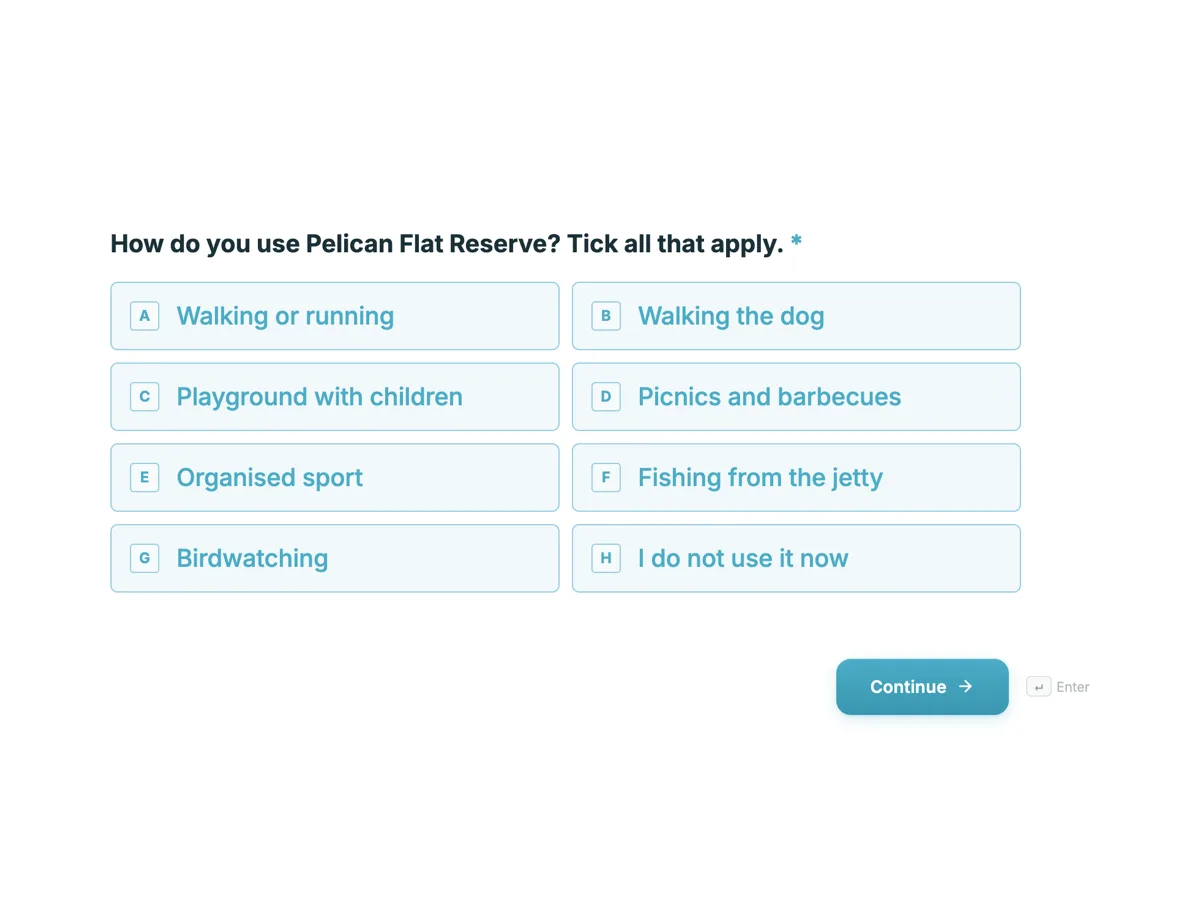
The form itself
The first screen of the form. A conversational form shows one question per screen, so the remaining screens are listed in the field table below. Nothing here can be filled in or submitted, so read it as a reference and build your own from the button above.
Every field, and what it collects
The complete field list, in the order respondents meet it.
- How do you use Pelican Flat Reserve? Tick all that apply.Multiple choiceRequired
- Options: Walking or running · Walking the dog · Playground with children · Picnics and barbecues · Organised sport · Fishing from the jetty · Birdwatching · I do not use it now
- How often do you visit?Single choiceRequired
- Options: Most days · Weekly · Monthly · A few times a year · Never
- How do you usually get there?Single choiceRequired
- Options: Walk · Bike or scooter · Car · Bus
- How important is each of these to you?Rating gridRequired
- Statements:
- Shade trees and shelters
- An accessible toilet
- A bigger playground
- Lighting on the main path
- Fenced off lead dog area
- Protecting the wetland edge for birds
- More car parking
- Which concept plan do you prefer?Single choiceRequired
- Concept A keeps the open lawn and adds a nature play space, a boardwalk along the wetland and new shade trees. Concept B moves the playground beside the car park, adds a fenced dog park and a second barbecue shelter, and lights the main path.
- Options: Concept A: nature play and boardwalk · Concept B: dog park, shelter and lighting · I like both equally · I do not like either
- What made you choose that answer?Long text
- Do you have any concerns about the upgrade?Long text
- For example noise, parking, construction access or the loss of a tree you value.
- Which suburb do you live in?DropdownRequired
- Options: Pelican Flat · Kurrajine · Gum Creek · Wattle Point · Another suburb in the shire · Outside the shire
- Which age group are you in?Single choiceRequired
- Options: Under 18 · 18 to 34 · 35 to 49 · 50 to 64 · 65 to 79 · 80 and over
- Email for updates on this project (optional)Email
- Used only to send you the engagement summary and the final design. Leave blank to stay anonymous.
What each screen of this survey collects
Screen one is a checkbox of eight uses, from dog walking to fishing off the jetty, ending in "I do not use it now". Screen two asks how often, screen three how people get there. The priorities grid rates seven features as not important, somewhat or very important. Screen five describes concept A and concept B in its help text and asks which is preferred, with "both equally" and "neither" as real options. Two optional long text screens follow: why that answer, and any concerns. Suburb is a dropdown of six, age group a radio of six bands, and an optional email collects an address for updates. Seven of the ten screens are required.
Why the concept question is not the first question
Asked cold, "A or B" turns a consultation into a vote, and the loudest street wins. Asking about use, frequency, travel and priorities first does two things. It reminds each person how they actually use the reserve, so the concept answer is grounded, and it lets officers read the preference by group: whether daily dog walkers and weekly playground parents prefer different plans, or whether people who drive care more about parking than people who walk. Non users are kept in deliberately. People who do not use the reserve now are often the ones an upgrade is meant to bring in.
The Victorian rules behind council engagement
The Local Government Act 2020 requires every Victorian council to adopt a community engagement policy and to follow engagement principles, including that participants are given objective and relevant information and are told how their input will influence the decision. The welcome screen points to where both concept plans are displayed, and the thank-you screen promises an engagement summary before Council decides. The optional email is personal information, so its help text says what it is used for, as Victoria's Privacy and Data Protection Act 2014 expects of councils.
How to adapt this survey
A road safety consultation swaps the uses for travel modes and the concepts for two intersection treatments. A library redesign rates study space, children's area and opening hours. A smaller "tell us what you think" survey with no options drops the concept screens and keeps the priorities grid and concerns.
What makes this form work
Seven priorities on one screen
Shade, an accessible toilet, a bigger playground, path lighting, a dog area, the wetland edge and parking are rated together, so trade offs show before anyone sees the concept question.
Both concepts described the same way
The help text lists what concept A and concept B each add, in parallel, and the options include "both equally" and "neither", so no one is forced into a preference they do not hold.
Results that can be read by group
Use, frequency, travel, suburb and age band let officers show which plan dog walkers, parents, drivers and non users preferred, instead of a single headline count.
Questions people ask
Is a community consultation survey a vote?
No, and the thank-you screen avoids saying it is. Council weighs survey results with submissions, drop in sessions, technical advice and budget. A survey tells decision makers what matters to the people who answered, by group. Saying so honestly at the start builds more trust than letting residents believe the most popular concept automatically wins.
How do you stop one group flooding the survey?
The suburb and age questions let officers see who answered and compare that with the area's census profile. If one street or club answered in large numbers, the report says so and shows results with and without them. A login requirement would cut duplicates but also cut participation, so most councils accept an open survey and report its makeup.
Why include people who never visit the reserve?
Because an upgrade is often meant to attract them. If non users mostly prefer the plan with lighting and toilets, that tells council what is keeping them away. The use checkbox ends in "I do not use it now", and the frequency question includes never, so their answers can be separated and read on their own.
Should the concept images be inside the survey?
They help, and an image block can sit on the concept screen in the builder. This example describes both plans in the question's help text and points people to the displays at the library and the noticeboard. Keep descriptions neutral: list what each concept adds or removes, not why it is better.
How long should a consultation survey stay open?
Long enough to reach people who do not follow council news, usually four to six weeks, and longer over school holidays. Shorter periods favour residents already engaged. This survey says consultation closes at the end of the month, which suits a project already promoted through rates notices and local signage.
Is it fine to ask for an email address?
Only as an optional field, with the reason stated. This survey asks for it last, after the answers that matter, and says the address is used only to send the summary and final design. Making it required would cost responses from people who want to stay anonymous and add little to the result.
Build your own in about a minute
The button below opens the generator with this use case already described. Change the wording to match your own, generate, then edit anything you like.
Make one like thisOther form examples
Employee wellbeing survey template with workload and support items
An employee wellbeing survey has to find the work conditions that wear people down, workload, isolation, aggression and poor support, without asking anyone about their health. This anonymous template for an Australian home care provider rates six psychosocial hazards by frequency and checks whether staff know where to get help.
Parent survey for a school: communication, safety and care
A parent survey for a school has to find out whether families hear what they need, in the way they read it, and whether they trust the school with their children. This anonymous template for an Australian primary school maps the channels parents actually use, then asks five agreement statements on communication, safety, teaching, homework and bullying.
Student satisfaction survey template for an Australian training provider
A student satisfaction survey for a training provider has to show whether trainers, assessments and materials worked, and whether the course led anywhere for the learner. This template, written for an Australian registered training organisation, rates the trainer in one grid, asks if assessments were fair and ends with the employment outcome.
Want the steps in the builder? Read Create a conversational form with AI, then View, export and manage your responses. For everything this generator can do, see the form maker.
Written and checked by the OneCraft team. Last checked .