Conversational form
Student satisfaction survey template for an Australian training provider
A student satisfaction survey for a training provider has to show whether trainers, assessments and materials worked, and whether the course led anywhere for the learner. This template, written for an Australian registered training organisation, rates the trainer in one grid, asks if assessments were fair and ends with the employment outcome.
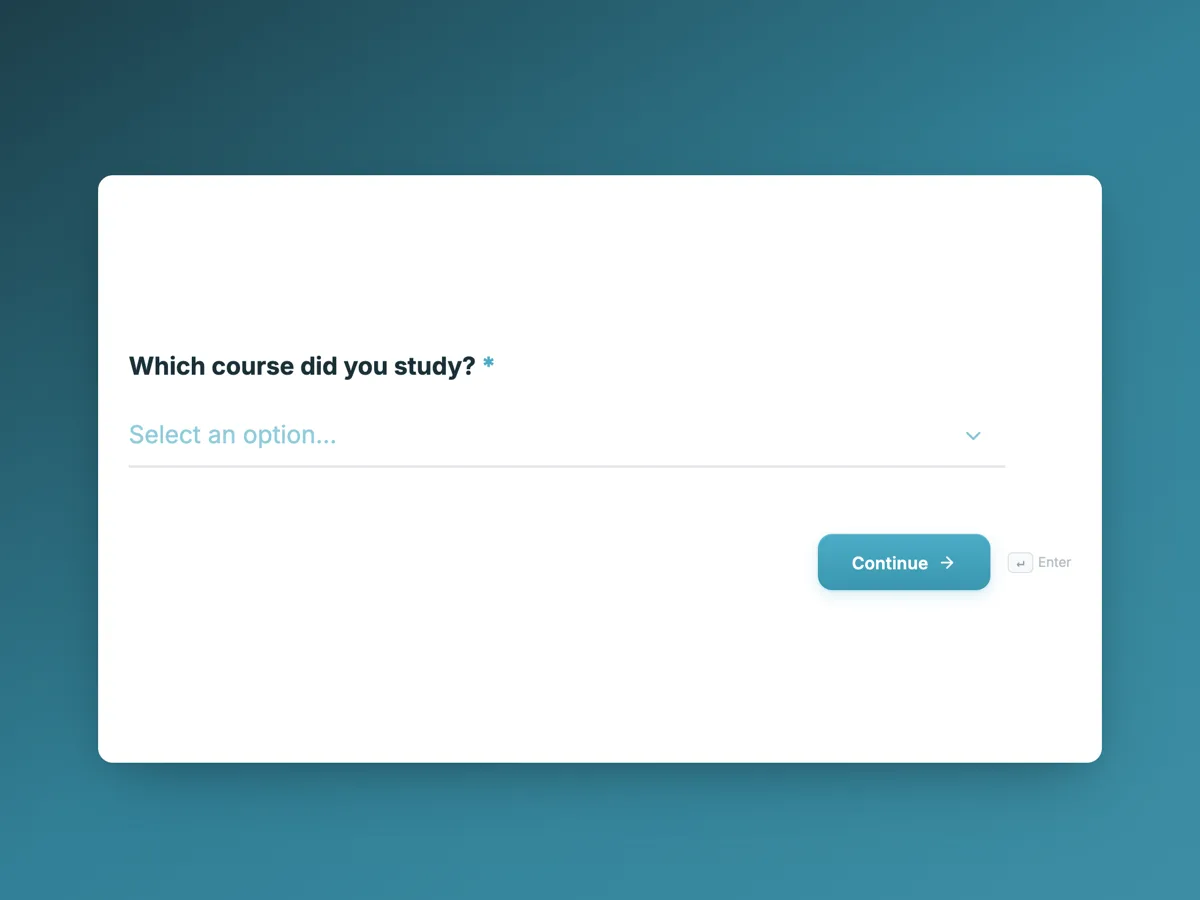
The form itself
The first screen of the form. A conversational form shows one question per screen, so the remaining screens are listed in the field table below. Nothing here can be filled in or submitted, so read it as a reference and build your own from the button above.
Every field, and what it collects
The complete field list, in the order respondents meet it.
- Which course did you study?DropdownRequired
- Options: CHC33021 Certificate III in Individual Support · CHC50121 Diploma of Early Childhood Education and Care · BSB40120 Certificate IV in Business · SIT30821 Certificate III in Commercial Cookery · CPC30220 Certificate III in Carpentry · HLTAID011 Provide First Aid
- How did you study?Single choiceRequired
- Options: On campus, in class · Online with live sessions · Online at my own pace · Mostly in the workplace, as a trainee or apprentice
- What was your main reason for doing this course?Single choiceRequired
- Options: To get a job · To get a better job or a promotion · My employer required it · To change career · For personal interest
- How would you rate your trainer on each of these?Rating gridRequired
- Statements:
- Explained things clearly
- Kept a pace that suited the group
- Gave useful feedback on my work
- Was available when I needed help
- Did the assessments fairly test what you had learned?Single choiceRequired
- Options: Yes, always · Mostly · Sometimes · No
- How suitable were the facilities and equipment, or the online platform?Single choiceRequired
- Options: Very suitable · Suitable · Not very suitable · Not suitable at all
- How useful were the learning materials?Single choiceRequired
- Options: Very useful · Useful · Out of date or hard to follow · Not useful
- Would you recommend Saltwattle to a friend doing the same course?Single choiceRequired
- Options: Yes · Maybe · No
- What has happened with work since you finished?Single choiceRequired
- Options: I got a job in this field · I was already in this field and stayed · I got a promotion or more hours · I am looking for work · I went on to further study · Too early to say
- Is there anything else you would like the training team to know?Long text
What each screen of this survey collects
Course is a dropdown of six nationally recognised qualifications and units, listed by code and title. Study mode separates classroom, live online, self paced and workplace based learning. Reason for enrolling is a radio of five. The trainer grid rates clarity, pace, feedback and availability from poor to excellent. Assessment fairness, facilities and materials are radios of four, with materials naming out of date as an answer. Recommendation is yes, maybe or no. Employment outcome has six answers, from got a job in this field to too early to say. The comment is optional. Nine of the ten screens are required.
Why the outcome question matters as much as the trainer
A learner can rate a trainer excellent and still finish a course that did not lead to work. Asking the reason for enrolling at the start and the outcome at the end lets a provider check each course against the goal people brought to it: if most learners in a qualification enrolled to get a job and most are still looking, the problem is the course or its placements, not the classroom. Study mode is asked early because self paced online learners rate availability and feedback very differently from classroom learners, and their results should not be blended into one trainer score.
The Australian rules behind it
Registered training organisations are regulated by ASQA, and the Standards for RTOs that took effect in 2025 expect providers to gather feedback from learners and use it to improve training and assessment. Course codes follow national training packages, so CHC33021 is the same qualification at every provider. Graduates may also receive NCVER's national Student Outcomes Survey, which is why the thank-you screen explains that it is separate.
How to adapt this survey
A university or college swaps the course codes for its own units and adds a question on the learning management system. A short course provider removes the employment outcome and asks whether the learner can now do the task. A provider with work placements adds a screen rating the host employer.
What makes this form work
Courses named by code
The dropdown lists six qualifications by national code and title, so results attach to the exact qualification and compare across intakes.
Reason in, outcome out
The reason for enrolling and the employment outcome bracket the survey, showing whether each course delivered what learners came for.
Study mode splits the scores
Classroom, live online, self paced and workplace learners are separated before the trainer grid, so their different experiences are not blended.
Questions people ask
When should a training provider send a student satisfaction survey?
At the end of each course, before the certificate is issued if possible, so most learners answer while the experience is fresh. The employment outcome question works best a few months later, so a short follow up with that question alone is worth sending to graduates. Mid course pulse checks catch trainer problems earlier.
Why list the course by its national code?
Because the code identifies the qualification exactly. Two courses with similar names, such as a Certificate III and a Certificate IV in the same field, differ in content and outcomes. Using the code also lets results be compared with national data for the same qualification and avoids learners guessing which version they studied.
Does every row of the trainer grid need an answer?
The grid is required, but the form counts it as answered once any one row is rated. Most learners rate all four, and a blank row usually means the learner never needed help or feedback in that way. Report each row from the people who rated it rather than averaging blanks in as zero.
Should the survey ask which trainer taught the course?
Only where a trainer teaches enough learners that the answers stay anonymous. In a group of eight, naming the trainer and the intake can identify a learner, which makes criticism less likely. Many providers report trainer scores by course and intake instead, and discuss them privately with each trainer.
How should a provider act on low assessment fairness scores?
Read them with the comments and the course code. Low scores often trace to one assessment task with unclear instructions or a practical assessment held before learners had enough practice, as the placeholder suggests. Reviewing that task with the trainers and assessors, then checking the next intake's scores, closes the loop.
Can learners complete this survey on a phone?
Yes. A conversational form shows one question per screen, which suits a phone, and the trainer grid fits a phone screen at four rows and four columns. Many vocational learners study around work and are more likely to answer on a phone in a break than at a computer.
Build your own in about a minute
The button below opens the generator with this use case already described. Change the wording to match your own, generate, then edit anything you like.
Make one like thisOther form examples
Employee wellbeing survey template with workload and support items
An employee wellbeing survey has to find the work conditions that wear people down, workload, isolation, aggression and poor support, without asking anyone about their health. This anonymous template for an Australian home care provider rates six psychosocial hazards by frequency and checks whether staff know where to get help.
Tenant satisfaction survey template on repairs, contact and renewal
A tenant satisfaction survey template asks renters how well their property manager responds, fixes things and handles inspections, and whether they plan to stay. This one covers all of that in eight screens for an Australian agency, with a five line repairs grid and a renewal question.
Patient satisfaction survey template for an Australian GP clinic
A patient satisfaction survey for a general practice has to find out how a visit felt from booking to consultation without collecting anything that identifies the patient. This anonymous template asks about waiting, reception, being listened to, clear explanations, privacy and access, then invites one suggestion.
Want the steps in the builder? Read Create a conversational form with AI, then View, export and manage your responses. For everything this generator can do, see the form maker.
Written and checked by the OneCraft team. Last checked .