Conversational form
Patient satisfaction survey template for an Australian GP clinic
A patient satisfaction survey for a general practice has to find out how a visit felt from booking to consultation without collecting anything that identifies the patient. This anonymous template asks about waiting, reception, being listened to, clear explanations, privacy and access, then invites one suggestion.
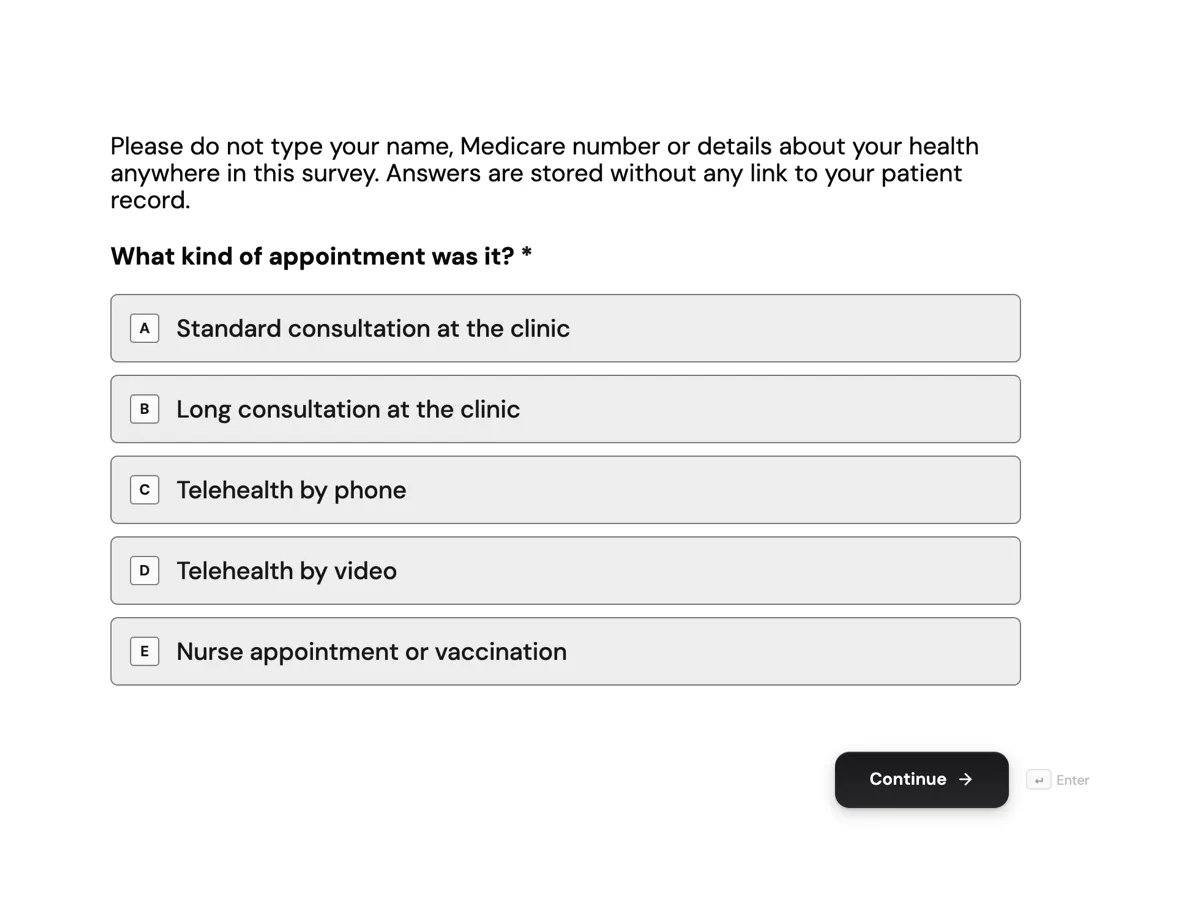
The form itself
The first screen of the form. A conversational form shows one question per screen, so the remaining screens are listed in the field table below. Nothing here can be filled in or submitted, so read it as a reference and build your own from the button above.
Every field, and what it collects
The complete field list, in the order respondents meet it.
- What kind of appointment was it?Single choiceRequired
- Options: Standard consultation at the clinic · Long consultation at the clinic · Telehealth by phone · Telehealth by video · Nurse appointment or vaccination
- How long did you wait past your appointment time?Single choiceRequired
- Options: I was seen on time · Up to 15 minutes · 15 to 30 minutes · More than 30 minutes
- How were you treated by reception?Single choiceRequired
- Options: Very well · Well · Neither well nor poorly · Poorly
- Did the doctor or nurse listen to what you had to say?Single choiceRequired
- Options: Yes, completely · Yes, mostly · Only partly · No
- Did they explain things in a way you could understand?Single choiceRequired
- Options: Yes, completely · Yes, mostly · Only partly · No · Nothing needed explaining
- Did you feel your privacy was respected at reception and in the consultation?Single choiceRequired
- Options: Yes, completely · Mostly · No, others could overhear · No, for another reason
- How easy was it to get an appointment when you needed one?Single choiceRequired
- Options: Very easy · Fairly easy · Fairly hard · Very hard
- What is one thing the practice could do better?Long text
What each screen of this survey collects
The first screen carries a privacy note above the appointment type, a radio of five covering clinic, long, phone and video telehealth and nurse visits. Waiting time runs from seen on time to more than 30 minutes. Reception is a radio of four. Listening and explanation each have four answers, and explanation adds nothing needed explaining. Privacy separates being overheard from other concerns. Access asks how easy it was to get an appointment when needed. The suggestion is an optional long text capped at 600 characters. Seven of the eight screens are required, and none asks for a name, date of birth or Medicare number.
Why the survey is anonymous
Patients rate a doctor they will see again more kindly when they can be identified, so an anonymous survey gives truer answers about listening and explanation. Leaving out identifiers also keeps the practice from collecting health information it does not need. The note on screen one asks patients not to type health details into the free text, and the thank-you screen sends anyone needing a personal reply to reception. Publish the form with public access rather than login required, so no account is linked to a response. The cost is that answers cannot be matched to a doctor or a day, so results are read as monthly totals.
The Australian rules behind it
Accredited practices are assessed against the RACGP Standards for general practices, which expect a practice to seek patient feedback and use it to improve. Telehealth appears as its own option because Medicare funds phone and video consultations and patients judge them differently. If a practice did collect identifying or health details, the Privacy Act 1988 and the Australian Privacy Principles would apply, including telling patients why it is collected and how it is stored.
How to adapt this survey
A dental or physiotherapy clinic replaces the appointment types with its own services and adds a question on cost being explained before treatment. A practice with several sites adds a location radio. A clinic wanting answers per doctor adds a doctor dropdown, accepting that small numbers make responses easier to identify.
What makes this form work
Nothing identifies the patient
No name, date of birth or Medicare number is asked, and a note on screen one asks patients not to type health details anywhere.
Telehealth is its own answer
The appointment type separates phone and video telehealth from clinic visits, so listening and explanation scores can be compared by format.
Privacy failures are specific
The privacy screen distinguishes being overheard from other concerns, which points straight at the reception layout when it scores low.
Questions people ask
Should a patient satisfaction survey name the doctor?
Only in a large practice. With few patients per doctor each week, a doctor dropdown plus a day can identify the patient, which defeats the anonymity promised on the welcome screen. Small practices get more honest answers by reporting the whole practice. Larger ones can add a doctor list and report only months with enough responses.
How often should a GP clinic run this survey?
Continuously, with a link on the appointment reminder text or a QR code at reception, and results read monthly. A single annual survey misses seasonal problems such as winter waiting times. Running it all year also lets the practice see whether a change, such as a new booking system, actually improved access.
Can patients be stopped from typing health details?
Not technically. A long text box accepts whatever is typed, so the survey relies on the note on the first screen and on the question itself, which asks for one thing the practice could do better rather than about the visit's reason. Staff reviewing comments should remove any health details that slip through.
Is a patient experience survey the same as a clinical audit?
No. A clinical audit measures care against clinical standards from records, such as whether checks happened on time. A patient experience survey measures how care felt to the patient: being listened to, waiting and privacy. Accreditation looks for both, and the two often explain each other when results are discussed together.
What should a practice do with poor privacy answers?
Look at where privacy fails. The answer no, others could overhear points at the reception layout, phone calls taken at the desk or a waiting room too close to the counter. Simple changes, such as a sign offering a private word away from the desk, can be checked in the following months' results.
How can the survey reach patients who do not use smartphones?
Offer a tablet at reception set to the form, and let reception staff hand it over without watching the answers. A printed version entered later works too. Older patients and those with low digital literacy are often the ones with the most to say about booking and waiting, so leaving them out skews results.
Build your own in about a minute
The button below opens the generator with this use case already described. Change the wording to match your own, generate, then edit anything you like.
Make one like thisOther form examples
Student satisfaction survey template for an Australian training provider
A student satisfaction survey for a training provider has to show whether trainers, assessments and materials worked, and whether the course led anywhere for the learner. This template, written for an Australian registered training organisation, rates the trainer in one grid, asks if assessments were fair and ends with the employment outcome.
Parent survey for a school: communication, safety and care
A parent survey for a school has to find out whether families hear what they need, in the way they read it, and whether they trust the school with their children. This anonymous template for an Australian primary school maps the channels parents actually use, then asks five agreement statements on communication, safety, teaching, homework and bullying.
Employee wellbeing survey template with workload and support items
An employee wellbeing survey has to find the work conditions that wear people down, workload, isolation, aggression and poor support, without asking anyone about their health. This anonymous template for an Australian home care provider rates six psychosocial hazards by frequency and checks whether staff know where to get help.
Want the steps in the builder? Read Create a conversational form with AI, then Control who can fill in your form. For everything this generator can do, see the form maker.
Written and checked by the OneCraft team. Last checked .