Conversational form
Parent survey for a school: communication, safety and care
A parent survey for a school has to find out whether families hear what they need, in the way they read it, and whether they trust the school with their children. This anonymous template for an Australian primary school maps the channels parents actually use, then asks five agreement statements on communication, safety, teaching, homework and bullying.
The form itself
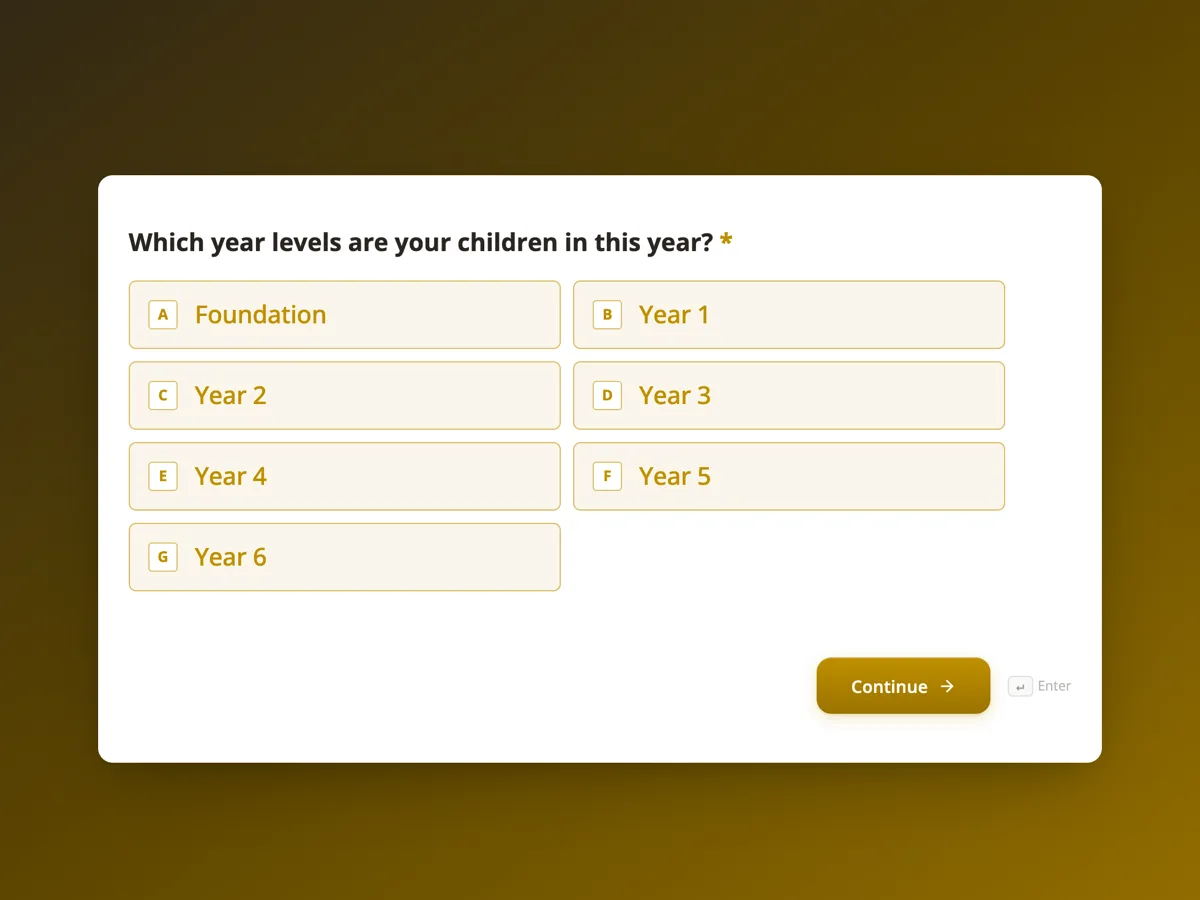
The first screen of the form. A conversational form shows one question per screen, so the remaining screens are listed in the field table below. Nothing here can be filled in or submitted, so read it as a reference and build your own from the button above.
Every field, and what it collects
The complete field list, in the order respondents meet it.
- Which year levels are your children in this year?Multiple choiceRequired
- Options: Foundation · Year 1 · Year 2 · Year 3 · Year 4 · Year 5 · Year 6
- Which ways of hearing from the school do you use?Multiple choiceRequired
- Options: The school app · The fortnightly newsletter · Emails from the class teacher · The school Facebook page · Talking to staff at drop off or pick up · Printed notes in the school bag
- Which one would you most like the school to use for important news?Single choiceRequired
- Options: The school app · Email · Text message · Printed notes
- How well informed do you feel about your child's progress?Single choiceRequired
- Options: Very well informed · Mostly informed · Not well informed · I only find out at report time
- How much do you agree with each statement?Rating gridRequired
- Statements:
- The school tells me what I need to know in good time
- My child feels safe at school
- Teachers expect my child to do their best
- The amount of homework is about right
- Bullying is dealt with when it is reported
- Is your child happy to come to school most days?Single choiceRequired
- Options: Yes, most days · Some days · Rarely
- How many school events have you attended this year?Single choiceRequired
- For example assemblies, the sports carnival, information evenings or working bees.
- Options: None · One or two · Three to five · More than five
- Do your children use before or after school care at the school?Single choiceRequired
- Options: Before school care · After school care · Both · Neither
- What does the school do well?Long text
- What is one thing the school could do better?Long text
What each screen of this survey collects
Year levels is a checkbox from Foundation to Year 6, so families with several children tick each. Channels used is a checkbox of six, from the school app to printed notes. Preferred channel for important news is a radio of four. Progress asks how informed parents feel, with an answer for only at report time. The grid takes five statements, on timely information, safety, expectations, homework and bullying, from strongly disagree to strongly agree. Happiness at school, events attended and before or after school care are radios. The last two screens ask what the school does well and one improvement, both optional. Eight of the ten screens are required.
Why channels used and channel preferred are separate questions
Most schools send the same news through four or five channels and still hear that parents did not know. Asking which channels families use shows reach; asking which one they want for important news shows where to put the things that matter, such as closures and excursion deadlines. When the two differ, for example a newsletter that most families receive but few would choose, the school can stop relying on it for anything urgent. The grid has no neutral column, so each statement gets a lean either way, and the bullying statement asks about response rather than whether bullying happens, which parents can actually judge.
The Australian context
Year level names differ by state: the first year of school is Prep in Victoria and Queensland, Kindergarten in New South Wales and Reception in South Australia, so the survey uses Foundation, the Australian Curriculum term. Government schools in several states run their own parent opinion surveys; a school survey like this one asks the local questions those do not. Collecting no names keeps it outside most of the Australian Privacy Principles, but the survey should still say how results are used.
How to adapt this survey
A secondary school replaces year levels with Years 7 to 12 and adds subject selection and careers advice to the grid. A kindergarten or early learning centre swaps homework for routines and transitions. A school wanting answers per class adds a class dropdown, as long as classes are large enough to stay anonymous.
What makes this form work
Reach and preference are both measured
Six channels used and one preferred channel for important news show where urgent messages should go and which channels to stop relying on.
No fence sitting in the grid
Five statements on four points with no neutral column make each family lean on communication, safety, teaching, homework and bullying response.
Families with several children fit
The year level checkbox from Foundation to Year 6 lets one response cover every child without asking any names.
Questions people ask
How can a school stop families from answering twice?
An anonymous survey cannot fully prevent it, which is why the welcome screen asks for one response per family. Sending the link once through the school app and closing the survey after two weeks keeps duplicates rare. Requiring a login would stop repeats but would also link answers to a family and reduce honesty.
Should parents be asked to rate individual teachers?
Not in a survey like this. In a primary school a parent can usually be identified from the class, and teacher ratings from a handful of families are not reliable. The grid asks whether teachers expect children to do their best, a school wide statement. Concerns about a particular teacher are better raised directly with the principal.
What response rate should a school aim for?
Aim for at least a third of families, enough that results reflect more than the most engaged parents. Shorter surveys, a reminder through the app, and a tablet at the school gate during pick up all help. Families who rarely attend events are the hardest to reach and often have the most useful answers about communication.
How are multiple children handled in one response?
The year levels question is a checkbox, so a family ticks every year level. The rest of the survey asks about the family's overall experience, which is what one response per family measures. If experiences differ sharply between children, the open questions at the end give space to say so, and many parents do.
What should the school do with the results?
Report them back. Share the main findings and two or three actions in the newsletter, as the thank-you screen promises, and take them to School Council. Parents who see their answers lead to a change, such as dates appearing in the app calendar, are more likely to answer the next survey.
Can the survey be offered in community languages?
Yes. Make a copy of the form for each language, translate the questions and options, and share each link with the families who need it. Keep the questions identical in meaning so the results can be combined. A note in the newsletter in each language helps families find the right version.
Build your own in about a minute
The button below opens the generator with this use case already described. Change the wording to match your own, generate, then edit anything you like.
Make one like thisOther form examples
Student satisfaction survey template for an Australian training provider
A student satisfaction survey for a training provider has to show whether trainers, assessments and materials worked, and whether the course led anywhere for the learner. This template, written for an Australian registered training organisation, rates the trainer in one grid, asks if assessments were fair and ends with the employment outcome.
Tenant satisfaction survey template on repairs, contact and renewal
A tenant satisfaction survey template asks renters how well their property manager responds, fixes things and handles inspections, and whether they plan to stay. This one covers all of that in eight screens for an Australian agency, with a five line repairs grid and a renewal question.
Webinar feedback survey template: content, audio and next topic
A webinar feedback survey has to separate what was said from how it came across on screen, and use the moment to decide the next session. This template asks whether people watched live or on replay and at what level, rates content, sound and length separately, and ends with a vote on next month's topic.
Want the steps in the builder? Read Create a conversational form with AI, then Control who can fill in your form. For everything this generator can do, see the form maker.
Written and checked by the OneCraft team. Last checked .