Conversational form
Barber booking form with the cut and the beard timed separately
A barbershop books in fifteen minute blocks, so a booking form that cannot tell a buzz cut from a skin fade with a hot towel shave is just a message with extra steps. This one asks the cut and the beard as two separate questions, each carrying the minutes the chair is held for, and it finishes on a mobile number because confirmation happens by text.
The form itself
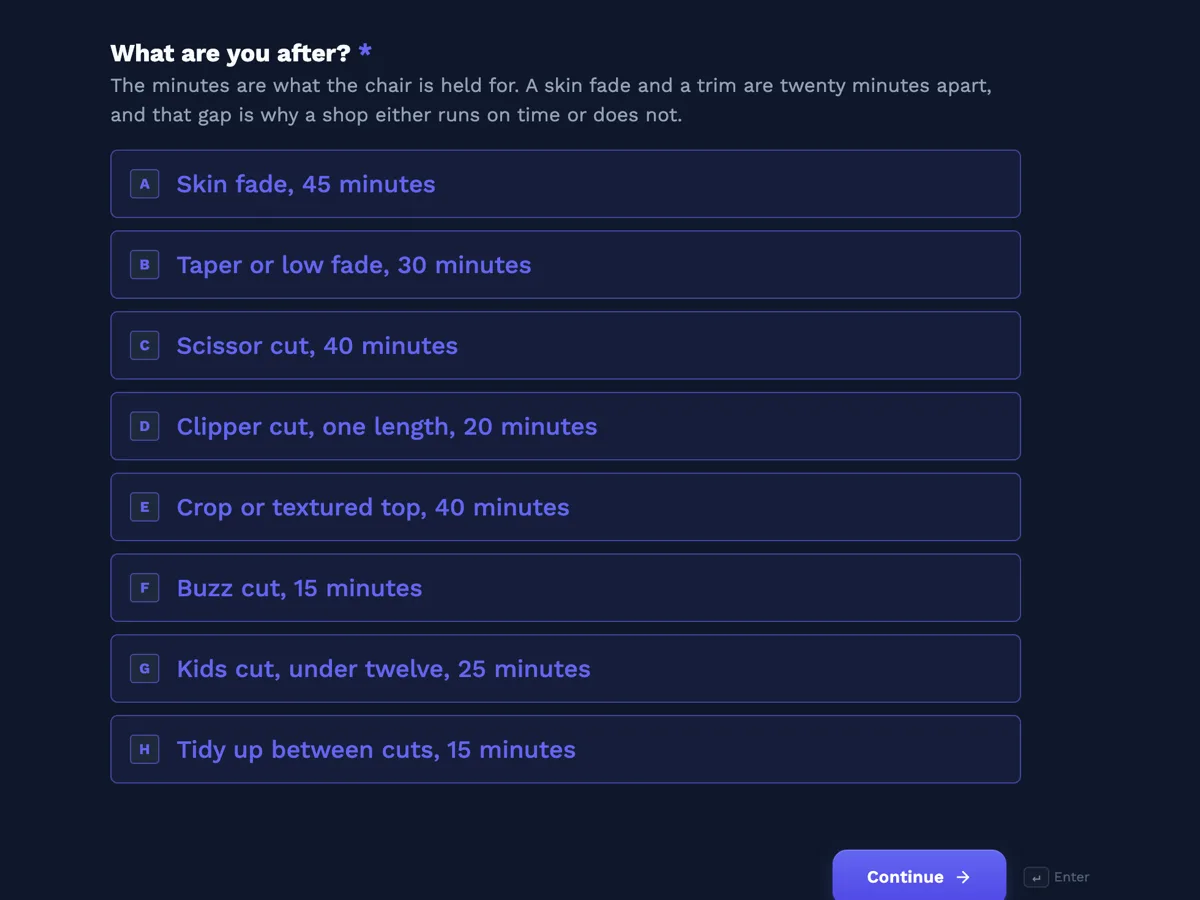
The first screen of the form. A conversational form shows one question per screen, so the remaining screens are listed in the field table below. Nothing here can be filled in or submitted, so read it as a reference and build your own from the button above.
Every field, and what it collects
The complete field list, in the order respondents meet it.
- What are you after?Single choiceRequired
- The minutes are what the chair is held for. A skin fade and a trim are twenty minutes apart, and that gap is why a shop either runs on time or does not.
- Options: Skin fade, 45 minutes · Taper or low fade, 30 minutes · Scissor cut, 40 minutes · Clipper cut, one length, 20 minutes · Crop or textured top, 40 minutes · Buzz cut, 15 minutes · Kids cut, under twelve, 25 minutes · Tidy up between cuts, 15 minutes
- Anything for the beard?Single choiceRequired
- Options: Nothing, just the hair · Beard trim and shape, 15 minutes · Beard trim with a razor line up, 20 minutes · Hot towel shave, 30 minutes · Head shave with a razor, 30 minutes · First proper beard shape, talk me through it, 30 minutes
- What day?DateRequired
- Saturdays fill about ten days out. A Tuesday or Wednesday is almost always available at short notice.
- What time would you like?TimeRequired
- Give the time you actually want. If the chair is taken you will be sent the two nearest slots rather than being told no.
- Which barber?Single choiceRequired
- Options: Rafa, fades and clipper work · Deen, scissor work and beards · Kit, everything, quietest chair · Whoever is free
- First time here?Single choiceRequired
- First visits get five extra minutes so the barber can talk through what you want before the clippers start. It is not charged for.
- Options: Yes, first time · Been before, different barber · Regular, same barber each time
- Where do we send the confirmation?ProfileRequired
What each screen of this booking asks, in order
Screen one takes the cut as one of eight named services, each carrying the minutes the chair is held for. Screen two takes the beard work as a separate question, starting with nothing, just the hair, and running through a trim and shape, a razor line up, a hot towel shave, a head shave and a first beard shape with a conversation. Screen three takes the day and notes that Saturdays fill about ten days out. Screen four takes the time as an actual time, with help text promising the two nearest slots if the chair is taken. Screen five takes the barber, naming three with what each is known for plus whoever is free. Screen six asks whether this is a first visit, a return with a different barber or a regular with the same one. The last screen is a profile block taking a name for the book and a mobile, with email switched off entirely.
Why the beard is its own question
A combined dropdown would need every cut multiplied by every beard service, which is forty eight options nobody will read. Two questions give the same coverage in two taps, and the barber adds the two to get a chair time the shop can trust: a thirty minute taper plus a thirty minute hot towel shave is an hour, worked out before anybody replies. Separating them also changes what gets sold. A client who would never scroll to find scissor cut with beard trim and razor line up will happily tap beard trim on the screen after the cut, because at that point they have already decided to come in.
How to adapt this form
A shop that takes mostly walk ins can cut this to four screens, the cut, the beard, a rough arrival window and a mobile, and use it as a queue ticket rather than a booking. A shop with a barber who only does kids adds an age question after the cut screen and a note about the booster seat, which parents ask about and rarely get told. A shop that wants to reduce no shows keeps all seven screens and adds a deposit conversation to the thank you screen rather than to the form, since a form collects answers and does not take payments, so the deposit link has to come from the confirmation message.
What makes this form work
Two questions cover forty eight combinations
Eight cuts on one screen, six beard services on the next, each with its own chair time. The barber adds the two into a total length the shop can trust, and the client answers in two taps instead of scrolling a combined list nobody reads.
The time screen promises alternatives, not a rejection
Help text under the time question says the two nearest slots come back if the chair is taken. That single sentence is why people pick the time they actually want rather than a safe one, which is what makes the request useful to the diary.
The last screen asks for two things
A name for the book and a mobile, with email switched off in the profile block. Nothing dangles, nothing is collected that the shop will never use, and a two minute form ends in two taps rather than in a contact form.
Questions people ask
Why is the mobile number required but not an email?
Because the shop confirms by text and nothing else. The profile block on the last screen has email switched off, so there is no dead field and no unanswered question about which one gets used. It also keeps the last screen to two inputs, which is what a two minute form should end on.
Does the form hold the time slot?
No. It sends a request, and the thank you screen says a text comes either way: confirmed if the chair is free, or the two nearest slots if it is not. A form does not read a diary. What it does is arrive with enough structure that the person holding the diary can answer in one message.
Why ask whether it is a first visit?
Because first visits get five extra minutes for the conversation before the clippers start, and the help text says so and says it is not charged for. It also tells the shop which requests are new customers, which is the number most barbershops want and almost none measure.
Should the time question be a free time field?
For a shop running fifteen minute blocks, yes. A window would lose the precision the diary is built on, and a barbershop is small enough to answer every request by hand. The help text removes the anxiety by promising alternatives rather than a rejection, which is what stops people picking a safe time they do not want.
What stops somebody booking a forty five minute fade in a fifteen minute gap?
The shop does, when it confirms. The minutes in each option are there so that both sides are looking at the same number, not so the form can enforce it. Requests that do not fit come back with the two nearest slots, which is the same answer a phone call would have produced.
Can the same form work for a mobile barber?
Nearly. Add a screen for the address and one for parking or access, and replace the named barbers with a travel radius question. Everything else holds, because the cut and beard timing question is the same problem whether the chair is in a shop or in somebody kitchen.
Build your own in about a minute
The button below opens the generator with this use case already described. Change the wording to match your own, generate, then edit anything you like.
Make one like thisOther form examples
Tour booking form that asks about fitness before the date
A day tour is ruined for everybody when one person is on a walk that is two grades harder than they expected, and no booking system catches that. This tour booking form names the distance, the climb and the grading in every option, then asks the group to describe the least fit person coming, in words that make the honest answer easy to give.
Vet appointment booking form with the reason and the urgency
A vet appointment booking form has to tell reception what the visit is for and how soon the animal must be seen, because those two set the consult length and the place in the queue. This one asks both on their own screens, sends real emergencies to the phone before the first question, and flags new clients.
Nail appointment booking form that asks about removal first
A nail appointment overruns for one reason more than any other, which is that the previous set had to come off and nobody booked time for it. This booking form asks about removal on the second screen, before the date is chosen, and takes the saved design as an upload so the technician can say whether it fits the slot.
Want the steps in the builder? Read Create a conversational form with AI, then Design your welcome and thank-you screens. For everything this generator can do, see the form maker.
Sources
Written and checked by the OneCraft team. Last checked .