Conversational form
Class booking form
A single class is a small booking with a surprising number of ways to go wrong: the wrong session, a second person who was never counted, and a student who cannot grip clay for three hours. This booking form asks the four things that decide whether the class runs well and states the two rules that cause every argument. It is conversational, because it is answered on a phone from a studio Instagram post.
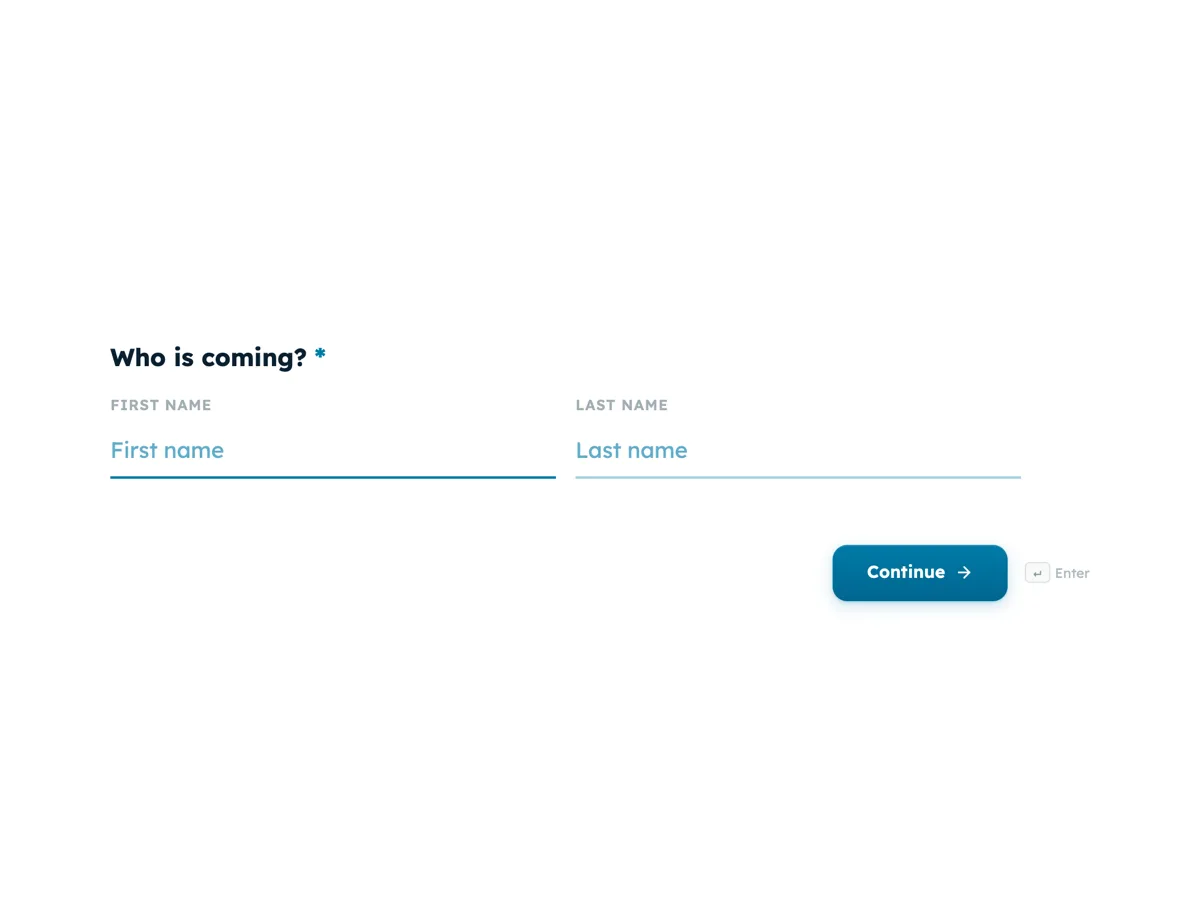
The form itself
The first screen of the form. A conversational form shows one question per screen, so the remaining screens are listed in the field table below. Nothing here can be filled in or submitted, so read it as a reference and build your own from the button above.
Every field, and what it collects
The complete field list, in the order respondents meet it.
- Who is coming?NameRequired
- Which class?DropdownRequired
- All four run for three hours and all four include clay, glazes and the two firings.
- Options: Wheel throwing for absolute beginners, Tuesday 6.30pm · Wheel throwing, second session, Thursday 6.30pm · Handbuilding and slab work, Saturday 10am · Open studio for people who have done a term, Sunday 2pm
- Which date suits you?DateRequired
- Pick the date of the session you want. If that week is full you will hear back within a day with the next two that are not.
- How many places?NumberRequired
- Two at most per booking, because there are six wheels and a waiting list. Book twice if you are four.
- How much have you thrown before?Single choiceRequired
- Nobody is turned away for the answer. It decides how many people the tutor stands behind for the first hour.
- Options: Never touched a wheel · Had a go once or twice · Done a term somewhere · I throw regularly and want the wheel time
- Email for the confirmationShort textRequired
- The door code is in that email and the studio buzzer is not staffed, so use an address you can open on the night.
- Mobile numberShort textRequired
- Used once, if a tutor is sick and the session moves. A class of six cannot absorb a no show.
- Anything about your hands, wrists or back we should plan around?Long text
- Throwing is three hours of pressure through the heel of the hand. Tell us now and the tutor sets your wheel height and gives you softer clay, which is a two minute job before you arrive and impossible once the class starts.
- The two studio rules that catch people outMultiple choiceRequired
- Options: I can move or cancel free up to 48 hours before, and after that the place is charged · Firing takes about three weeks, and work not collected within eight weeks of the class is recycled
- How did you find the studio?Dropdown
- Options: Walked past it · Instagram · A friend who has done a class · The market stall · A gift voucher · Searched for a pottery class
What makes this form work
The cancellation rule is agreed to, not published
Forty eight hours and an eight week collection limit sit in a required tick box on the way in, in the student's own words rather than in a terms page nobody opened. A studio that has to charge a late cancellation can point at the moment it was accepted.
The hands question earns its answer with a reason
Three hours of pressure through the heel of the hand is a specific claim about the activity, and it is followed by what the studio will do about it. A form that says what changes as a result of an answer gets a different quality of answer.
Two places is a rule with an alternative attached
The question says two places at most, and the next sentence says to book twice if you are four. A conversational number field shows no limit while typing, so the wording carries the rule. Capping without an alternative sends a group of four to a different studio; capping with one keeps them and keeps the wheel count honest.
Questions people ask
What does a class booking form need that a generic contact form does not?
The session, the date and the number of places, in that order, plus a statement of the cancellation rule the student is agreeing to. Those four turn an enquiry into a booking. Without the place count a tutor plans for one person and two arrive, which in a six wheel studio means somebody watching.
Can this form check whether a class is actually full?
No. A form records a request; it has no live seat count and no per option limit, so a date that is already full can still be chosen. The honest way to handle it is what this form says on the date screen: if that week is full you hear back within a day with the next two that are not.
Why ask about experience if beginners are welcome?
Because it changes where the tutor stands. Four absolute beginners and two returning students is a different first hour from six people who have all thrown before. Saying plainly that nobody is turned away for the answer is what stops people over claiming to look competent.
Is a free text health question enough?
For a craft studio, yes, and asking about the specific thing the activity demands is what earns an answer. For anything that raises a heart rate it is not: a gym or a yoga studio is expected to run closed screening questions in the pattern of the PAR-Q plus questionnaire, because a tick box answer can be audited and a paragraph cannot. Build that as a rating grid of statements against yes and no rather than a text box.
How many places should one booking allow?
As many as the class can take, asked as a number rather than assumed to be one. This form asks how many places straight after the date, because friends book pottery together and a form that only takes one person forces a second booking. The number also tells the studio what the class is really worth.
Where do the studio rules belong on a booking form?
On the form, near the end, phrased as the two things that catch people out. This one names them rather than linking to a terms page nobody opens. A rule read at booking is a rule you can point back to, and putting it last means it does not scare somebody off before they have chosen a date.
Build your own in about a minute
The button below opens the generator with this use case already described. Change the wording to match your own, generate, then edit anything you like.
Make one like thisOther form examples
Catering order form with per head packages and dietary counts
A catering order is a headcount, a time and an address, and every other detail exists to protect one of those three. This form takes the order the way a kitchen reads it, packages by the head, dietary needs as numbers rather than sentences, and a delivery window the driver can meet.
Exhibitor stand booking form
A stand booking is a contract, an order for services and a safety record all at once, which is why it ends in a signature and a position in the business. This one takes the floor plan detail, the add ons that get forgotten until build day, and the insurance evidence as structured fields rather than a promise. It is a classic form, because it is a contract, and a contract revealed one question at a time is not one anybody would sign.
Photography booking form that gets a quote back
A photographer’s inbox is full of enquiries that have to be answered with a question. This form asks the ten things a quote depends on, one screen at a time, and finishes with the contact block so nobody hands over an email before they know what they are asking for.
Want the steps in the builder? Read Create a conversational form with AI, then Automate your form with add-ons. For everything this generator can do, see the form maker.
Written and checked by the OneCraft team. Last checked .