Classic form
Informed consent counselling form, confidentiality first
Informed consent for counselling means the client knows, before the first session, what stays private, when it cannot, what it costs and how notes and contact are handled. This form puts the four limits of confidentiality first, each ticked separately, then fees, notes and contact, and ends with a signature and date.
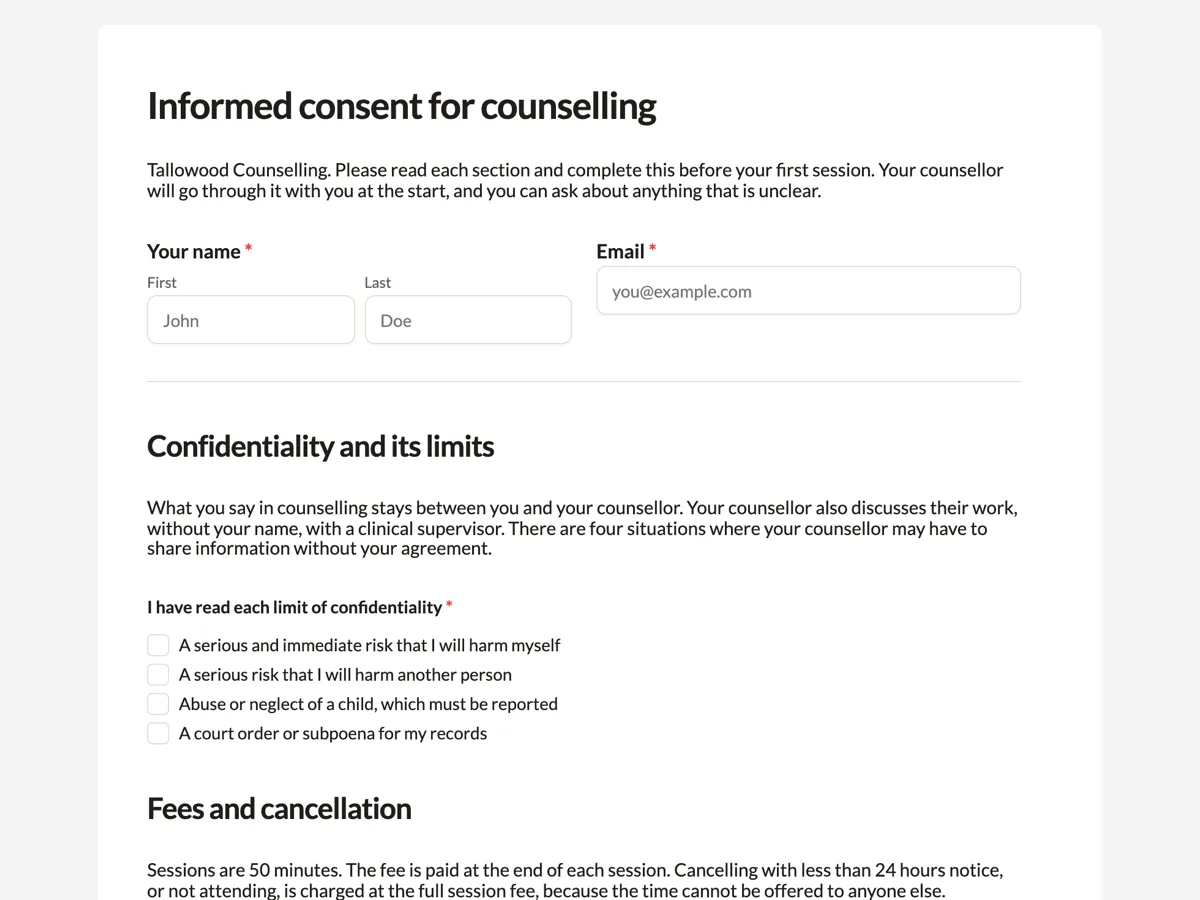
The form itself
A static copy of the finished form, exactly as it renders. Nothing here can be filled in or submitted, so read it as a reference and build your own from the button above.
Every field, and what it collects
The complete field list, in the order respondents meet it.
- Your nameNameRequired
- EmailShort textRequired
- I have read each limit of confidentialityMultiple choiceRequired
- Options: A serious and immediate risk that I will harm myself · A serious risk that I will harm another person · Abuse or neglect of a child, which must be reported · A court order or subpoena for my records
- Fees and cancellationMultiple choiceRequired
- Options: I understand the session fee and the 24 hour cancellation charge
- Session notes are brief, kept securely for seven years, and you can ask to see them. Which is right for you?Single choiceRequired
- Options: I understand how notes are kept · I would like to talk about notes at the first session
- Contact between sessions, for booking changes onlySingle choiceRequired
- Options: Text message · Email · Phone call · No contact, I will get in touch
- Anything you would like to ask before you signLong text
- Client signatureSignatureRequired
- Date signedDateRequired
Confidentiality and its limits
Fees and cancellation
Notes and contact
What each field on this form collects
Name and email open the form. A paragraph explains confidentiality and clinical supervision, then a required checkbox lists the four limits: risk to self, risk to others, child abuse or neglect, and a court order. A fees paragraph sets out the 50 minute session and the 24 hour cancellation rule, confirmed with a single tick. The notes radio explains how notes are kept and offers a second answer for a client who wants to discuss them. Contact between sessions is a two column radio of four, for booking changes only. An optional long text collects questions, and the client signs beside the date. Eight of the nine fields are required.
Why every limit is a separate tick
A single box beside a paragraph of exceptions proves the client scrolled past it. Four boxes, each naming one limit in plain words, prove they read each one. The checkbox is required, but because it counts as answered once any box is ticked, the counsellor still checks at the first session that all four are ticked and goes through any that are not. The question box below gives clients a place to write what worries them. Many people start counselling unsure whether their counsellor would have to report something, and this form lets them ask before they say it.
What professional codes expect
Counselling bodies such as the British Association for Counselling and Psychotherapy expect practitioners to explain confidentiality, its limits, fees and record keeping at the start, and to treat consent as ongoing. The American Psychological Association ethics code sets the same expectation for psychologists, including telling clients about the limits of confidentiality as early as possible. The details differ by country, so a counsellor checks the reporting duties where they practise before using this wording.
How to adapt this form
A couples counsellor adds a paragraph on secrets shared by one partner alone and a second signature. A school counsellor rewrites the limits for young people and adds when parents are told. An online only practice adds the location and emergency contact questions from a telehealth consent.
What makes this form work
Four limits, four boxes
Risk to self, risk to others, child abuse or neglect, and a court order each get a line. The client reads and ticks each one, not one dense paragraph.
A place to ask before signing
The optional question box sits right above the signature. Clients write what they are unsure about, and the counsellor answers it at the start of the first session.
Contact limited to bookings
The contact radio says booking changes only, with four ways to choose from. Clients know texts are not for therapy between sessions, which protects both sides.
Questions people ask
Should informed consent be signed before or at the first session?
Both work, and this form does both. The client fills it in beforehand so they have time to read, and the thank-you screen says the counsellor will go through it at the first session. Consent in counselling is ongoing, so the counsellor checks again whenever something changes, such as a new fee.
Why mention clinical supervision in the confidentiality section?
Because a client who later learns their sessions were discussed with someone else may feel betrayed, even when no name was used. Supervision is a normal part of safe practice, and naming it before the first session keeps it from becoming a surprise. The paragraph says supervision happens without the client name.
What if the client does not tick all four limits?
The form will still submit once one limit is ticked, so the counsellor checks the response before the first session. An unticked limit usually means the client wants to talk about it, often the risk to self item. The counsellor raises it gently at the start rather than treating it as a refusal.
Is a cancellation charge fair to include in consent?
It is fair when the client knows it in advance, which is the point of putting it here. The paragraph explains why the time cannot be offered to someone else. Some counsellors waive the charge for illness or emergencies, and a practice that does can add that sentence to the paragraph.
How long are counselling notes kept?
This form says seven years, which is common, but the right period depends on the country, the client age and the professional body. Records for children are often kept longer. The practice should check the rule that applies where it works and change the radio label to match.
Can a client stop counselling after signing?
Yes. The paragraph above the signature says the client can end counselling at any time without giving a reason. Signing agrees to the terms of counselling, not to a number of sessions. A submitted form cannot be edited, so a change of mind is recorded in the client notes.
Build your own in about a minute
The button below opens the generator with this use case already described. Change the wording to match your own, generate, then edit anything you like.
Make one like thisOther form examples
Massage consent form with draping, areas and the right to stop
A massage consent form records which treatment a client agrees to, which parts of the body may be massaged and that they can stop at any time. This one also explains draping in plain words, asks about pregnancy and health conditions, and takes the client's signature before the first appointment.
Dental treatment consent form with item numbers and fees
A dental treatment consent form has to record the procedure, what it will cost, the other options the patient heard, the risks they read and how they will be sedated. This one asks for each in turn, with a four row table for the item numbers and fees from the treatment plan and a signature at the end.
PAR Q form online: seven questions, clearance and a signature
A PAR Q form is a short physical activity readiness questionnaire that asks seven yes or no questions to find people who should check with a doctor before exercising more. This one puts the seven questions online for a Pilates studio, then asks about clearance for any yes and takes a dated signature.
Want the steps in the builder? Read Form builder components, then Design your welcome and thank-you screens. For everything this generator can do, see the form maker.
Sources
Written and checked by the OneCraft team. Last checked .