Conversational form
Customer feedback survey
A conversational feedback survey of six questions, shown one at a time with a 1 / 6 counter at the top of each screen. It opens with a five point satisfaction question about today's visit, moves to the Net Promoter question on a 0 to 10 scale, asks for the reason behind the score, then closes with what went well, one thing to improve and an optional email for a reply.
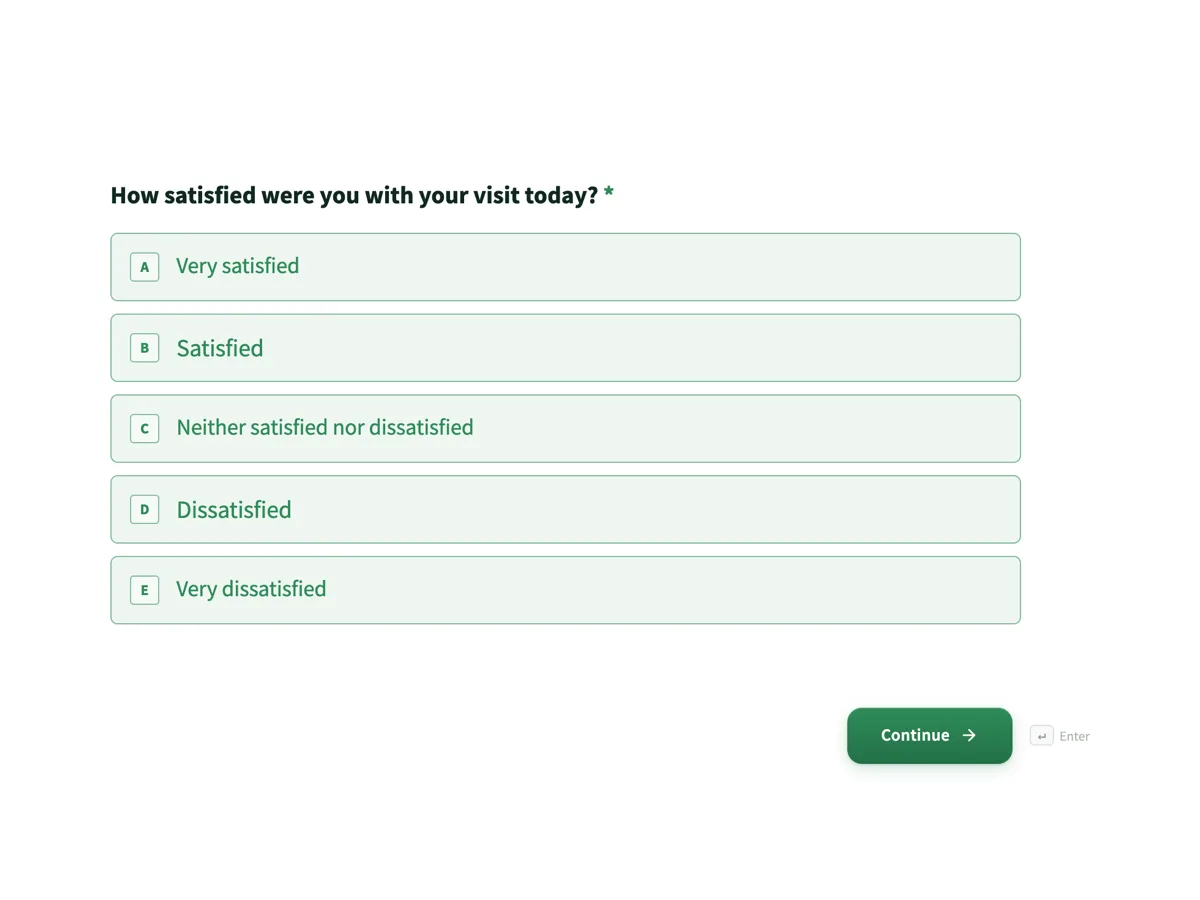
The form itself
The first screen of the form. A conversational form shows one question per screen, so the remaining screens are listed in the field table below. Nothing here can be filled in or submitted, so read it as a reference and build your own from the button above.
Every field, and what it collects
The complete field list, in the order respondents meet it.
- How satisfied were you with your visit today?Single choiceRequired
- Options: Very satisfied · Satisfied · Neither satisfied nor dissatisfied · Dissatisfied · Very dissatisfied
- How likely are you to recommend us to a friend or colleague?Single choiceRequired
- 0 means not at all likely, 10 means extremely likely.
- Options: 0 · 1 · 2 · 3 · 4 · 5 · 6 · 7 · 8 · 9 · 10
- What is the main reason for your score?Long textRequired
- What went well?Multiple choice
- Options: The staff · The speed · The quality · The value · The atmosphere · Nothing in particular
- What is the one thing we could do better?Long text
- If you would like a reply, what is your email?Short text
- Leave it blank to stay anonymous.
Question banks built on this form
What makes this form work
The NPS question keeps its exact wording
Question two reads "How likely are you to recommend us to a friend or colleague?" with eleven options from 0 to 10 and a note that 0 means not at all likely and 10 means extremely likely. That is the wording Bain published with the metric. Change the words or the scale and your score is no longer comparable with anyone else's.
A score is always followed by a why
The third question, "What is the main reason for your score?", is a required long text box straight after the 0 to 10 rating. The number tells you the direction, the sentence tells you what to fix. The optional "What went well?" checklist and the "one thing we could do better" box add the same pairing on the positive side.
Six questions, and it says so
The welcome screen promises six quick questions in about ninety seconds, and the counter on each screen shows the promise being kept. Only three of the six are required, so somebody in a hurry can answer the satisfaction rating, the recommendation score and the reason, and still submit a complete, usable response.
Questions people ask
What is the difference between NPS and CSAT?
CSAT asks how satisfied someone was with a specific experience, usually on a five point scale. NPS asks how likely they are to recommend you on a 0 to 10 scale, and measures the relationship rather than the moment. This survey uses both.
How many questions should a feedback survey have?
Three to five for a transactional survey sent after a visit, five to eight for a relationship survey sent once or twice a year. Completion drops as length grows, and a finished short survey beats an abandoned long one. This one has six because it measures both the visit and the relationship, and only three of the six are required, so a hurried customer is done in under a minute.
Should feedback be anonymous?
Let people choose. The last question here asks for an email only if they want a reply, and it is optional, so the survey stays anonymous unless the respondent decides otherwise. That gets you follow ups with the people who want one without suppressing the honest answers from everyone else, which are usually the critical ones a named survey never hears.
Why is the satisfaction question first?
It is the easiest one to answer, five labelled options from very satisfied to very dissatisfied about a visit that just happened. Starting with a one tap question gets people moving, and it keeps the CSAT reading about the visit separate from the NPS reading about the relationship, which is the reason the form asks both.
Should a feedback survey ask for an email address?
Ask, but make it optional and say why. The last question on this survey offers a reply, so the email is a request for contact rather than a tracking field. Making it required turns an anonymous survey into an identified one and drops your response rate, usually from the people whose feedback you most needed.
Why ask for the reason behind the score?
Because a number tells you the temperature and nothing about the cause. This survey asks for the main reason immediately after the recommendation score, while the reason is still the thing on the respondent mind. Answers collected at that moment are specific, and they are what turns a monthly average into something a team can act on.
Build your own in about a minute
The button below opens the generator with this use case already described. Change the wording to match your own, generate, then edit anything you like.
Make one like thisOther form examples
Course evaluation form that separates teaching from materials
When one grid mixes the trainer, the slides and the assessment, a bad textbook sinks a good teacher. This evaluation splits the three, asks the workload question numerically, and keeps free text to the two questions a coordinator can act on before the next intake.
NPS survey with the score explained
Net Promoter Score is one question, and most surveys ruin it by adding nine more. This one is the question, one follow up, and a permission to reply, and the page shows how the number is worked out from the responses table.
Event feedback form that asks what to change
Feedback collected a week later is memory; collected the next morning it is evidence. This survey is eight screens, two of them free text, built so the organiser gets a ranked list of sessions and two sentences per person about what to keep and what to drop.
Want the steps in the builder? Read Create a form from scratch with AI, then View, export and manage your responses. For everything this generator can do, see the form maker.
Written and checked by the OneCraft team. Last checked .