Conversational form
NPS survey with the score explained
Net Promoter Score is one question, and most surveys ruin it by adding nine more. This one is the question, one follow up, and a permission to reply, and the page shows how the number is worked out from the responses table.
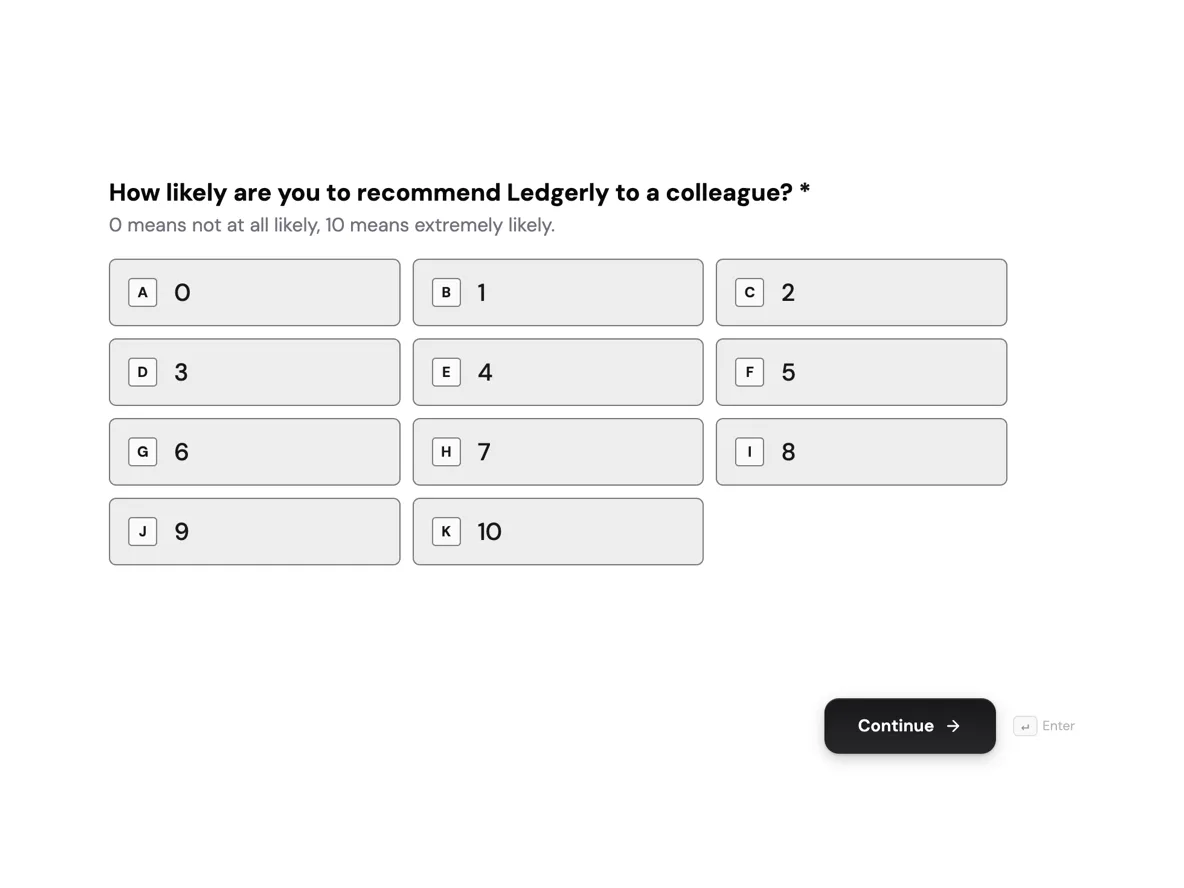
The form itself
The first screen of the form. A conversational form shows one question per screen, so the remaining screens are listed in the field table below. Nothing here can be filled in or submitted, so read it as a reference and build your own from the button above.
Every field, and what it collects
The complete field list, in the order respondents meet it.
- How likely are you to recommend Ledgerly to a colleague?Single choiceRequired
- 0 means not at all likely, 10 means extremely likely.
- Options: 0 · 1 · 2 · 3 · 4 · 5 · 6 · 7 · 8 · 9 · 10
- What is the main reason for your score?Long text
- Can a person from the product team reply to you?Single choiceRequired
- Options: Yes · No
- Your email, if yesEmail
- Only used to reply about your answer, then left alone.
Question banks built on this form
What NPS is, and how the score is calculated
The question comes from Frederick Reichheld’s 2003 Harvard Business Review article and its wording is fixed: how likely are you to recommend us, on a scale of 0 to 10. Scores of 9 and 10 are promoters, 7 and 8 are passives, 0 through 6 are detractors, and the score is the percentage of promoters minus the percentage of detractors. From 120 responses with 54 promoters and 30 detractors, that is 45 percent minus 25 percent, an NPS of 20. The number runs from minus 100 to plus 100, and the trend across quarters tells you more than any single reading.
How to adapt this form
A transactional version goes out after a support case closes, with the wording shifted to based on this experience, and the results read weekly. A relationship version, which is what this form is, goes to the whole base each quarter and feeds the trend line. An in-app placement works too: link the same form from the product footer and accept that a steady trickle replaces the quarterly spike. Whatever the cadence, resist adding questions. The follow up already captures the reason in the customer’s own words, and every extra screen costs detractor answers first.
What makes this form work
Eleven options in three columns, no slider
The 0 to 10 question renders as eleven radio options laid out in three columns, which is the only honest way to put the full scale on a screen. A slider hides the endpoints and nudges toward the middle; eleven explicit buttons make 0 and 10 exactly as easy to choose as 5.
One follow up, in the customer’s own words
The second screen is a single open question, not a category list. The reason for the score arrives as a sentence the customer chose to write, which is what a product team can actually act on, and it is optional, so the score itself is never held hostage to an essay.
Consent to reply is its own question
Screen three asks outright whether a person may respond, and the email on screen four is only used when the answer is yes. A detractor who wants to vent without a follow-up call gets exactly that, which is precisely why they answer honestly.
Questions people ask
What is a good NPS?
It depends on the industry. Published benchmark tables put averages anywhere from the twenties to the high sixties across sectors, so a software company at 35 might be ahead of its market while a consultancy at 50 is behind. The safer reading is your own trend: the same survey, the same audience, quarter after quarter.
Why not use a 1 to 5 scale instead?
Because the 0 to 10 scale is the definition. Promoters, passives and detractors are cut at fixed points on an eleven point scale, and changing the scale breaks the arithmetic and the comparability at the same time. If you prefer five point scales, run a CSAT question, and call the result CSAT rather than NPS.
How do you calculate the score from the CSV?
Export the responses, then count the 9s and 10s, count the 0 through 6s, divide each by the total and subtract. With 120 rows, 54 promoters and 30 detractors give 45 percent minus 25 percent, an NPS of 20. One column holds the score, so the whole job is three spreadsheet formulas.
Should the follow up question change with the score?
The form cannot branch, so the follow up is worded to work for everyone: what is the main reason for your score. A delighted 10 and a furious 2 can both answer it honestly, and the reason arrives in the respondent’s own words, which beats a category picker for finding out what actually happened.
How often should you send an NPS survey?
Quarterly for the relationship survey, after each closed case for the transactional one, and never both to the same person in the same month. NPS fatigue is real, and a customer asked twice in four weeks stops answering or, worse, answers carelessly. Pick a cadence and hold it so the trend stays comparable.
Is this survey anonymous?
By default, yes. There is no welcome screen collecting details and no required identity field. The only way an answer gets a name attached is if the respondent says a reply is welcome and leaves an email on the final screen, which is also the only thing that email is used for.
Build your own in about a minute
The button below opens the generator with this use case already described. Change the wording to match your own, generate, then edit anything you like.
Make my nps survey with the score explainedOther form examples
Event feedback form that asks what to change
Feedback collected a week later is memory; collected the next morning it is evidence. This survey is eight screens, two of them free text, built so the organiser gets a ranked list of sessions and two sentences per person about what to keep and what to drop.
Customer feedback survey
A conversational feedback survey of six questions, shown one at a time with a 1 / 6 counter at the top of each screen. It opens with a five point satisfaction question about today's visit, moves to the Net Promoter question on a 0 to 10 scale, asks for the reason behind the score, then closes with what went well, one thing to improve and an optional email for a reply.
Course evaluation form that separates teaching from materials
When one grid mixes the trainer, the slides and the assessment, a bad textbook sinks a good teacher. This evaluation splits the three, asks the workload question numerically, and keeps free text to the two questions a coordinator can act on before the next intake.
Want the steps in the builder? Read Create a conversational form with AI, then View, export and manage your responses. For everything this generator can do, see the form maker.
Sources
Written and checked by the OneCraft team. Last checked .