Conversational form
Newsletter reader survey on topics, frequency and format
A newsletter reader survey asks subscribers what they want more of, how often they want it and how they read it, so the next issues fit their week. This one does it in seven screens for a weekly money newsletter, ending with a single question on interest in a paid tier.
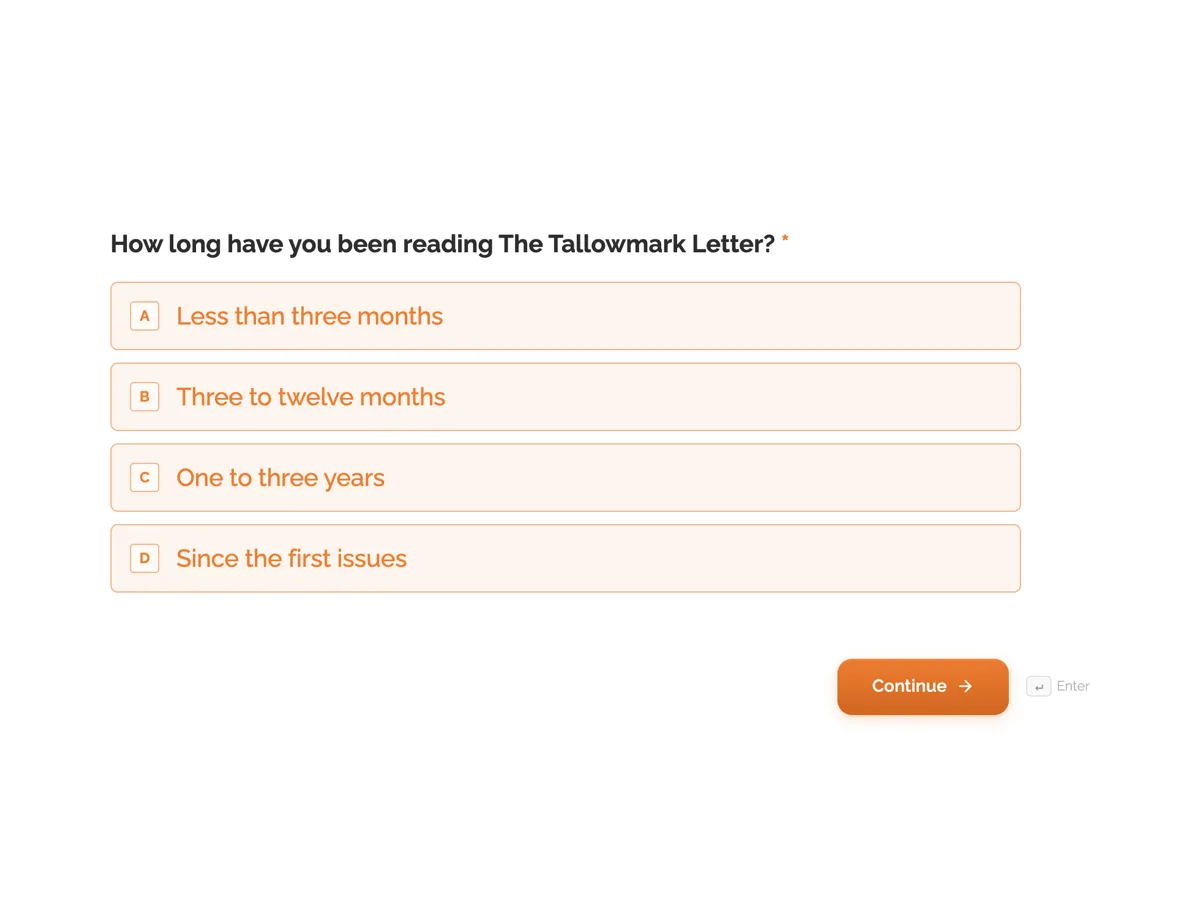
The form itself
The first screen of the form. A conversational form shows one question per screen, so the remaining screens are listed in the field table below. Nothing here can be filled in or submitted, so read it as a reference and build your own from the button above.
Every field, and what it collects
The complete field list, in the order respondents meet it.
- How long have you been reading The Tallowmark Letter?Single choiceRequired
- Options: Less than three months · Three to twelve months · One to three years · Since the first issues
- Which topics do you want more of? Pick up to three.Multiple choiceRequired
- Options: Budgeting and saving · Investing basics · Retirement planning · Tax time tips · Buying a first home · Paying off debt · Money and relationships · Reader questions answered
- How often would you like to receive it?Single choiceRequired
- Options: Weekly, as now · Every two weeks · Monthly · Twice a week
- Where do you usually read it?Single choiceRequired
- Options: Phone · Computer · Tablet · Printed out
- How long should each issue be?Single choiceRequired
- Options: A three minute read · About five minutes, as now · Ten minutes or more · Varies with the topic, that is fine
- Which recent issue was most useful to you?Short text
- A subject line or topic is enough.
- Would you pay for an extra monthly issue with worked examples and spreadsheets?Single choiceRequired
- Options: Yes, definitely · Maybe, depending on the price · No, I prefer the free letter only
What each screen of this survey collects
Screen one sets subscription length in four bands. Screen two is a checkbox of eight topics, from budgeting to reader questions, with the label asking for up to three. Screen three asks preferred frequency, keeping weekly first because that is the current schedule. Screen four asks the main reading device, including printed out. Screen five asks the ideal length in reading time rather than words. Screen six is an optional short text for the most useful recent issue. Screen seven asks whether the reader would pay for an extra monthly issue with worked examples. Six of the seven screens are required.
Why one question about money, asked last
A reader survey is not a pricing study, and a newsletter that asks about payment on every screen will hear less about everything else. One question, placed last, measures interest without colouring the topic and format answers. It also names a concrete product, an extra monthly issue with worked examples and spreadsheets, so "yes" means something. The middle answer, "maybe, depending on the price", is the useful group: they are the readers to ask about price in a follow up. Asking subscription length first means the paid tier answer can be split between new readers and long time ones, who usually behave very differently.
How to adapt this survey
A company newsletter for customers swaps the topics for product news, case studies and tips, and replaces the paid tier question with one on whether readers want event invitations. A local news email adds a question on which suburbs to cover. A podcast with a companion newsletter adds a screen on whether readers also listen, and which they prefer first.
What makes this form work
Topics capped at three
The topic screen offers eight options but asks readers to pick up to three, so the results show real priorities instead of a list where everything is popular.
Length measured in minutes
Readers are asked whether an issue should be a three minute read, about five, or ten or more, which maps directly onto how long the next issue is written to take.
The paid tier asked once, last
A single question about a named product, an extra monthly issue with worked examples, sits after every format question so it does not colour them.
Questions people ask
How many questions should a newsletter reader survey have?
Between five and ten. Readers are giving time on top of the time they already spend reading, so the survey should take about as long as one issue. This one has seven screens and a two minute estimate on the welcome screen, which suits a link placed near the top of a regular issue.
Should the survey be tied to subscriber email addresses?
Not usually. Linking answers to addresses lets you segment, but readers answer more honestly when they know the survey is separate from their subscription. This form asks for no email, and the welcome screen says so. If segmenting matters, add a question such as subscription length instead.
Why ask readers to pick only three topics?
Because a list of eight with no limit gets everything ticked, which tells you nothing about priorities. The form cannot cap the number of ticks, so the label asks for up to three. Most readers follow it, and those who tick more still show which topics are most popular overall.
What do you do with the "printed out" answers?
Take them seriously if the share is meaningful. Readers who print an issue usually keep it, and they need a layout that works on paper: no colour only charts, visible links written out, and tables that fit an A4 page. It is a small group, but often a loyal one.
How should the results go back to readers?
In an issue, as the thank-you screen promises. Share three or four numbers, such as the favourite topics and the preferred length, and the changes you will make. Readers who see their answers lead to a change are far more likely to answer next year, and some forward the issue to friends.
Does a reader survey need to meet anti spam rules?
The survey itself does not send email. Sending the link inside a newsletter that readers subscribed to is ordinary commercial email and follows the same rules as every issue, such as a working unsubscribe link and a real sender. The FTC guide for business linked below covers the United States rules.
Build your own in about a minute
The button below opens the generator with this use case already described. Change the wording to match your own, generate, then edit anything you like.
Make one like thisOther form examples
Market research survey template for a new product launch
A market research survey for a launch has to establish how the target buyer behaves today before testing what they think of the new product, so reactions can be read against real habits. This template covers frequency, channel and spend, then shows a written concept and asks for appeal, purchase likelihood and an expected price.
Brand awareness survey template with unaided and aided recall
A brand awareness survey measures how many people in a market know a brand, first without any prompt and then from a list, and what they think of it. This template asks unaided recall before any brand is shown, then aided recall, purchase and consideration from the same eight names, and an association grid.
Training feedback form: objectives met and what staff will apply at work
A training feedback form has to show whether a session did its job, not only whether people enjoyed it, which means asking if the objectives were met and what will change at work. This one rates the trainer in a grid, checks pace and confidence, and requires one specific thing each person will do differently.
Want the steps in the builder? Read Create a conversational form with AI, then Design your welcome and thank-you screens. For everything this generator can do, see the form maker.
Written and checked by the OneCraft team. Last checked .