Conversational form
Market research survey template for a new product launch
A market research survey for a launch has to establish how the target buyer behaves today before testing what they think of the new product, so reactions can be read against real habits. This template covers frequency, channel and spend, then shows a written concept and asks for appeal, purchase likelihood and an expected price.
The form itself
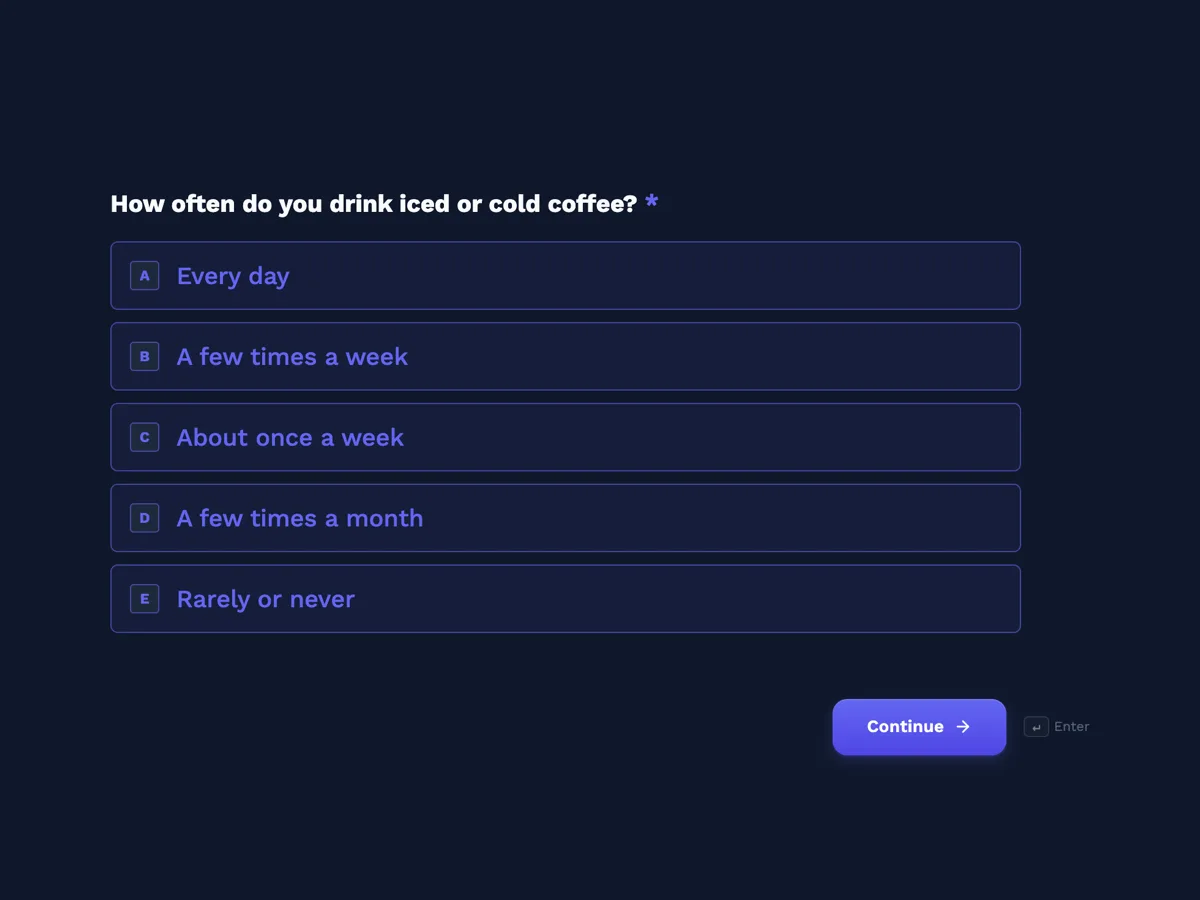
The first screen of the form. A conversational form shows one question per screen, so the remaining screens are listed in the field table below. Nothing here can be filled in or submitted, so read it as a reference and build your own from the button above.
Every field, and what it collects
The complete field list, in the order respondents meet it.
- How often do you drink iced or cold coffee?Single choiceRequired
- Options: Every day · A few times a week · About once a week · A few times a month · Rarely or never
- Where do you usually get it?Multiple choiceRequired
- Options: A café · Ready to drink from a supermarket · Ready to drink from a petrol station or convenience store · I make it at home · At work
- What did you pay for the last one you bought?Single choiceRequired
- Options: Under $3 · $3 to $4.99 · $5 to $6.99 · $7 or more · I made it myself
- Which do you drink most?Single choiceRequired
- Options: Iced latte or iced coffee with milk · Cold brew, black · Cold brew with milk · Espresso over ice · Flavoured coffee drinks
- How appealing is this product to you?Single choiceRequired
- Options: Very appealing · Somewhat appealing · Neither · Not very appealing · Not at all appealing
- If it were on sale where you shop, how likely would you be to buy it in the next month?Single choiceRequired
- Options: Definitely would · Probably would · Might or might not · Probably would not · Definitely would not
- What price would you expect to pay for one 250 ml can, in dollars?NumberRequired
- Type a number, for example 4.50.
- Which versions would you try?Multiple choice
- Options: Original black · With oat milk · Vanilla, no added sugar · Decaf · None of these
- Which pack would you most likely buy?Single choiceRequired
- Options: A single can · A four pack · A twelve can carton online
- Which age band are you in?Single choiceRequired
- Options: 18 to 24 · 25 to 34 · 35 to 44 · 45 to 54 · 55 or over
- Which best describes your household?Single choiceRequired
- Options: I live alone · A couple, no children at home · A household with children · A share house · Living with parents or family
- Where do you live?Single choiceRequired
- Options: A capital or large city · A regional city or large town · A small town or rural area
What each screen of this survey collects
Frequency is a radio of five, from every day to rarely. Where bought is a checkbox of five channels. Last price paid is a radio of four bands plus made it myself. Style drunk most is a radio of five. The concept screen shows a three sentence description of the product above a five point appeal question. Purchase likelihood is the standard five point intent scale. Expected price is a number field with a placeholder of 4.50. Versions to try is an optional checkbox, pack size is a radio of three, and age, household and location close it. Eleven of the twelve screens are required.
Why habits come before the concept
Reactions to a concept only mean something next to what people do now. A very appealing from someone who drinks cold coffee every day and already pays five dollars at a café is worth more than the same answer from someone who rarely drinks it. Asking habits first also keeps the concept from colouring them: once people have read about a smooth, low bitterness cold brew, they tend to report drinking more of it. The concept is written as plain facts, the steeping time, the can size and the caffeine, with no adjectives about taste beyond what a label would say, so appeal measures the product rather than the copywriting.
How to adapt this survey
A food product swaps the style question for current brands and adds a dietary needs screen. A service launch, such as a dog walking business, replaces pack size with frequency and the price question with a weekly amount. A launch into one city replaces the location screen with suburbs or postcodes.
What makes this form work
Today's habits frame every reaction
Frequency, channel, last price paid and preferred style come first, so appeal can be read separately for daily café drinkers and occasional buyers.
The concept is factual
The concept screen states the 18 hour steep, the 250 ml can and the caffeine level with no sales language, so appeal reflects the product.
Price expectation is unprompted
The expected price is a free number asked before any price is shown, so it measures what buyers expect rather than reacting to a figure.
Questions people ask
What is the top two box score in market research?
It is the share of people choosing the two most positive answers on a five point scale, such as definitely would and probably would buy. It is easier to compare between concepts and over time than an average. Many teams also discount it, because stated intent overstates real buying, especially for new products.
Should the concept include a price?
Not in this design. Showing a price first anchors the expected price question that follows, so you learn what people think of your number rather than what they would expect. Collect the unprompted expectation here, then test specific prices separately, either with a pricing survey or with different concepts shown to different groups.
Can the number field stop people typing silly prices?
No. In a conversational form the number field does not enforce a minimum or maximum as people type, so expect the odd 0 or 450. Clean these when analysing: decide a plausible range in advance, such as one to fifteen dollars, and exclude answers outside it rather than averaging them in.
How many people should a launch survey reach?
At least 200 people who are actually in the category, more if you want to compare groups such as daily and weekly drinkers. The frequency screen identifies those who rarely drink cold coffee, so their answers can be set aside. A survey sent only to existing customers will overstate appeal for any new product from the same brand.
Why ask demographics at the end?
Because they are easy to answer when attention is lowest, and because asking them first can feel intrusive before people know what the survey is about. They are kept to three broad questions with no name or email, so the answers stay anonymous as the welcome screen promises, while still letting results be checked against the target market.
What does this survey not tell you?
It cannot tell you how the product tastes to people, whether they would buy it twice, or how it performs against a competitor on the same shelf. Those need a tasting, a trial and sales data. A survey like this narrows the options cheaply before any of that is paid for, which is its job.
Build your own in about a minute
The button below opens the generator with this use case already described. Change the wording to match your own, generate, then edit anything you like.
Make one like thisOther form examples
Brand awareness survey template with unaided and aided recall
A brand awareness survey measures how many people in a market know a brand, first without any prompt and then from a list, and what they think of it. This template asks unaided recall before any brand is shown, then aided recall, purchase and consideration from the same eight names, and an association grid.
Patient satisfaction survey template for an Australian GP clinic
A patient satisfaction survey for a general practice has to find out how a visit felt from booking to consultation without collecting anything that identifies the patient. This anonymous template asks about waiting, reception, being listened to, clear explanations, privacy and access, then invites one suggestion.
Webinar feedback survey template: content, audio and next topic
A webinar feedback survey has to separate what was said from how it came across on screen, and use the moment to decide the next session. This template asks whether people watched live or on replay and at what level, rates content, sound and length separately, and ends with a vote on next month's topic.
Want the steps in the builder? Read Create a conversational form with AI, then Form builder components. For everything this generator can do, see the form maker.
Written and checked by the OneCraft team. Last checked .