Conversational form
Brand awareness survey template with unaided and aided recall
A brand awareness survey measures how many people in a market know a brand, first without any prompt and then from a list, and what they think of it. This template asks unaided recall before any brand is shown, then aided recall, purchase and consideration from the same eight names, and an association grid.
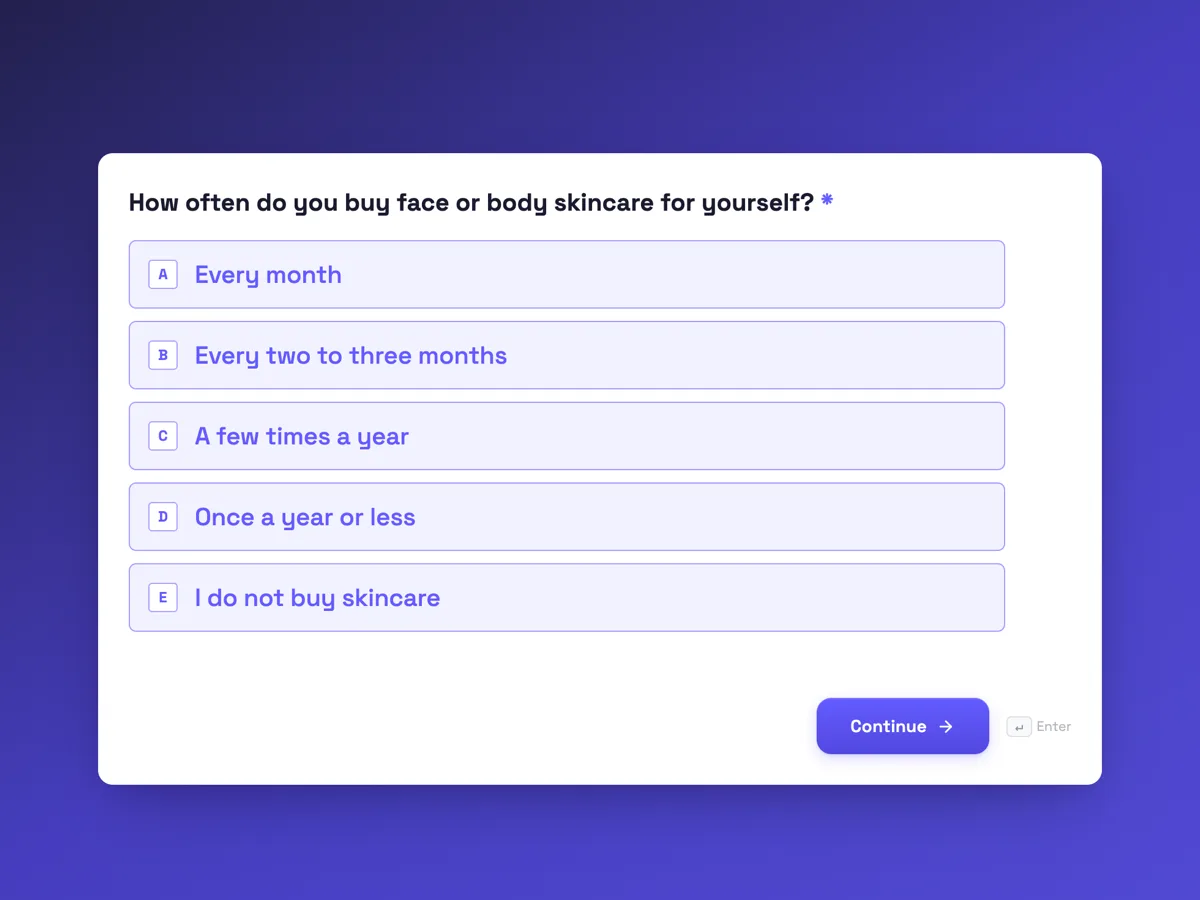
The form itself
The first screen of the form. A conversational form shows one question per screen, so the remaining screens are listed in the field table below. Nothing here can be filled in or submitted, so read it as a reference and build your own from the button above.
Every field, and what it collects
The complete field list, in the order respondents meet it.
- How often do you buy face or body skincare for yourself?Single choiceRequired
- Options: Every month · Every two to three months · A few times a year · Once a year or less · I do not buy skincare
- Which skincare brands can you think of? Type every one that comes to mind.Long textRequired
- Please do not look anything up. Spelling does not matter.
- Which of these brands have you heard of, even if only the name?Multiple choiceRequired
- Options: Kelpwood · Oatmarrow · Tansywell · Fernquill · Dewmarrow · Solvayle · Mossbright · Clayfrond · None of these
- Which have you bought in the last 12 months?Multiple choice
- Options: Kelpwood · Oatmarrow · Tansywell · Fernquill · Dewmarrow · Solvayle · Mossbright · Clayfrond · None of these
- Which would you consider buying next time?Multiple choiceRequired
- Options: Kelpwood · Oatmarrow · Tansywell · Fernquill · Dewmarrow · Solvayle · Mossbright · Clayfrond · None of these
- Which words fit each brand you have heard of?Rating grid
- Tick as many as fit in each row. Leave a row blank if you do not know the brand.
- Statements:
- Kelpwood
- Oatmarrow
- Tansywell
- Fernquill
- Where have you seen Kelpwood in the last three months?Multiple choice
- Options: On a pharmacy or supermarket shelf · Social media posts or videos · An online store · Recommended by a friend · A magazine or podcast · I have not seen it
- Where do you usually buy skincare?Single choiceRequired
- Options: Pharmacy · Supermarket · Department store · Online, from the brand · Online marketplace
- How would you describe your skin?Single choiceRequired
- Options: Dry · Oily · Combination · Sensitive · Normal · Not sure
- Which age band are you in?Single choiceRequired
- Options: 18 to 24 · 25 to 34 · 35 to 44 · 45 to 54 · 55 to 64 · 65 or over
What each screen of this survey collects
Buying frequency is a radio of five and doubles as a screener, since people who never buy skincare can be filtered out later. Unaided recall is a required open text with no brand shown anywhere before it. Aided recall is a checkbox of eight brands plus none of these. Purchase in the last 12 months and consideration repeat the same eight. The association grid lists four brands against five words, natural, good value, clinically proven, gentle on skin and premium, as a checkbox matrix. Where seen asks about the sponsor only. Buying channel, skin type and age band close the survey. Seven of the ten screens are required.
Why the order of the first five screens matters
Unaided recall has to come before any brand name appears, including on the welcome screen, or the survey measures its own prompt. That is why the welcome says only that a skincare company runs the study, Kelpwood sits in the lists like any other brand until the where seen screen, and the thank-you screen names it as the sponsor. Aided recall, purchase and consideration then use the same eight names so they form a funnel: heard of, bought, would buy again. The drop between steps is the useful number. A brand known by most people but considered by few has an image problem; one considered by most who know it has a reach problem. The grid then shows which image.
How to adapt this survey
A café or gym replaces the brand list with local competitors and asks where seen about street signage and delivery apps. A business to business brand swaps the age band for job role and company size. A brand tracking awareness over time keeps every wording identical between waves and changes only the list order.
What makes this form work
Recall before any prompt
The open recall screen comes second, before any brand name appears, and the sponsor is only identified at the end, so unaided awareness is not inflated by the survey itself.
One list, one funnel
Heard of, bought and would consider all use the same eight brands, so the drop from awareness to consideration reads straight off the counts.
Associations are optional per brand
The four by five checkbox grid lets people tick several words for brands they know and leave unknown brands blank instead of guessing.
Questions people ask
What is the difference between aided and unaided brand awareness?
Unaided awareness is the share of people who name a brand with no prompt, usually from an open question about a category. Aided awareness is the share who recognise it when shown a list. Unaided is the harder, more valuable measure, because it reflects which brands come to mind at the moment of buying.
How do you code the unaided recall answers?
Export the responses and match each typed name to a brand, allowing for misspellings and nicknames, then count how many people mentioned each. The first brand typed is often recorded separately as top of mind. Do this by hand or with a lookup list; the form collects the text as typed and does not score it.
Why are some brands in the list not real competitors?
In this example every brand name is fictional. In a live survey the list should hold the sponsor and its real competitors, in a fixed order, sometimes with one invented brand added as a check: anyone claiming to know a brand that does not exist is answering carelessly, and their responses can be reviewed.
How many responses does a brand awareness survey need?
Enough that the smallest group you will report on has a few hundred people. A national sample of around 400 gives a margin of error of about five percentage points on a single awareness figure. Splitting by age band or skin type needs more, which is why the thank-you screen promises groups of at least 50.
Should the association grid include every brand?
Only brands a reasonable share of people know, otherwise most rows are blank. This grid keeps four of the eight and asks people to leave rows for unfamiliar brands empty. The matrix is a checkbox type, so several words can fit one brand, and none is forced on a brand someone has never heard of.
Where should a brand awareness survey be sent?
To people in the market, not to existing customers, who already know the brand and inflate every number. A research panel or a targeted social audience works; a newsletter list does not. The buying frequency screen helps remove people outside the category, and the age band lets the sample be checked against the market.
Build your own in about a minute
The button below opens the generator with this use case already described. Change the wording to match your own, generate, then edit anything you like.
Make one like thisOther form examples
Pricing survey template with the four Van Westendorp questions
A pricing survey finds the range of prices buyers will accept by asking where a price becomes too cheap to trust, a bargain, expensive and too expensive. This template asks those four Van Westendorp questions for a paid app plan, after current spend, and follows them with the features people would use and who they are.
Market research survey template for a new product launch
A market research survey for a launch has to establish how the target buyer behaves today before testing what they think of the new product, so reactions can be read against real habits. This template covers frequency, channel and spend, then shows a written concept and asks for appeal, purchase likelihood and an expected price.
Post purchase survey template: discovery, checkout and delivery
A post purchase survey has to walk the order from the buyer's side, from how they found the shop to the moment the box was opened, so each team sees its own part. This template asks one question per stage, adds an optional photo of the product at home, and ends on a recommendation score.
Want the steps in the builder? Read Create a conversational form with AI, then View, export and manage your responses. For everything this generator can do, see the form maker.
Written and checked by the OneCraft team. Last checked .