Conversational form
Concept testing survey template: two concepts, one preference
A concept testing survey shows people a product idea before it is built and measures how appealing and believable it is, so a team can choose between ideas on evidence. This template rates two written concepts one at a time on the same scales, then asks which one people would choose and why.
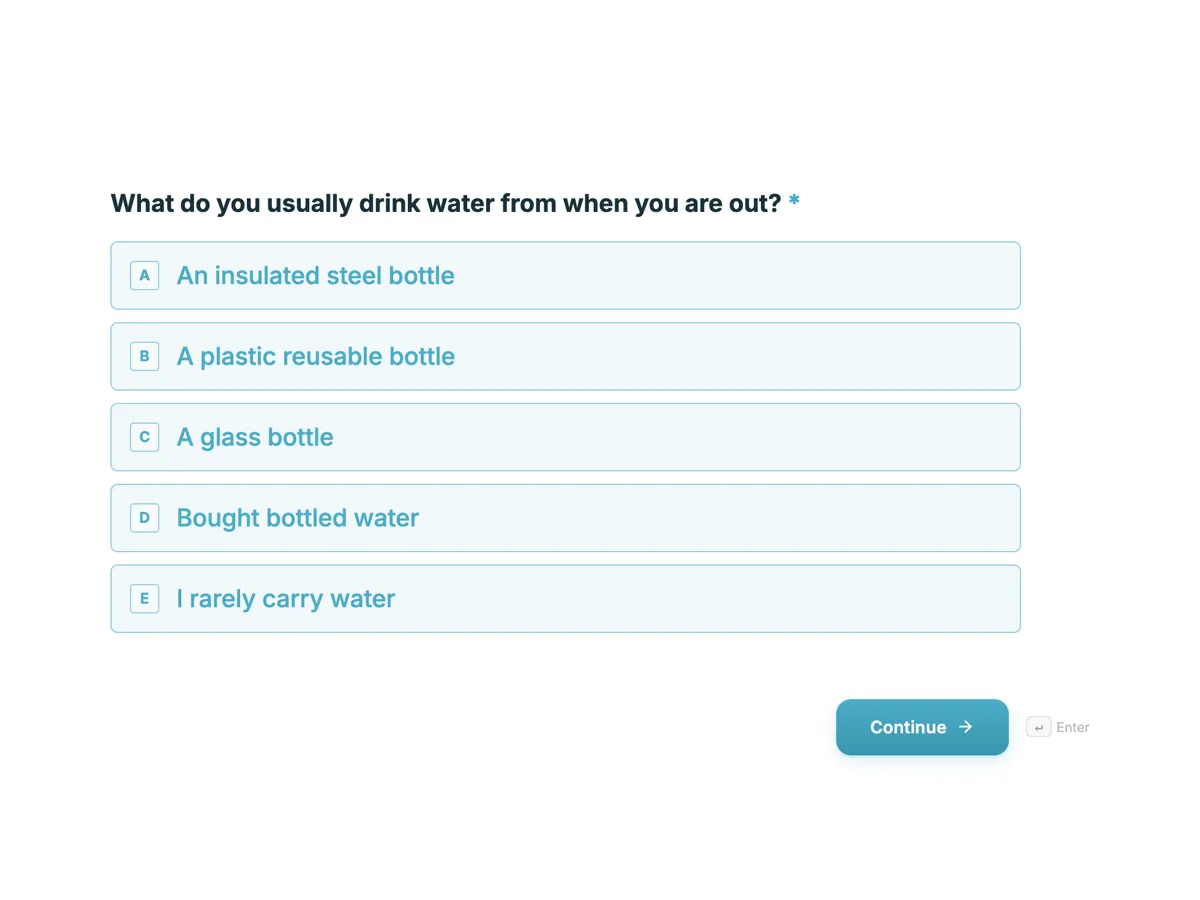
The form itself
The first screen of the form. A conversational form shows one question per screen, so the remaining screens are listed in the field table below. Nothing here can be filled in or submitted, so read it as a reference and build your own from the button above.
Every field, and what it collects
The complete field list, in the order respondents meet it.
- What do you usually drink water from when you are out?Single choiceRequired
- Options: An insulated steel bottle · A plastic reusable bottle · A glass bottle · Bought bottled water · I rarely carry water
- How often do you buy a new reusable bottle?Single choiceRequired
- Options: Every few months · About once a year · Every two or three years · Only when one breaks or gets lost
- How appealing is Idea A to you?Single choiceRequired
- Options: Very appealing · Somewhat appealing · Neither appealing nor unappealing · Not very appealing · Not at all appealing
- How believable are the claims about Idea A?Single choiceRequired
- Options: Completely believable · Somewhat believable · Not very believable · Not at all believable
- How appealing is Idea B to you?Single choiceRequired
- Options: Very appealing · Somewhat appealing · Neither appealing nor unappealing · Not very appealing · Not at all appealing
- How believable are the claims about Idea B?Single choiceRequired
- Options: Completely believable · Somewhat believable · Not very believable · Not at all believable
- If you could only have one, which would you choose?Single choiceRequired
- Options: Idea A, the Fold · Idea B, the Keeper · Neither
- Why that one?Long textRequired
- If your choice were on sale at a fair price, how likely would you be to buy it?Single choiceRequired
- Options: Definitely would · Probably would · Might or might not · Probably would not · Definitely would not
What each screen of this survey collects
Current bottle is a radio of five, from insulated steel to rarely carrying water. Replacement frequency is a radio of four. Idea A appears as a paragraph above a five point appeal question, and the next screen asks how believable its claims are on four points. Idea B follows with the same two scales. Preference is a forced choice of A, B or neither. Why that one is a required long text with a concrete placeholder, and purchase intent is the five point scale from definitely would to definitely would not. All nine screens are required.
Why each concept is rated alone before the choice
Asking only which do you prefer hides whether either idea is any good: a preference of 60 to 40 between two weak concepts still produces a winner. Rating each one on its own, with identical appeal and believability scales, shows the absolute strength of both before they compete. Believability matters because a striking claim, such as a lid that tracks the last opening, can score high on appeal and low on trust. The two concepts are written to the same length and structure, a name, three facts and one limitation each, so the copy does not favour either. Each is shown as text rather than a picture so design polish does not decide the result.
How to adapt this survey
A food brand swaps the concepts for two recipes and adds a dietary screen. A software team tests two onboarding flows described in three sentences each. Order bias is the main risk: publish a second copy with Idea B first, send each copy to half the list, and combine the results.
What makes this form work
Each idea is scored on its own first
Both concepts get the same five point appeal and four point believability scales before any comparison, so a weak winner is visible.
Statements are matched
Each concept names a capacity, a weight and one limitation in about the same number of words, so the copy does not tip the choice.
The reason is required
The why that one screen must be answered, and its placeholder shows the kind of specific reason that explains a preference.
Questions people ask
What is the difference between monadic and comparative concept testing?
In a monadic test each person sees only one concept, which gives the cleanest reading of it but needs a separate sample per concept. In a sequential monadic test, like this one, each person rates every concept in turn and then compares them. It needs fewer people, at the cost of the first concept colouring the second.
How do you stop the first concept from always winning?
Rotate the order. This form shows Idea A first to everyone, so run a second copy with the concepts swapped and send each copy to a random half of your list. Compare results across the two copies; if A wins only when shown first, the preference is mostly order and neither concept is clearly ahead.
Can a concept test include images?
Yes. A conversational form has an image block that can sit on the same screen as the question, so a sketch or render can appear above each concept. This example uses text only, which keeps both ideas on equal footing. If you add images, make them the same style and quality for every concept.
What makes a good concept statement?
A name, the problem it solves, two or three concrete facts and one honest limitation, in plain words and roughly equal length across concepts. Avoid adjectives such as revolutionary or premium, because respondents rate the copywriting instead of the idea. Each statement here names a capacity, a weight and one care instruction.
Why ask about believability separately?
Because appeal and trust can split. People may love the idea of a bottle that tracks when it was opened while doubting it would work, and that doubt is something marketing would have to overcome at launch. A concept with high appeal and low believability usually needs a demonstration, a guarantee or a simpler claim.
How should the open reasons be analysed?
Read every answer and tag it with one or two themes, such as size, weight, temperature or cleaning. Then count themes separately for people who chose A and B. The themes behind the losing concept are often the most useful, because they show what to borrow for the winner before it goes to prototype.
Build your own in about a minute
The button below opens the generator with this use case already described. Change the wording to match your own, generate, then edit anything you like.
Make one like thisOther form examples
Brand awareness survey template with unaided and aided recall
A brand awareness survey measures how many people in a market know a brand, first without any prompt and then from a list, and what they think of it. This template asks unaided recall before any brand is shown, then aided recall, purchase and consideration from the same eight names, and an association grid.
Pricing survey template with the four Van Westendorp questions
A pricing survey finds the range of prices buyers will accept by asking where a price becomes too cheap to trust, a bargain, expensive and too expensive. This template asks those four Van Westendorp questions for a paid app plan, after current spend, and follows them with the features people would use and who they are.
Newsletter reader survey on topics, frequency and format
A newsletter reader survey asks subscribers what they want more of, how often they want it and how they read it, so the next issues fit their week. This one does it in seven screens for a weekly money newsletter, ending with a single question on interest in a paid tier.
Want the steps in the builder? Read Create a conversational form with AI, then Form builder components. For everything this generator can do, see the form maker.
Written and checked by the OneCraft team. Last checked .