Classic form
Veggie box order form with swaps and gate instructions
A veggie box order form has to set the box size, how often it comes and the few vegetables a household will never eat, then get the driver through the gate to a shady spot. This one prices three box sizes, allows up to two swaps with the rule written out, and makes the gate instructions a required question.
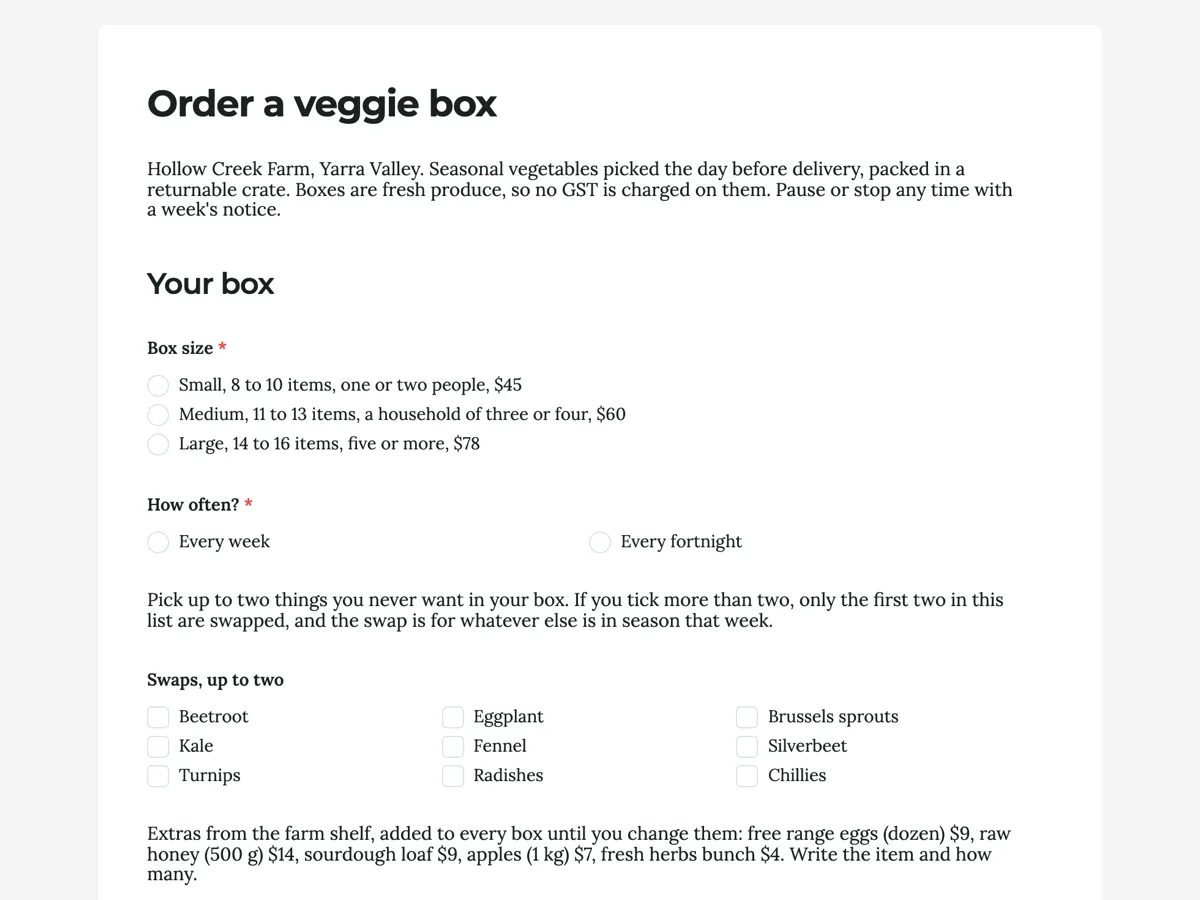
The form itself
A static copy of the finished form, exactly as it renders. Nothing here can be filled in or submitted, so read it as a reference and build your own from the button above.
Every field, and what it collects
The complete field list, in the order respondents meet it.
- Box sizeSingle choiceRequired
- Options: Small, 8 to 10 items, one or two people, $45 · Medium, 11 to 13 items, a household of three or four, $60 · Large, 14 to 16 items, five or more, $78
- How often?Single choiceRequired
- Options: Every week · Every fortnight
- Swaps, up to twoMultiple choice
- Options: Beetroot · Eggplant · Brussels sprouts · Kale · Fennel · Silverbeet · Turnips · Radishes · Chillies
- ExtrasTable
- Columns: Extra · How many
- Delivery daySingle choiceRequired
- Options: Tuesday, eastern suburbs and the Yarra Valley · Thursday, inner and northern suburbs
- Delivery addressShort textRequired
- Where should the box go, and how does the driver get there?Long textRequired
- Your nameShort textRequired
- Mobile, for the night before textShort textRequired
Your box
Delivery
You
What each field on this form collects
Box size is a radio of three, small for one or two people at $45, medium at $60, large at $78, each with an item count. How often is weekly or fortnightly. A paragraph states the swap rule, then swaps is an optional checkbox of nine vegetables in three columns. A paragraph lists five farm shelf extras with prices, then extras is an optional three row table of extra and how many. Delivery day is a radio of two, Tuesday or Thursday, each naming its area. Delivery address is short text with an Australian placeholder. Gate and drop off instructions are a required long text. Your name and a mobile for the night before text close the form.
Why the swap limit is written, not enforced
A checkbox question cannot cap how many boxes are ticked, so the limit of two lives in the label and in the paragraph above, along with what happens if more are ticked: only the first two in the list are swapped. Writing the rule this way is more honest than pretending the form stops a third tick. It also keeps the farm's promise realistic. A box built around what is in season can absorb two swaps; it cannot become a custom order without losing the price.
Australian terms behind the form
Fresh fruit and vegetables are GST free in Australia, so the intro says no GST is charged on the boxes, while some extras may carry it. Australian consumer law treats a subscription like any other service: the terms for pausing and stopping should be clear before the first charge, which is why the intro says a week's notice ends it. The address placeholder uses the Australian format of suburb, state and postcode.
How to adapt this form
A fruit box swaps vegetables for fruit and adds a ripeness preference. A farm with a market stall adds pickup at the Saturday market beside the two delivery days. An organic grower adds the certification body to the intro, since certified organic is a claim buyers check.
What makes this form work
Box sizes are described by household
Small for one or two people, medium for three or four, large for five or more, with item counts and prices. Customers pick by who they feed, which is how they think about vegetables, rather than by a weight they cannot picture.
The swap rule says what happens at three
Up to two swaps, and if more are ticked, only the first two in the list are used. The form cannot cap ticks, so it states the rule plainly and the packers apply it the same way every week.
Drop off instructions are required
A required long text covers the gate, the latch, a shaded spot and the dog. Every box reaches the driver with a plan for where it goes, which matters more for fresh produce than any other question here.
Questions people ask
Why does a veggie box form ask for gate instructions?
Because the box is left unattended, often before anyone is home, and a box left in the sun or behind a locked gate is a box of wilted greens. The question is required and the placeholder shows what a useful answer covers: the gate, the latch, a shaded spot and a dog that might slip out.
Can a customer swap more than two vegetables?
The form does not stop a third tick, since a checkbox question has no maximum. The label says up to two, and the paragraph above says only the first two ticked in the list are swapped, for whatever else is in season. That keeps the box priced as a seasonal box rather than a custom order.
Do the extras come every week?
Yes, until the customer changes them, which the paragraph above the table says. That suits eggs and bread that a household buys every week. The table has three rows and cannot grow, so a household that wants more than three extras writes two items in one row or messages the farm.
How does the customer pause the box?
By texting or emailing the farm a week before the next delivery day, as the intro says. The form starts the subscription; it does not manage it afterwards, and a submitted response cannot be edited. The weekly night before text gives the customer a regular reminder of the next box and a chance to reply.
Why is the delivery day tied to an area?
Because the farm runs two delivery routes, and each covers a set of suburbs. Naming the area beside each day stops a customer in the inner north choosing Tuesday and waiting for a box that is not coming. A farm with more routes adds a row per route with its suburbs.
What does the night before text contain?
A list of what is in the next box, with any swaps already applied. The farm sends it from its own phone the evening before each delivery, using the mobile on the form. It also acts as a reminder to put the empty crate out, which is how the farm gets its crates back.
Build your own in about a minute
The button below opens the generator with this use case already described. Change the wording to match your own, generate, then edit anything you like.
Make one like thisOther form examples
Balloon order form with colours, garland length and setup
A balloon order form has to capture the product, the colours, the size in metres and whether the decorator installs on site, because those four set the balloon count and the time on the day. This one gives a length guide by wall and table, limits colours to four in the label, and asks for a photo of the space.
Invitation order form with wording, quantity and proofs
An invitation order form has to collect the exact wording, spelled as it will print, plus the count, the envelopes and how many proofs it takes to get it right. This one separates the names and the date line from the full wording, explains household counts, and takes the guest list as a PDF for addressing.
Firewood order form with delivery access and stacking
A firewood order form has to settle what wood, how much, and whether a tipper truck can get to the spot where the wood will be burnt or stored. This one prices four quantities by the tonne, asks about driveway width, low branches and wires, and offers stacking as a priced extra.
Want the steps in the builder? Read Form builder components, then View, export and manage your responses. For everything this generator can do, see the form maker.
Written and checked by the OneCraft team. Last checked .