Classic form
Firewood order form with delivery access and stacking
A firewood order form has to settle what wood, how much, and whether a tipper truck can get to the spot where the wood will be burnt or stored. This one prices four quantities by the tonne, asks about driveway width, low branches and wires, and offers stacking as a priced extra.
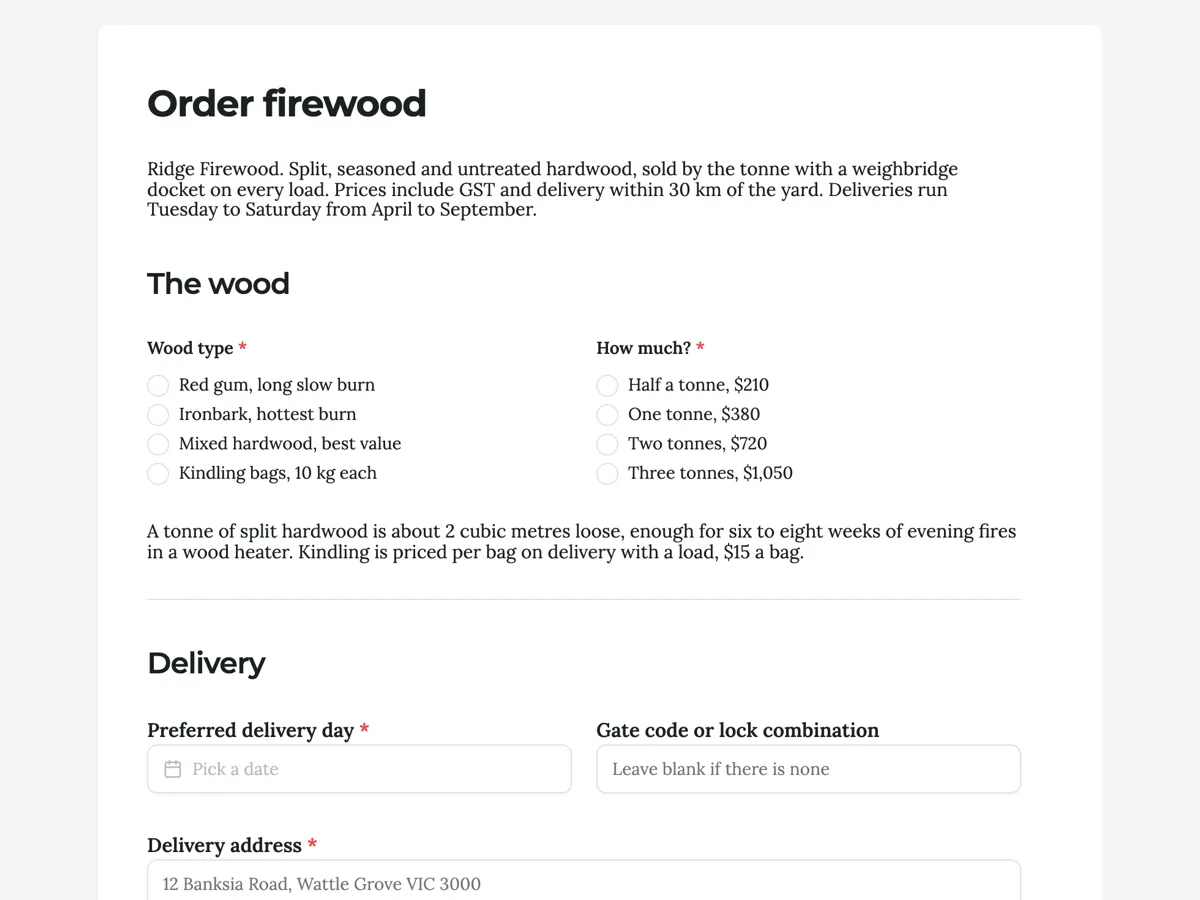
The form itself
A static copy of the finished form, exactly as it renders. Nothing here can be filled in or submitted, so read it as a reference and build your own from the button above.
Every field, and what it collects
The complete field list, in the order respondents meet it.
- Wood typeSingle choiceRequired
- Options: Red gum, long slow burn · Ironbark, hottest burn · Mixed hardwood, best value · Kindling bags, 10 kg each
- How much?Single choiceRequired
- Options: Half a tonne, $210 · One tonne, $380 · Two tonnes, $720 · Three tonnes, $1,050
- Preferred delivery dayDateRequired
- Gate code or lock combinationShort text
- Delivery addressShort textRequired
- Can a tipper truck get to where the wood goes?Single choiceRequired
- Options: Yes, a 3 m wide driveway with no low branches or wires · Only to the kerb, the wood is tipped on the nature strip · Narrow or steep access, please call before the day
- Tipped or stacked?Single choiceRequired
- Options: Tipped in one pile, included · Stacked against a wall or in a woodshed, $60 a tonne
- Your name and mobile, for the driverShort textRequired
The wood
Delivery
What each field on this form collects
Wood type is a radio of four: red gum, ironbark, mixed hardwood and kindling bags. How much sits beside it, four quantities from half a tonne to three tonnes, each with a GST inclusive price. A paragraph converts a tonne into cubic metres and weeks of evening fires. Preferred delivery day is a date, beside an optional gate code. The delivery address is one short text with an Australian placeholder. Tipper access is a radio of three, from a clear 3 m driveway to call before the day. Tipped or stacked is a radio of two, with stacking priced per tonne. A short text for the name and mobile closes it. Seven of the eight fields are required.
Why access gets its own question
A firewood truck tips its load from the tray, and it needs width, height and firm ground to do it. A driveway that suits a car can still have a carport roof, an overhanging branch or a service wire too low for a raised tray. When nobody asked, the driver tips at the kerb and the customer barrows two tonnes up the drive. The three options name the real conditions, and the third sends steep or narrow access to a phone call before the day, so the yard can send a smaller truck instead of a wasted trip.
Australian terms behind the form
Firewood is sold by measure, so Australian trade measurement law applies, administered by the National Measurement Institute; selling by the tonne with a weighbridge docket gives the buyer a figure they can check. Prices include GST, as consumer prices must. State environment protection authorities, such as EPA Victoria, ask households to burn only dry, seasoned and untreated hardwood to cut wood smoke, which is why the intro says so. The address placeholder uses the Australian suburb, state and postcode order.
How to adapt this form
A yard that also sells by the trailer load adds a collect from the yard option with trailer sizes. A rural supplier adds a question about stock or dogs on the property and which gates to close. A café or pizza oven customer adds a regular delivery frequency and an invoice name with an ABN.
What makes this form work
Quantity is priced and explained
Four quantities, each with a GST inclusive price, and a paragraph that turns a tonne into 2 cubic metres and weeks of fires. Customers choose an amount they understand.
Access names the obstacles
A 3 m driveway with no low branches or wires, kerb only, or call first. The three things that stop a tipper truck are in the options, not discovered on the day.
Stacking is a visible extra
Tipped in one pile is included, stacked costs $60 a tonne. The choice is made with the price in view, and the driver knows how long the stop will take.
Questions people ask
How much firewood is a tonne?
About 2 cubic metres of split hardwood, loose, which the paragraph on the form says. For a wood heater used most evenings, that is roughly six to eight weeks. A household heating mainly with wood through a southern winter usually orders three to four tonnes across the season, often in two deliveries.
Why is firewood sold by the tonne?
Because weight can be checked. A load sold as a trailer or a ute load varies with how it is stacked, while a weighbridge docket shows the exact mass. Trade measurement law applies to firewood as it does to any product sold by measure, so the form prices by the tonne and the docket comes with the load.
What is the difference between red gum and ironbark?
Both are dense Australian hardwoods. Red gum burns long and steady with good coals, and ironbark burns hotter and is heavier per piece. Mixed hardwood combines several species at a lower price. Each option on the form names its strength so a customer chooses by how they use the heater.
What happens if the truck cannot reach the spot?
If the customer answered kerb only, the load is tipped on the nature strip as agreed. If they chose call before the day, the yard rings to check and may send a smaller vehicle. A driver arriving to a surprise usually tips at the kerb, which is why access is asked before the booking.
Is stacking worth paying for?
For two tonnes or more, usually. Stacking against a wall or in a woodshed keeps the wood off the ground and dry, and saves the customer an afternoon. The form prices it per tonne beside the free tipped option, so the cost is clear before the order is sent, not added on the day.
Why does the form ask for a gate code?
Many deliveries happen while customers are at work. A gate code or lock combination lets the driver get the truck to the right spot without a call. The field is optional, and its placeholder says to leave it blank if there is none. The code goes only to the yard with the order.
Build your own in about a minute
The button below opens the generator with this use case already described. Change the wording to match your own, generate, then edit anything you like.
Make one like thisOther form examples
Made to measure order form with a measurements table
A made to measure order form has to collect measurements precise enough to cut from, with the method stated, because a blind cut too wide cannot be fixed. This one explains inside and outside mount before a six row windows table of room, width, drop and mount in millimetres, and asks for a photo of each window.
Gift hamper order form with a recipients table and gift messages
A gift hamper order form has to send many hampers from one buyer to many people, each with their own address and card message, on one dispatch date. This one puts recipients in a numbered six row table with name, delivery address and message columns, and takes the invoice details with an ABN.
Christmas order form for a butcher's ham and turkey
A Christmas order form for a butcher has to commit the customer to a ham size, a turkey and a pickup time weeks ahead, so the cool room and the counter can cope with the three busiest days of the year. This one prices each choice per kilogram, offers three pickup days in half hour slots, and confirms the $50 deposit.
Want the steps in the builder? Read Create a form with AI, then Form builder components. For everything this generator can do, see the form maker.
Written and checked by the OneCraft team. Last checked .