Classic form
Christmas order form for a butcher's ham and turkey
A Christmas order form for a butcher has to commit the customer to a ham size, a turkey and a pickup time weeks ahead, so the cool room and the counter can cope with the three busiest days of the year. This one prices each choice per kilogram, offers three pickup days in half hour slots, and confirms the $50 deposit.
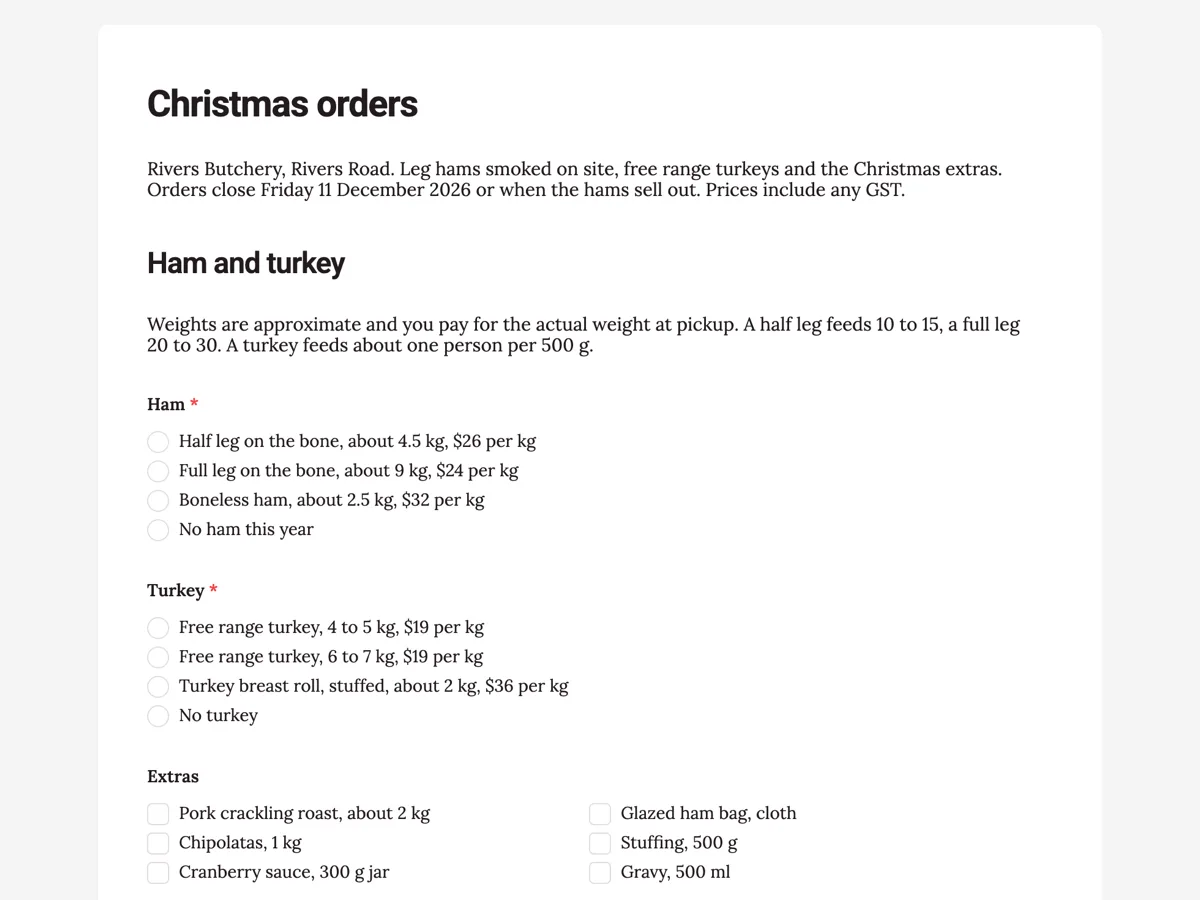
The form itself
A static copy of the finished form, exactly as it renders. Nothing here can be filled in or submitted, so read it as a reference and build your own from the button above.
Every field, and what it collects
The complete field list, in the order respondents meet it.
- HamSingle choiceRequired
- Options: Half leg on the bone, about 4.5 kg, $26 per kg · Full leg on the bone, about 9 kg, $24 per kg · Boneless ham, about 2.5 kg, $32 per kg · No ham this year
- TurkeySingle choiceRequired
- Options: Free range turkey, 4 to 5 kg, $19 per kg · Free range turkey, 6 to 7 kg, $19 per kg · Turkey breast roll, stuffed, about 2 kg, $36 per kg · No turkey
- ExtrasMultiple choice
- Options: Pork crackling roast, about 2 kg · Glazed ham bag, cloth · Chipolatas, 1 kg · Stuffing, 500 g · Cranberry sauce, 300 g jar · Gravy, 500 ml
- Pickup daySingle choiceRequired
- Options: Tuesday 22 December · Wednesday 23 December · Thursday 24 December, until 2 pm
- Pickup slotSingle choiceRequired
- Options: 7 to 7.30 am · 9 to 9.30 am · 11 to 11.30 am · 1 to 1.30 pm · 3 to 3.30 pm
- DepositMultiple choiceRequired
- Options: I will pay the $50 deposit in store within 7 days
- Name for the orderShort textRequired
- MobileShort textRequired
- EmailShort textRequired
Ham and turkey
Pickup
Contact
What each field on this form collects
A paragraph explains that weights are approximate and how many each ham and turkey feeds. Ham is a radio of four: half leg at about 4.5 kg, full leg at about 9 kg, boneless at about 2.5 kg, or none, each with a price per kilogram. Turkey is a radio of four in the same pattern. Extras is an optional checkbox of six, from a pork crackling roast to gravy. Pickup day is a radio of three dates, Tuesday 22 to Thursday 24 December, beside a pickup slot radio of five half hour windows. A paragraph sets out the deposit, and a required tick confirms it will be paid. Name, mobile and email close the form.
Christmas in an Australian butcher's shop
Christmas in Australia lands in summer, so the cold chain is the risk the form keeps returning to. The thank-you screen tells the customer to bring a cooler bag or esky, because the Food Safety Information Council's advice is to keep ham at 5°C or below, and a car in December is not. The deposit is paid at the counter, not through the form, and the paragraph says when it is refunded. Under Australian consumer law the terms of a deposit should be clear when it is taken, which is why they are written above the tick rather than on a sign at the shop.
How to adapt this form
A seafood shop swaps hams for prawns and oysters by the kilogram and moves pickup to 24 December only, since seafood is bought last. A deli adds cheese boards and a pick up or local delivery choice. A butcher doing Easter instead swaps turkey for lamb and keeps the deposit, the dated pickup days and the half hour slots, which are what make a rush week manageable.
What makes this form work
Every ham shows weight and price per kilogram
Half leg about 4.5 kg at $26 per kg, full leg about 9 kg at $24, boneless about 2.5 kg at $32. With the feeds 10 to 15 line above, the customer chooses the right ham for the table and knows the cost within a few dollars.
Days and slots spread the rush
Three dated pickup days beside five half hour slots on one row. The counter knows how many hams leave in every half hour of the busiest week, and the customer knows exactly when to arrive.
The deposit terms are agreed in writing
The paragraph says $50 within 7 days, off the final price, released on 14 December if unpaid, refundable before 18 December. A required tick confirms it. Disputes over deposits in Christmas week rarely start from terms everyone saw.
Questions people ask
Why does a Christmas order form offer only three pickup days?
Because a butcher's cool room can only hold so many hams at once, and most customers want them as close to Christmas as possible. Three days, 22 to 24 December, spread the collections. The half hour slots then spread each day, so the shop is not serving two hundred people between 8 and 10 am.
Why is the price per kilogram instead of a fixed price?
Because no two hams weigh the same. A half leg is about 4.5 kg, but it may be 4.2 or 4.9 on the day, and the customer pays the actual weight. The paragraph above says so, and each option gives an approximate weight so the customer can estimate the cost when ordering.
Where is the $50 Christmas deposit paid?
At the counter. The form records the order, and the deposit of $50 is paid at the counter within 7 days, which the thank-you screen repeats. A form does not process payments. The required tick confirms the customer has read the terms, and the shop releases unpaid orders on 14 December.
Can a Christmas order be changed after it is placed?
Yes, by phoning the shop before orders close on 11 December. After that the hams are allocated and the turkeys ordered from the farm, so a change depends on stock. Moving the pickup slot is usually easy, while moving to a larger ham is not, which is why the paragraph gives how many each size feeds.
How should a ham be carried home in summer?
In a cooler bag or an esky with ice bricks, straight home and into the fridge. Food safety guidance is to keep ham at 5°C or below. The thank-you screen says this because a December car boot in Australia can pass 40°C, and the shop would rather the customer hears it twice than once.
Build your own in about a minute
The button below opens the generator with this use case already described. Change the wording to match your own, generate, then edit anything you like.
Make one like thisOther form examples
Spare parts order form with model, serial and part numbers
A spare parts order form has to identify the exact machine before the part, because the same model can take different parts across production runs. This one asks the model and serial number first, takes part numbers, descriptions and quantities in a numbered table, and accepts a photo when a part number is missing.
Made to measure order form with a measurements table
A made to measure order form has to collect measurements precise enough to cut from, with the method stated, because a blind cut too wide cannot be fixed. This one explains inside and outside mount before a six row windows table of room, width, drop and mount in millimetres, and asks for a photo of each window.
Veggie box order form with swaps and gate instructions
A veggie box order form has to set the box size, how often it comes and the few vegetables a household will never eat, then get the driver through the gate to a shady spot. This one prices three box sizes, allows up to two swaps with the rule written out, and makes the gate instructions a required question.
Want the steps in the builder? Read Create a form with AI, then View, export and manage your responses. For everything this generator can do, see the form maker.
Written and checked by the OneCraft team. Last checked .