Conversational form
Open day registration form
An open day registration is not a headcount. It is the only chance an institution gets to find out what a visitor came for before they arrive, which is what turns a corridor full of strangers into a printed plan with room numbers on it. This one asks who the visitor is, what they want to look at and how many are in the car, in ten screens. It is conversational, because it is answered on a phone at a kitchen table with a course guide open.
The form itself
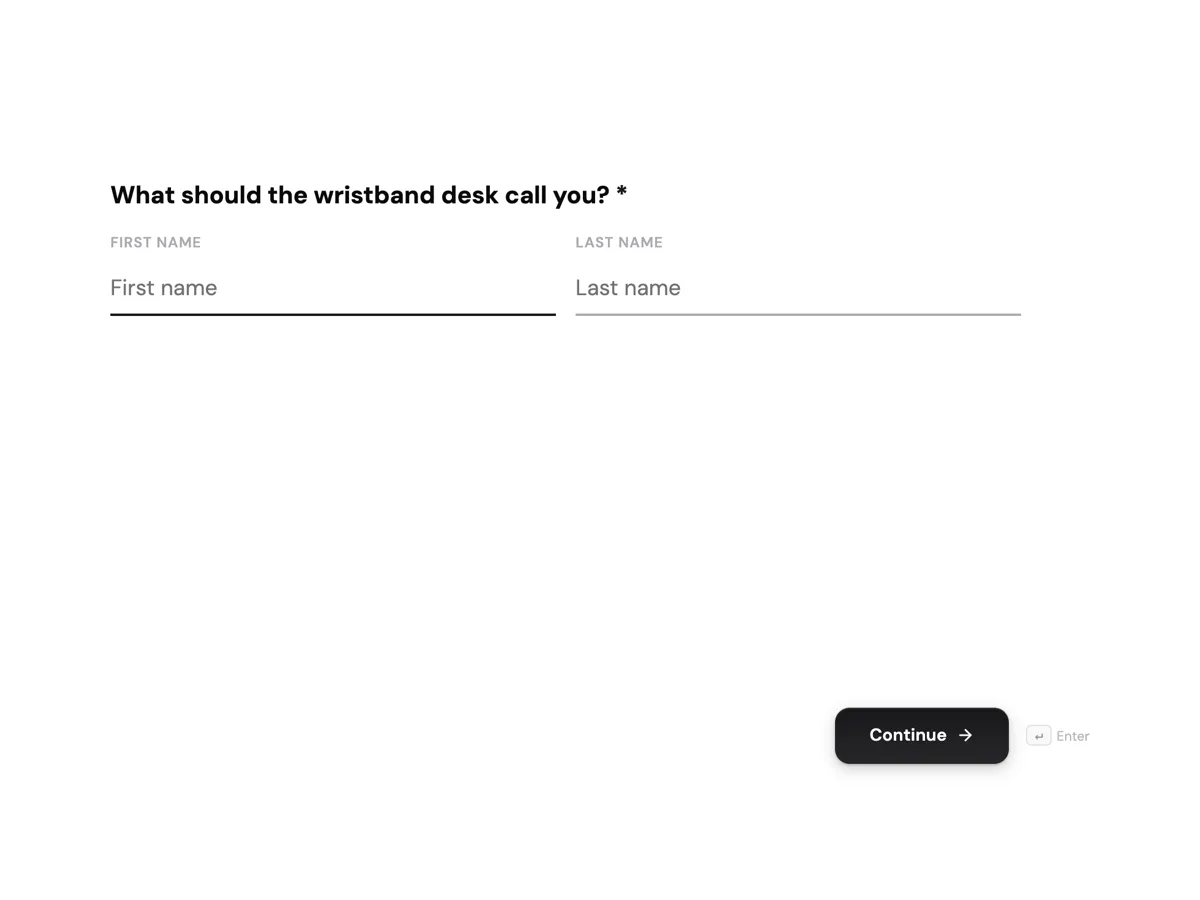
The first screen of the form. A conversational form shows one question per screen, so the remaining screens are listed in the field table below. Nothing here can be filled in or submitted, so read it as a reference and build your own from the button above.
Every field, and what it collects
The complete field list, in the order respondents meet it.
- What should the wristband desk call you?NameRequired
- Which of these is closest to you?Single choiceRequired
- It decides which plan gets printed. A Year 12 visitor and a career changer are sent to very different rooms.
- Options: Year 10 or 11 student · Year 12 student, applying this year · Finished school, taking a year out · Working, and thinking about retraining · Parent, carer or supporter · Teacher or careers adviser
- Email for your plan and your tour timeShort textRequired
- One email on the Thursday before, one on the morning. Nothing else, and nothing after September unless you ask for it.
- Mobile numberShort text
- Only used if a session moves rooms on the day. Leave it blank if you would rather we did not.
- Which campus are you coming to?Single choiceRequired
- The shuttle between them runs every twenty minutes, so you can start at one and finish at the other.
- Options: Riverside, for engineering, trades and agriculture · Halloran Street, for health, design, business and IT · Both, starting at Riverside
- What do you want to look at?Multiple choice
- Tick as many as you like. Anything you tick gets a room number and a time on your printed plan.
- Options: Engineering and advanced manufacturing · Electrical, plumbing and construction trades · Nursing and allied health · Agriculture and land management · Design and digital media · Business and accounting · IT, networking and cyber security · Still deciding, show me everything
- How many of you are coming?NumberRequired
- Counting yourself. This is what the catering, the parking marshals and the shuttle timetable are built from, so a rough number now beats an exact one never.
- Which campus tour would suit you?Dropdown
- Tours run for fifty minutes and take twenty five people. Booking one is the only part of the day with a limit on it.
- Options: 9.30am, Riverside · 11am, Riverside · 1.30pm, Riverside · 10am, Halloran Street · 12.30pm, Halloran Street · 2pm, Halloran Street · No tour, I will wander
- Anything we should know to make the day work for you?Long text
- The access team reads these on the Wednesday before and rings anybody whose answer needs a conversation.
- How did you hear about Open Day?Dropdown
- Options: My school · A careers adviser · Someone who studies here · Social media · Radio or a local paper · The institute website · A course guide in the post
What makes this form work
The visitor type question is the one that does the work
Six options, each written as a situation rather than a label, and the answer decides what gets printed. It is asked second, before email, because it is the question a visitor can answer without thinking and the one the institution most needs.
Group size is justified in the same breath as it is asked
People round down or skip a headcount when it looks like data collection. Saying that catering, parking marshals and the shuttle timetable are built from it turns the question into something the visitor has a reason to answer accurately.
The email promises exactly two messages and an end date
Two emails, one on the Thursday, one on the morning, and nothing after September. That is a specific enough commitment to be worth making, and it is why the field can be required without the visitor reaching for a throwaway address.
Questions people ask
What should an open day registration form ask beyond a name and an email?
Two things that change the day itself: what kind of visitor this is, and what they came to look at. A Year 12 applicant and a parent need different rooms, and a visitor who ticked nursing should not be handed a generic map. Group size is the third, because catering and parking are planned from it.
How do you stop a long list of subject areas becoming a wall of tickboxes?
Group them the way the campus is actually laid out, keep the list to eight, and put a "still deciding" option at the end that carries no penalty. On a conversational form the list gets a whole screen to itself, so eight options read as a short menu rather than a column squeezed beside another field.
Should the tour be a dropdown or a separate booking system?
A dropdown, until a tour actually sells out. The form records a preference; it cannot enforce a cap, because there is no per-option limit on a choice field. If the 11am fills up, someone has to email those registrants and move them, which for a once-a-year event is usually less work than running a second system.
Where do access needs belong on the form?
Near the end, as an open question with concrete examples in the placeholder, and with a line saying who reads it and when. Named examples give people permission to answer. A bare "any special requirements" gets left blank by exactly the people the question exists for.
Should an open day form ask how many people are coming?
Yes, because almost nobody comes alone. This form asks how many of you are coming, after the campus and the interests. Prospective students arrive with a parent, sometimes two, and catering, tour group sizes and wristbands all scale off that number rather than off the count of registrations.
Why ask which of these is closest to you?
Because a year eleven student, a parent and a mature age career changer need different emails afterwards. This form asks it second, straight after the name. One answer routes the follow up without asking three separate qualifying questions, and it keeps the rest of the form identical for everybody.
Build your own in about a minute
The button below opens the generator with this use case already described. Change the wording to match your own, generate, then edit anything you like.
Make one like thisOther form examples
Camp registration form
Camps do not run one registration form, they run a packet: the booking, the health record, the medication authority and the collection list. This is all four on one screen, ordered the way the camp office actually needs them on the first morning. It is a classic form, because four documents in one only works if a parent can scroll back to what they already wrote.
Webinar feedback survey template: content, audio and next topic
A webinar feedback survey has to separate what was said from how it came across on screen, and use the moment to decide the next session. This template asks whether people watched live or on replay and at what level, rates content, sound and length separately, and ends with a vote on next month's topic.
Conference registration form
A conference registration form template needs a name, an email, a ticket type and the few answers the organiser has to plan around: days, sessions, catering and access. This finished example for the two day Northbridge Tech Summit does that in three sections: who is coming, your ticket, and access and catering. Seven of its eleven fields are optional, so a Standard, Team or Virtual attendee can register in about three minutes and the organiser still gets a breakout track, a day selection and catering notes from everyone who fills it in.
Want the steps in the builder? Read Create a conversational form with AI, then Design your welcome and thank-you screens. For everything this generator can do, see the form maker.
Sources
Written and checked by the OneCraft team. Last checked .