Classic form
Property access consent form for a trade visit
A property access consent form records that a renter agreed to let a tradesperson in at a set time, with pets and keys sorted in advance. This one does that for a Victorian rental in eight fields, and its intro tells the renter what the notice rules would be if they did not agree.
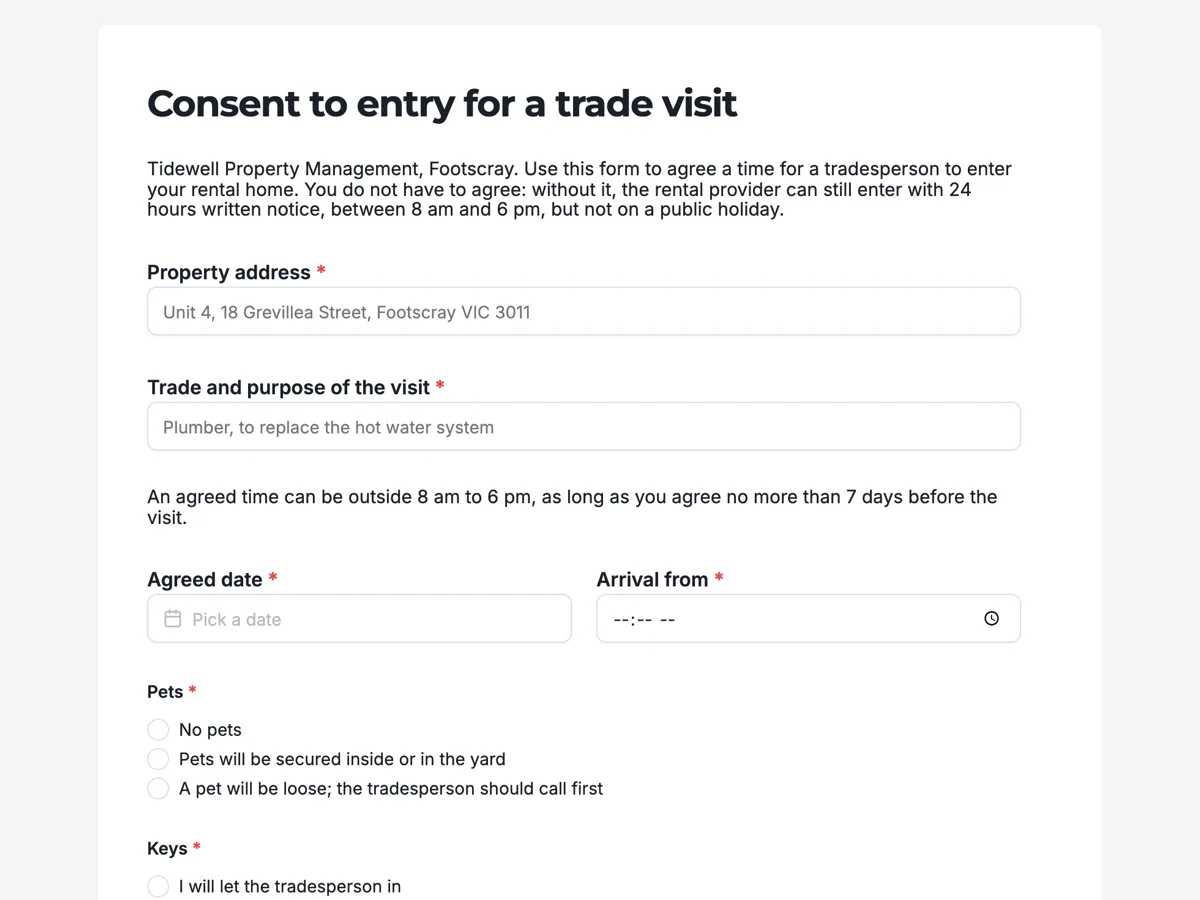
The form itself
A static copy of the finished form, exactly as it renders. Nothing here can be filled in or submitted, so read it as a reference and build your own from the button above.
Every field, and what it collects
The complete field list, in the order respondents meet it.
- Property addressShort textRequired
- Trade and purpose of the visitShort textRequired
- Agreed dateDateRequired
- Arrival fromTimeRequired
- PetsSingle choiceRequired
- Options: No pets · Pets will be secured inside or in the yard · A pet will be loose; the tradesperson should call first
- KeysSingle choiceRequired
- Options: I will let the tradesperson in · Use the office key, and return it the same day · A key will be left in a lockbox; I will text the code
- Will you be home?Single choiceRequired
- Options: Yes · No · For part of the visit
- Renter signatureSignatureRequired
What each field on this form collects
Property address is a short text with a Victorian street, suburb and postcode in the placeholder. Trade and purpose says who is coming and why, for example a plumber replacing the hot water system. A paragraph explains the 7 day rule, then the agreed date sits beside an arrival time. Pets is a radio of three, from no pets to a loose pet that needs a call first. Keys is a radio of three: the renter lets them in, the office key is used and returned the same day, or a lockbox code is sent by text. Will you be home is a three way radio, and the renter signs. All eight fields are required.
Why the form starts by saying no is allowed
A consent form that does not say the renter can refuse is not really asking for consent. The intro says it in plain words and gives the fallback: 24 hours written notice, 8 am to 6 pm, not on a public holiday. That honesty makes renters more willing to agree, because the form is clearly a way to pick a better time, not a demand. Each response covers one visit, so a renter who agrees once is not agreeing to every visit after it.
The Victorian rules this form follows
Consumer Affairs Victoria explains that a rental provider can enter for repairs with at least 24 hours written notice, between 8 am and 6 pm on any day except a public holiday. Entry at other times needs the renter's agreement, made no more than 7 days before the visit. The renter does not have to be home if valid notice was given or they agreed, and the people entering must not stay longer than needed. Other states have their own rules, so a property manager outside Victoria changes the intro and the 7 day paragraph.
How to adapt this form
A strata manager adds a common property question and a building access code field. A property manager in New South Wales rewrites the intro for that state's notice periods. An agency booking routine inspections uses a separate inspection notice, since those follow different rules.
What makes this form work
The fallback is printed up front
The intro gives the 24 hour notice rule and the 8 am to 6 pm window. The renter can see what agreeing changes before they answer anything.
Three ways to get the key
Renter lets them in, office key returned the same day, or a lockbox code by text. The tradesperson knows how to get in before they arrive.
Pets sorted before the van arrives
The pets radio includes a loose pet with a call first. The tradesperson does not open a gate onto a dog nobody mentioned.
Questions people ask
Does a renter have to sign a property access consent form?
No. Signing lets the renter choose a time that suits them, but without it the rental provider can still give written notice and enter within the legal hours. The intro says this, so the renter knows the form is an offer, not an obligation. A renter who does not want to agree can simply not submit.
Why ask about pets before a trade visit?
A loose dog is the most common reason a tradesperson leaves without doing the job, and an escaped cat is the most common complaint afterwards. Three answers cover the cases, including a loose pet where the tradesperson calls before entering. The answer goes to the tradesperson with the job.
Can one form cover several visits?
This one covers one visit, because the date and time fields hold one booking. Under the Victorian rule, agreement for entry outside the usual hours has to be made no more than 7 days before, so blanket consent for a month of visits would not fit. A second visit gets a second form.
How does the renter know who is coming?
The trade and purpose field names the trade, and the thank-you screen says the property manager will confirm the tradesperson. The form does not send that confirmation itself; the office does it by phone or message. A manager who wants a record can turn on an email alert so the office hears about each response.
Why not use the address field?
The address field's built in placeholders show a United States format. A short text with a Victorian street, suburb and postcode in the placeholder shows renters exactly what to write. One line is also easier to copy into a work order than five separate parts.
Build your own in about a minute
The button below opens the generator with this use case already described. Change the wording to match your own, generate, then edit anything you like.
Make one like thisOther form examples
Piercing consent form with an ID check and aftercare
A piercing consent form records who is being pierced, where, with what jewellery, and that the client is old enough, has declared relevant health conditions and has received aftercare instructions. This one, for an Australian studio, adds a photo of photo ID and a guardian signature for clients aged 16 or 17.
Photo consent form for a childcare centre, one use at a time
A photo consent form records where a child's photo may be used, for how long, and how a parent can withdraw that permission. This one asks Australian childcare families yes or no for four separate uses, whether a first name may appear, and whether there is a safety reason the child must not be identifiable.
Telehealth consent form for video and phone sessions
A telehealth consent form has to record how the session will run, where the client will physically be, what privacy risks they accept and who can be called in an emergency. This one asks those eight things on one page for a psychology practice, with the crisis numbers printed above the emergency question.
Want the steps in the builder? Read Form builder components, then View, export and manage your responses. For everything this generator can do, see the form maker.
Written and checked by the OneCraft team. Last checked .