Conversational form
Restaurant reservation form with the occasion and the seating
A restaurant reservation form has to settle the night, the time, the number of covers and where the party sits, because those four decide whether the table exists. This one adds the occasion, the dietary needs and a high chair, so the floor manager can place the booking before service instead of during it.
The form itself
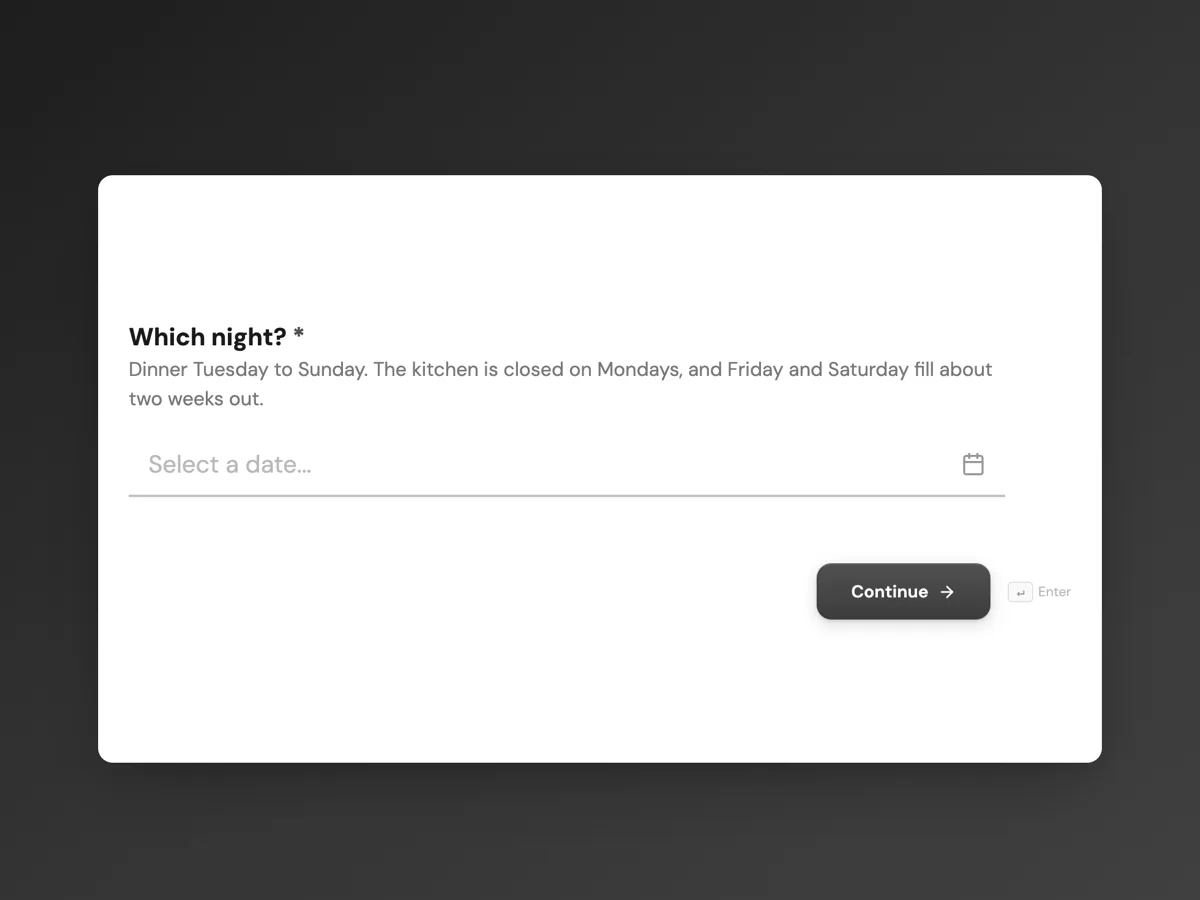
The first screen of the form. A conversational form shows one question per screen, so the remaining screens are listed in the field table below. Nothing here can be filled in or submitted, so read it as a reference and build your own from the button above.
Every field, and what it collects
The complete field list, in the order respondents meet it.
- Which night?DateRequired
- Dinner Tuesday to Sunday. The kitchen is closed on Mondays, and Friday and Saturday fill about two weeks out.
- What time would you like to sit down?Single choiceRequired
- Sittings start every half hour. Tables before 6.30 pm are returned by 8.15 pm for the second sitting.
- Options: 5.30 pm · 6.00 pm · 6.30 pm · 7.00 pm · 7.30 pm · 8.00 pm · 8.30 pm · 9.00 pm
- How many people, including children?NumberRequired
- Up to ten on this form. For eleven or more, the private dining room has its own enquiry form.
- Where would you like to sit?Single choiceRequired
- Options: Dining room, a quieter table · Bar counter, facing the open kitchen · Courtyard, outside under heaters · Wherever is free first
- Is it a special occasion?DropdownRequired
- Birthdays get a candle on dessert. Anniversaries and proposals get the corner tables if they are free.
- Options: No, just dinner · Birthday · Anniversary · Engagement or proposal · Business dinner · Celebrating something else
- Any dietary needs at the table?Multiple choice
- Tick everything that applies to anyone in the group. For a severe allergy, the server will go through the menu with you at the table.
- Options: Vegetarian · Vegan · Gluten free · Dairy free · Nut allergy · Shellfish allergy · Pregnant · None of these
- Do you need a high chair?Single choiceRequired
- There are three high chairs in the restaurant, so they are booked like tables.
- Options: No · Yes, one · Yes, two
- Who is the booking under?ProfileRequired
What each screen of this reservation asks, in order
Screen one is the date, with help text saying the kitchen is closed on Mondays. Screen two is the sitting as eight half hour times from 5.30 pm to 9 pm, noting that early tables turn at 8.15 pm. Screen three is the number of people including children, capped in words at ten with the larger groups sent to private dining. Screen four is the seating area: dining room, bar counter, courtyard or wherever is free first. Screen five is the occasion as a dropdown, from no occasion to a proposal. Screen six is a checkbox of dietary needs for the whole table, with none of these as its last option. Screen seven asks about a high chair, of which there are three. Screen eight is a profile block taking the name, email and a mobile for the confirmation text.
Why the time is a list and not a clock
A restaurant does not seat at 7.10 pm. It runs sittings, and a free time field invites requests the floor plan cannot honour. Listing the eight real start times turns every answer into one the manager can say yes to, and the note about early tables returning by 8.15 pm puts the second sitting in plain view before anyone books a 6 pm table expecting to stay until ten.
How to adapt this form
A wine bar that takes walk ins for the bar keeps the form for the dining room only and drops the seating screen. A family restaurant moves the high chair question next to the party size and adds a pram parking question, because a courtyard table with two prams is a different table. A degustation restaurant replaces the occasion dropdown with a required dietary screen and a note that the menu cannot change on the night, since a set menu needs every restriction before the shopping is done.
What makes this form work
Eight real sitting times
The time screen lists 5.30 pm to 9 pm in half hours, the actual start times, with a note that early tables turn at 8.15 pm. Every request lands on a time the floor plan can use, and the second sitting rule is read before anybody books.
Seating is asked, including no preference
Dining room, bar counter facing the kitchen, courtyard under heaters, or wherever is free first. The last option is the one that makes a busy Saturday possible, because it marks which guests the manager can move without disappointing anyone.
The high chair is booked, not assumed
Three high chairs, one required question with no, one or two. It is the smallest screen on the form and it removes the most common family complaint at the door, which is arriving to find there is nothing for the baby to sit in.
Questions people ask
Does this reservation form hold the table automatically?
No. It sends a request, and the floor manager replies by text between 11 am and 4 pm, which the thank-you screen says. A form does not read the booking diary. What it does is arrive with the date, sitting, party size and seating area already settled, so the reply is a yes or two alternative times.
Why is the party size capped at ten?
Because eleven or more needs the private room, a set menu and a deposit, which is a different conversation. The help text under the number says so and names the private dining enquiry instead. A conversational number field does not stop a larger number being typed, so the cap is stated in words and checked by the manager.
Why ask about dietary needs before the night?
Because the kitchen preps before service, and a vegan guest or a shellfish allergy changes what is set aside. The checkbox covers the whole table in one tick list, and the help text says a severe allergy is gone through with the server in person, which is where the detail belongs rather than in a form.
What does the occasion question change?
Placement and a small gesture. Birthdays get a candle on dessert, and anniversaries and proposals get the corner tables when they are free. Business dinners are seated away from the bar. Knowing the occasion before the night lets the floor plan reflect it, which is very hard to fix once the room is full.
Why is a high chair its own screen?
There are only three, so they are booked like tables. Asking separately catches the family who would otherwise arrive at 7 pm on a Saturday to find all three in use. The answer is required, so every booking states yes or no and none of them leaves the question unanswered.
Can a restaurant take a deposit through this form?
Not through the form itself, since a form collects answers rather than payments. A restaurant that wants deposits on weekend tables can mention the deposit on the thank-you screen and send a payment link in the confirmation text. The redirect add-on can also send the guest straight to a payment page after submitting.
Build your own in about a minute
The button below opens the generator with this use case already described. Change the wording to match your own, generate, then edit anything you like.
Make one like thisOther form examples
Nail appointment booking form that asks about removal first
A nail appointment overruns for one reason more than any other, which is that the previous set had to come off and nobody booked time for it. This booking form asks about removal on the second screen, before the date is chosen, and takes the saved design as an upload so the technician can say whether it fits the slot.
Barber booking form with the cut and the beard timed separately
A barbershop books in fifteen minute blocks, so a booking form that cannot tell a buzz cut from a skin fade with a hot towel shave is just a message with extra steps. This one asks the cut and the beard as two separate questions, each carrying the minutes the chair is held for, and it finishes on a mobile number because confirmation happens by text.
Salon booking form that asks what has been on your hair
A salon booking goes wrong when the slot booked and the service required are different lengths, and colour is where that gap gets expensive. This booking form puts the real duration beside every service, asks what has been on the hair in the last twelve months, and checks whether a patch test exists before anybody is offered a colour appointment.
Want the steps in the builder? Read Create a conversational form with AI, then Design your welcome and thank-you screens. For everything this generator can do, see the form maker.
Sources
Written and checked by the OneCraft team. Last checked .