Conversational form
Coffee bean subscription order form with grind and cadence
A coffee bean subscription order form has to match the grind to how the person brews and the delivery gap to how fast they drink, or the beans arrive stale or too late. This one asks both on their own screens, explains each choice in grams and cups, and sets the first roast date before taking the address.
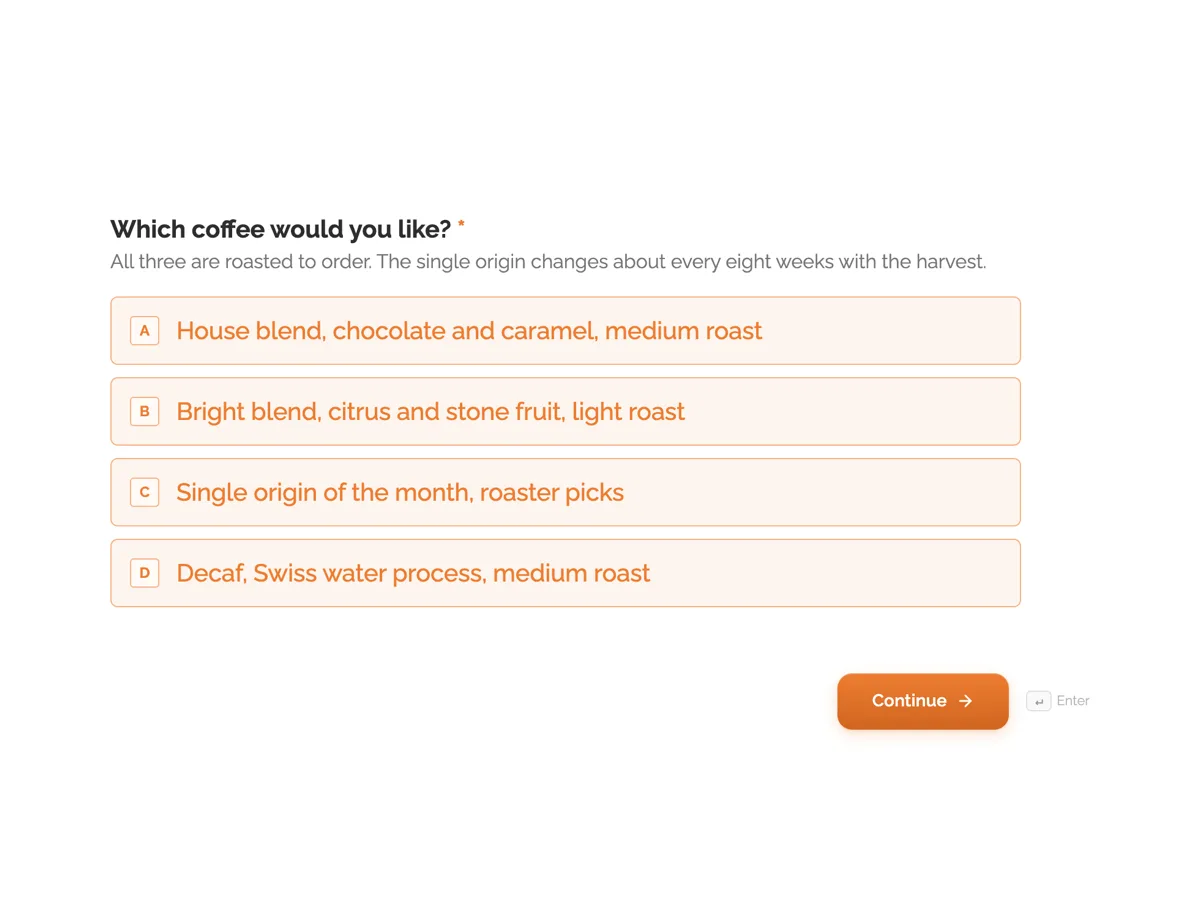
The form itself
The first screen of the form. A conversational form shows one question per screen, so the remaining screens are listed in the field table below. Nothing here can be filled in or submitted, so read it as a reference and build your own from the button above.
Every field, and what it collects
The complete field list, in the order respondents meet it.
- Which coffee would you like?Single choiceRequired
- All four are roasted to order. The single origin changes about every eight weeks with the harvest.
- Options: House blend, chocolate and caramel, medium roast · Bright blend, citrus and stone fruit, light roast · Single origin of the month, roaster picks · Decaf, Swiss water process, medium roast
- How should it be ground?Single choiceRequired
- Whole beans stay fresh longest. If you grind, choose the method you use most, because each needs a different grind size.
- Options: Whole beans, I grind at home · Espresso, fine · Moka pot, fine to medium · Pour over or drip filter, medium · Plunger or cold brew, coarse
- What size bag?Single choiceRequired
- A 250 g bag makes about 14 espresso shots or 16 mugs of filter coffee.
- Options: 250 g · 500 g · 1 kg
- How often should it arrive?Single choiceRequired
- Pick the gap that finishes one bag just before the next lands. One person drinking two cups a day gets through 250 g in about two weeks.
- Options: Every week · Every two weeks · Every three weeks · Every four weeks
- When should the first bag be roasted?DateRequired
- The roaster runs on Mondays and Thursdays and ships the same day. Choose any date and the first bag goes out on the next roast day.
- Where should the coffee go?AddressRequired
- Bags fit most letterboxes up to 500 g. A 1 kg bag is left at the door.
- Anything the courier should know?Short text
- Who is the subscription for?ProfileRequired
What each screen of this subscription asks
Blend is a radio of four: a medium house blend, a light bright blend, a rotating single origin and a Swiss water decaf, each with its tasting notes. Grind is a radio of five, from whole beans through espresso, moka pot and pour over to coarse for a plunger or cold brew. Bag size is 250 g, 500 g or 1 kg, with a help line converting 250 g into shots and mugs. Frequency runs from every week to every four weeks. The first roast date is a date question, and its help text names the two roast days. The delivery address follows, then an optional note for the courier, then a profile block with name, email and mobile. Seven of the eight screens are required.
Why grind and frequency get the most explanation
These are the two answers that decide whether a subscriber stays. Coffee ground for espresso and brewed in a plunger tastes thin and muddy, and the subscriber blames the beans. Naming the brew method instead of asking for fine, medium or coarse means the person answers a question they actually know. Frequency is the other way people quietly cancel: too often and bags pile up and go stale, too rarely and they buy coffee elsewhere. The help text gives a rule of thumb, one person at two cups a day uses 250 g in about two weeks, so the first choice is close to right.
How to adapt this form
A roaster selling to offices replaces bag size with kilograms per week and adds a machine type question. A tea subscription keeps the structure and swaps grind for loose leaf or bags. A gift subscription adds a screen for the recipient and a fixed number of deliveries, so it ends on its own instead of renewing.
What makes this form work
Grind is asked as a brew method
Five options, from whole beans to coarse for a plunger or cold brew, each named for the equipment. A subscriber who has never heard of burr settings still picks the right grind.
Bag size comes with a cups guide
The help text turns 250 g into about 14 espresso shots or 16 mugs. With that number, choosing between every week and every four weeks becomes arithmetic rather than a guess.
The first date is a roast date
The date screen names Mondays and Thursdays as roast days and ships the same day. The subscription starts from freshness, which is the promise a roaster is selling.
Questions people ask
Should a coffee subscription offer pre ground beans?
Yes, because many people do not own a grinder, but whole beans should be the first option. Ground coffee loses aroma within days, so a subscriber who grinds at home gets a better cup. Offering grind by brew method keeps pre ground orders usable, and the help text tells people why whole beans last longer.
How many cups does a 250 g bag make?
Roughly 14 double espresso shots at about 18 g each, or 16 mugs of filter coffee at about 15 g each. The form prints that conversion under the bag size question, so a household can multiply by its own cups a day and choose a bag size and frequency that line up.
Does the form take payment for the subscription?
No. The form records the order, and the thank-you screen says the roastery emails a confirmation with the price per delivery and a payment link. Nothing is charged until the subscriber confirms. Keeping payment out of the form also lets the roaster check the address and roast day before the first charge.
Why ask for a first roast date rather than a start date?
Because freshness is counted from the roast, not from the order. The help text says the roaster runs on two days a week and ships the same day, so any date chosen maps to the next roast. Subscribers moving house or travelling can push the first bag out without a separate message.
How does a subscriber pause or cancel?
The welcome screen says a week of notice pauses, skips or stops the subscription. The form only starts it, and a submitted response cannot be edited, so changes go to the roastery by email or a reply to the confirmation. Stating the cancellation terms before the first charge is also what subscription laws expect.
Why is the courier note optional?
Most addresses need no instructions, and a required note would collect a lot of none. The placeholder shows the kind of note that helps, a parcel locker and a code, and the address help text already says which bag sizes fit a letterbox. People in apartment blocks fill it in without being asked.
Build your own in about a minute
The button below opens the generator with this use case already described. Change the wording to match your own, generate, then edit anything you like.
Make one like thisOther form examples
Flower order form with the occasion, budget and card message
A flower order form has to settle what the flowers are for, how much to spend, what the card says and exactly where and when they arrive. This one asks each on its own screen, leaves the stems to the florist inside a style and colour brief, and separates the person receiving from the person paying.
Bakery pre order form for pickup day and time
A bakery pre order form has to tell the bakers how many of each loaf and pastry to bake for which morning, and tell the counter whose bag goes on the shelf and when they will come. This one starts with an item and quantity table, asks the pickup day and an hourly window, and settles slicing and packing before the dough is shaped.
Meal prep order form with a weekly menu grid
A meal prep order form has to turn a weekly menu into a cooking list: which meals, how many of each, what size and which delivery day. This one prints the week's menu above a seven row meal and quantity table, asks portion size and dietary swaps, and is set up to send each order to the kitchen sheet by webhook.
Want the steps in the builder? Read Create a conversational form with AI, then Design your welcome and thank-you screens. For everything this generator can do, see the form maker.
Sources
Written and checked by the OneCraft team. Last checked .