Conversational form
Gym member satisfaction survey for classes, equipment and hours
A gym member satisfaction survey has to show where members are frustrated, the equipment, the timetable or the crowding, in a way that points at a spending decision. This one asks when people train, rates each equipment area in one grid, checks crowding at their usual time and ends with the one change they want.
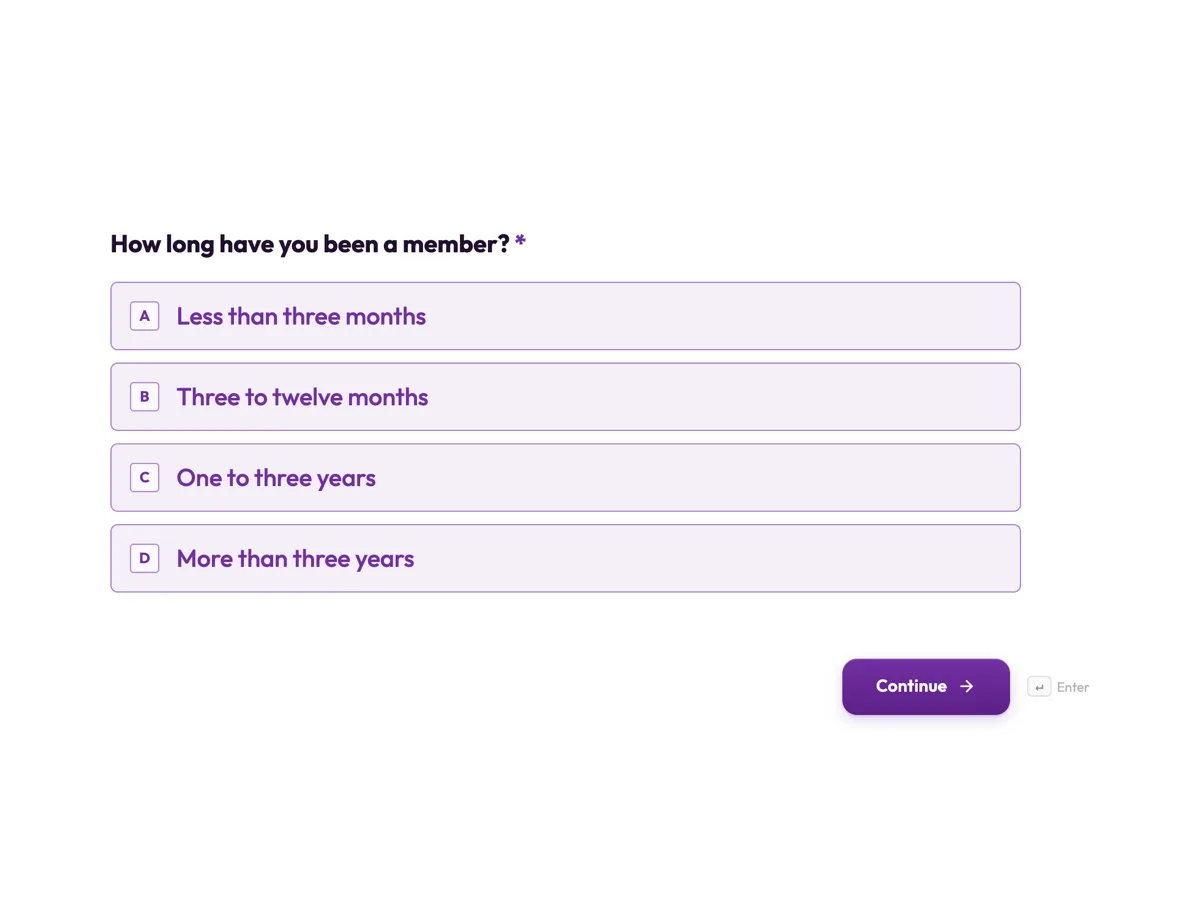
The form itself
The first screen of the form. A conversational form shows one question per screen, so the remaining screens are listed in the field table below. Nothing here can be filled in or submitted, so read it as a reference and build your own from the button above.
Every field, and what it collects
The complete field list, in the order respondents meet it.
- How long have you been a member?Single choiceRequired
- Options: Less than three months · Three to twelve months · One to three years · More than three years
- How many times a week do you usually train here?Single choiceRequired
- Options: Less than once · Once · Two or three times · Four or more times
- When do you usually train?Single choiceRequired
- Options: Early morning, before 8am · Daytime, 8am to 4pm · After work, 4pm to 7pm · Evening, after 7pm · Weekends mostly
- Rate the equipment in each areaRating gridRequired
- Think about condition and whether there is enough of it. Skip areas you never use.
- Statements:
- Cardio machines
- Free weights
- Weight machines
- Squat racks and platforms
- Stretching and mat area
- Which classes have you been to in the last month?Multiple choice
- Options: Spin · HIIT · Yoga · Pilates · Boxing · Strength circuit · None
- At your usual time, how crowded is the gym?Single choiceRequired
- Options: Plenty of room · Busy but fine · I often wait for equipment · Too crowded to train properly
- How clean are the gym floor and change rooms?Single choiceRequired
- Options: Very clean · Clean enough · Often untidy · Not clean
- How helpful are the floor staff and trainers?Single choiceRequired
- Options: Very helpful · Helpful when asked · Hard to find · Not helpful
- If you could change one thing about Anvilgate, what would it be?Long textRequired
What each screen of this survey collects
Membership length and weekly visits are radios of four. Usual training time is a radio of five windows, from before 8am to weekends. The equipment grid rates cardio machines, free weights, weight machines, squat racks and the stretching area from poor to excellent, with a note to skip areas never used. Classes attended is an optional checkbox of six classes plus none. Crowding asks about the member's own usual time. Cleanliness and staff are radios of four. The one change is a required long text with a placeholder showing a specific, fixable answer. Eight of the nine screens are required.
Why crowding is asked about the member's own time
A general question about how busy the gym is gets a general answer. Asking how crowded it is at your usual time, right after the question on when that is, produces a map: if most after work members say they wait for equipment while early risers say there is plenty of room, the fix is more racks or a timetable change between 4pm and 7pm, not a bigger gym. The equipment grid works the same way, by area, so the budget goes to the area with low scores from the people who use it. The required one change question is the tie breaker when two areas score alike.
How to adapt this survey
A boutique studio replaces the equipment grid with a class grid rating instructor, music and difficulty. A climbing gym lists wall areas and route setting. A council leisure centre adds pool lanes and a question on fees, and a 24 hour gym adds a screen on staffed versus unstaffed hours.
What makes this form work
Crowding is tied to a time
Usual training time comes just before the crowding question, so complaints about waiting map onto one window of the day.
Equipment is rated by area
Five areas share one poor to excellent grid, so the budget goes to the racks or the cardio floor, wherever scores are low.
One change is required
The final question must be answered and its placeholder models a specific request, giving the club a ranked wish list in members' words.
Questions people ask
How often should a gym survey its members?
Twice a year is enough for a full survey like this, timed before budget decisions and before the timetable changes. More often, and members stop answering. Between surveys, a single question at check in, such as how was today, can catch sudden problems like a broken machine or a dirty change room.
Should a gym survey be anonymous?
This one does not ask for a name, which makes members more honest about staff and cleanliness. The link can still be sent only to members so outsiders do not answer. If you want to follow up on complaints, add an optional email screen at the end and say that leaving it blank is fine.
What does a low equipment score usually mean?
Either the equipment is worn or there is not enough of it, and the grid's help text asks members to think of both. Read the score with the crowding answers for the same training times. A low free weights score from members who also report waiting points at quantity; from members who report plenty of room, at condition.
How can survey answers reduce membership cancellations?
Members who say they cannot train properly at their usual time are the ones most likely to leave. Fixing the busiest window, adding a class at that time or extending staffed hours, addresses the cause rather than offering a discount. Comparing these answers with cancellation reasons over the following months shows whether the change worked.
Can this survey show which classes to cut?
Partly. The classes checkbox shows how many respondents went to each class in the last month, which reflects popularity among people who answered. Combine it with class attendance records before cutting anything. A small class can be loved by a loyal group who would leave without it, which no survey count will show.
Why ask staff helpfulness separately from trainers' skill?
Members rarely judge a trainer's technical skill, but they notice whether anyone is on the floor to help or to fix a machine. The answer hard to find is the useful one: it usually reflects rostering, not attitude. Personal training clients can be asked about their trainer in a separate, shorter survey.
Build your own in about a minute
The button below opens the generator with this use case already described. Change the wording to match your own, generate, then edit anything you like.
Make one like thisOther form examples
Pricing survey template with the four Van Westendorp questions
A pricing survey finds the range of prices buyers will accept by asking where a price becomes too cheap to trust, a bargain, expensive and too expensive. This template asks those four Van Westendorp questions for a paid app plan, after current spend, and follows them with the features people would use and who they are.
Brand awareness survey template with unaided and aided recall
A brand awareness survey measures how many people in a market know a brand, first without any prompt and then from a list, and what they think of it. This template asks unaided recall before any brand is shown, then aided recall, purchase and consideration from the same eight names, and an association grid.
Post purchase survey template: discovery, checkout and delivery
A post purchase survey has to walk the order from the buyer's side, from how they found the shop to the moment the box was opened, so each team sees its own part. This template asks one question per stage, adds an optional photo of the product at home, and ends on a recommendation score.
Want the steps in the builder? Read Create a conversational form with AI, then View, export and manage your responses. For everything this generator can do, see the form maker.
Written and checked by the OneCraft team. Last checked .