Classic form
Gym membership form
A membership application for Ironbark Fitness that gets a new member from first visit to signed up in one sitting. Five sections cover personal details, an emergency contact, the membership plan and payment method, the seven question PAR-Q health screen as a yes or no grid, and a waiver signed on screen. About five minutes.
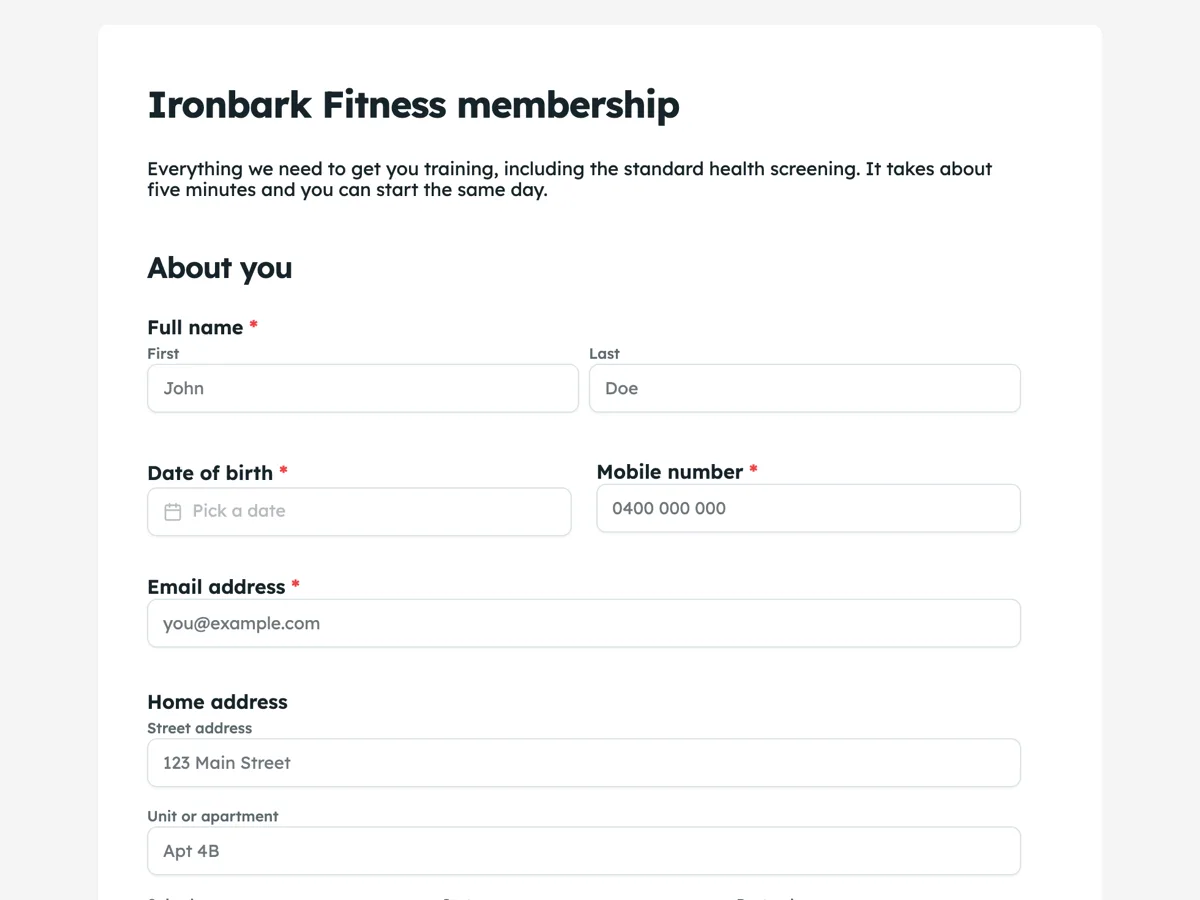
The form itself
A static copy of the finished form, exactly as it renders. Nothing here can be filled in or submitted, so read it as a reference and build your own from the button above.
Every field, and what it collects
The complete field list, in the order respondents meet it.
- Full nameNameRequired
- Date of birthDateRequired
- Mobile numberShort textRequired
- Email addressShort textRequired
- Home addressAddress
- Contact nameShort textRequired
- Relationship to youShort text
- Contact phoneShort textRequired
- Membership planSingle choiceRequired
- Options: Full access, $24.90 per week · Off peak, weekdays before 4pm, $18.90 per week · Classes only, $16.90 per week · 12 month paid upfront, $999
- Preferred start dateDateRequired
- How would you like to pay?Single choice
- Options: Direct debit from a bank account · Recurring card payment · Paid upfront
- What are you training for?Multiple choice
- Options: General fitness · Strength · Weight loss · Sport specific · Rehabilitation · Something else
- Physical Activity Readiness QuestionnaireRating grid
- Statements:
- Has your doctor ever said that you have a heart condition, or that you should only do physical activity recommended by a doctor?
- Do you feel pain in your chest when you do physical activity?
- In the past month, have you had chest pain when you were not doing physical activity?
- Do you lose your balance because of dizziness, or do you ever lose consciousness?
- Do you have a bone or joint problem that could be made worse by a change in your physical activity?
- Is your doctor currently prescribing drugs for your blood pressure or a heart condition?
- Do you know of any other reason why you should not do physical activity?
- If you answered yes to any of the above, tell us moreLong text
- SignedSignatureRequired
About you
Emergency contact
Your membership
Health screening
Waiver and signature
Question banks built on this form
What makes this form work
The PAR-Q is a grid, not seven questions
The Physical Activity Readiness Questionnaire is a single rating grid with Yes and No columns and the seven standard statements as rows, from a doctor diagnosed heart condition through chest pain, dizziness, joint problems and blood pressure medication. One grid reads as a quick pass rather than an interrogation, and every response comes back in the same shape for the trainer to review.
The screening explains itself first
A short paragraph above the grid says these are the seven standard PAR-Q questions and that answering yes does not stop you joining, it only means checking with your doctor and building the programme around it. A long text box underneath, "If you answered yes to any of the above, tell us more", collects the detail without a phone call.
The waiver is signed on the spot
The final section prints the waiver as a paragraph: the information is true, exercise carries risk, the member takes part at their own risk, will report health changes and has read the terms and cancellation policy. The member then signs in the required Signature field, which is what records their agreement. Nothing is printed or scanned, and plan, start date and payment method are already captured above.
Questions people ask
What is the PAR-Q?
The Physical Activity Readiness Questionnaire, the widely used pre exercise health screen. It is seven yes or no questions about heart conditions, chest pain, dizziness, joint problems, blood pressure medication and any other reason not to exercise. On this form the seven sit as rows of one grid, with a text box under it for the detail behind any yes.
Does answering yes to a PAR-Q question stop someone joining?
No. It means the gym asks them to check with their doctor first and builds the program around it. The paragraph above the grid says so in plain words, and that matters, because people who think a yes will stop them joining answer no to avoid the hassle. A true yes that leads to a doctor's note is safer for everyone than a false no.
Is a signature on a web form enough for a waiver?
An inline signature is drawn or typed by the member and stored with their response, and it prints into the response PDF. For a membership waiver that is usually enough evidence that a named person read the terms. For a countersigned agreement, use the e-signature add-on instead, so each signer gets their own emailed link and a certificate of completion.
What membership and payment options does the form offer?
Four plans as a single choice: full access at $24.90 a week, off peak weekdays before 4pm at $18.90, classes only at $16.90, or twelve months paid upfront at $999. A separate question asks whether to pay by direct debit, recurring card or upfront. The waiver also refers to the membership terms and cancellation policy, which in Australia must not contain unfair contract terms.
Why ask what somebody is training for?
Because it is the one answer that changes the first session. This form asks it just before the health screening, so a trainer sees the goal and the risk together. A member training for a first ten kilometre run needs a different induction from one rebuilding after surgery, and the goal is also what brings them back in week six.
Should a membership form ask for a preferred start date?
Yes, because a joining date and a billing date are not the same thing. This form asks for a preferred start date beside the plan and the payment method. Somebody signing up on the twenty eighth usually wants to start on the first, and a form that assumes today creates a refund conversation in the first week.
Build your own in about a minute
The button below opens the generator with this use case already described. Change the wording to match your own, generate, then edit anything you like.
Make one like thisOther form examples
Patient intake form
A patient intake form template collects who the patient is, why they are coming in, their history, medicines and allergies, how they will pay and their signed consent, before the first appointment. This one is a new patient registration for an Australian general practice, filled in at home in about ten minutes. Seven sections walk from personal details and an emergency contact to the reason for the visit, medical and family history, a medicines table, lifestyle, health fund details with a card photo, and three consent ticks signed by the patient or a guardian.
Therapy intake form that asks the safety question properly
A counselling intake form does two things a medical one does not: it lets the client say in their own words why they came, and it asks about safety in a way that is honest about what happens to the answer. This form does both, then takes the consent to counselling and the cancellation terms before the first session.
Dental patient intake form the dentist can read before you sit down
A dentist needs ten medical facts before touching a patient, and a paper form on a clipboard in the waiting room gets them four minutes before the appointment. This form asks for them on the phone the day before, with the health fund and child benefit questions the front desk needs, and the consent lines signed once.
Want the steps in the builder? Read Create a form from scratch with AI, then Send a PDF for e-signature. For everything this generator can do, see the form maker.
Written and checked by the OneCraft team. Last checked .