Classic form
Therapy intake form that asks the safety question properly
A counselling intake form does two things a medical one does not: it lets the client say in their own words why they came, and it asks about safety in a way that is honest about what happens to the answer. This form does both, then takes the consent to counselling and the cancellation terms before the first session.
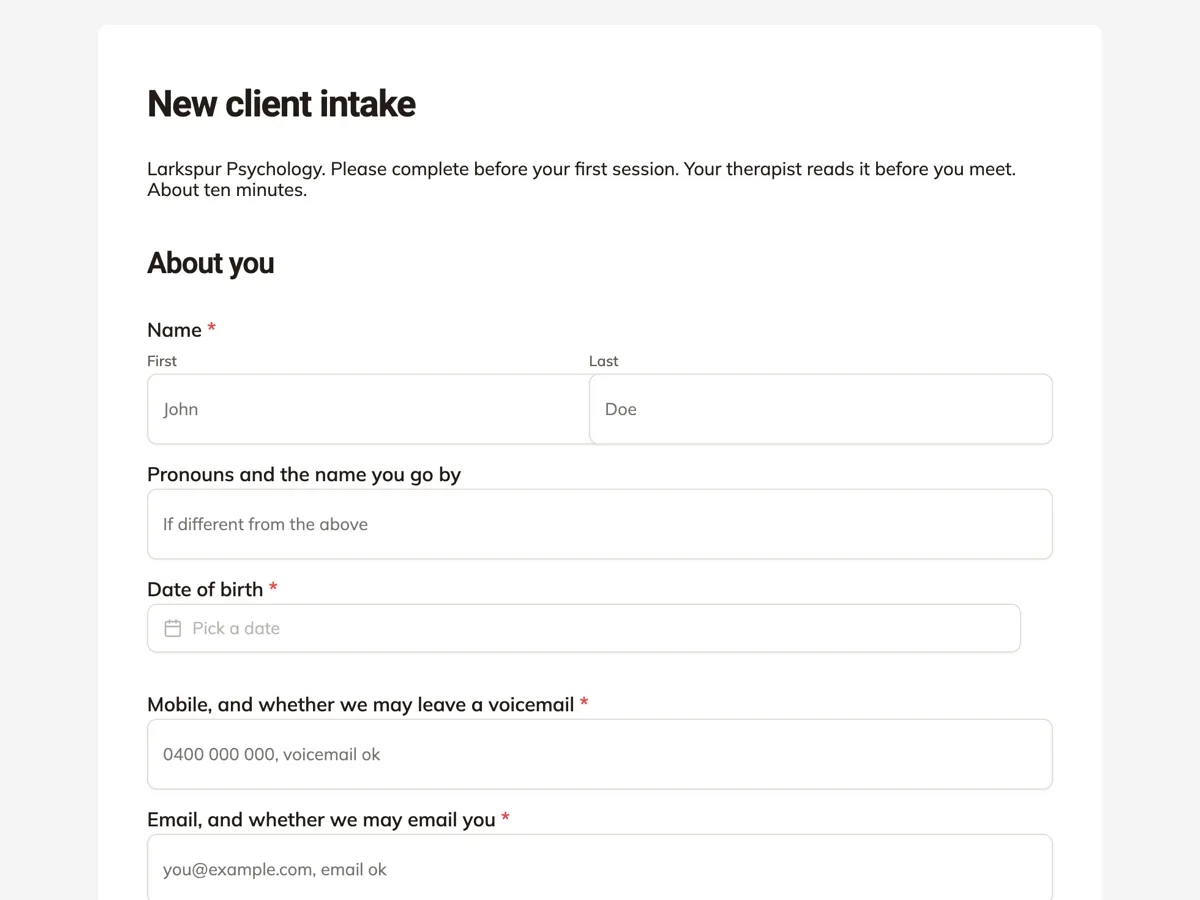
The form itself
A static copy of the finished form, exactly as it renders. Nothing here can be filled in or submitted, so read it as a reference and build your own from the button above.
Every field, and what it collects
The complete field list, in the order respondents meet it.
- NameNameRequired
- Pronouns and the name you go byShort text
- Date of birthDateRequired
- Mobile, and whether we may leave a voicemailShort textRequired
- Email, and whether we may email youShort textRequired
- Emergency contact, relationship and phoneShort textRequired
- GP name and practiceShort text
- Referred bySingle choiceRequired
- Options: GP with a Mental Health Treatment Plan · Self · Employer EAP · NDIS · Other
- In your own words, what brings you to counselling now?Long text
- What would you like to be different in three months?Long text
- Over the last two weeks, how often have youRating grid
- Statements:
- Felt down or hopeless
- Had little interest in things
- Felt nervous or on edge
- Slept badly
- Struggled to concentrate
- Previous counselling or psychiatric careSingle choice
- Options: None · Some · Ongoing elsewhere
- Current medicationsLong text
- Have you had thoughts of harming yourself in the last month?Single choiceRequired
- Options: No · Yes · Prefer to discuss in session
- I have read the above and consent to counsellingMultiple choiceRequired
- Options: I consent
- SignatureSignatureRequired
About you
Why you are here
Safety
Consent and fees
Question banks built on this form
Asking about safety on a form
The safety question fails two ways: not asked at all, or asked like a checkbox on a tax return. This form frames it with a paragraph that does three honest things before the question appears. It says everyone is asked, so a yes is not self-selection into a category. It says what happens next, the therapist raises it gently in the first session, so the answer has a known consequence rather than an imagined one. And it puts Lifeline on 13 11 14 and 000 in the same breath, because a form is not a crisis service and should say where the crisis service is. The third answer, prefer to discuss in session, exists because some true answers are not ready to be typed.
How to adapt this form
A couples version duplicates the contact block for a second client and asks the presenting concern once, since the relationship is the client. A school counsellor version adds a guardian consent block and swaps the fees paragraph for the school's referral pathway. An EAP version removes fees entirely, adds the employer program name, and states clearly what the employer does and does not learn, which is the confidentiality question every EAP client is silently asking. The safety section transfers to all of them unchanged, paragraph first, three answers, no exceptions.
What makes this form work
The safety question has three answers, not two
No, yes, and prefer to discuss in session. The third option is the pressure valve that keeps the question honest: a client who cannot type the word yes can still tell the truth, and the therapist still knows to open the conversation. Its existence is why the answers can be believed.
The confidentiality limits sit above the consent tick
Serious risk to self or others, or a legal requirement: the two exceptions to confidentiality are printed in plain words on the form, in the same paragraph as the fee and the cancellation rule, directly above the I consent checkbox. Nobody consents to a document they have not seen.
Contact permissions are collected with the contact details
The mobile field asks in the same line whether a voicemail may be left, and the email field whether email is welcome. For a counselling client sharing a house or an inbox, those permissions are the difference between discretion and disclosure, and this form treats them as part of the address.
Questions people ask
Should an intake form ask about self harm?
Yes, when the practice can state what it will do with the answer, and this one does: the paragraph above the question promises a gentle follow up in session, and the thank-you screen adds a phone call within a working day if the answers suggest support is needed sooner. A safety question without a stated follow up is surveillance, not care.
Is the five item mood grid a diagnosis?
No. It is a brief screen in the style of the standard two week instruments, five statements rated from not at all to nearly every day, and it is optional. It gives the therapist a starting temperature before the first session; the full validated questionnaires are administered properly later if needed.
Why is the presenting concern optional?
Because some clients cannot write it yet, and the form should not be a wall between them and the first appointment. The welcome screen says outright that everything except contact and consent can be left blank. An empty box tells the therapist something too, and the session starts there.
Who sees these answers, and where do they live?
The client's therapist, before the first session, and the practice under its login. Psychologists in Australia work under a code of conduct and privacy law that treat health information as the most sensitive category there is; the linked pages set out those obligations. The form collects nothing the first session would not.
What is a Mental Health Treatment Plan and why does the form ask?
A GP-issued plan that opens Medicare rebates for a set number of psychology sessions. The referral question puts it first among the options because it changes the fee conversation: the paragraph in the consent section mentions the rebate, and the desk confirms the numbers before the first invoice.
Can this be completed on a phone?
Yes. The flow layout stacks to a single column on a phone screen, the grid is five rows, and ten minutes is the honest estimate on the welcome screen. Clients often complete it the evening before, which is exactly when the in-your-own-words answer gets written properly.
Build your own in about a minute
The button below opens the generator with this use case already described. Change the wording to match your own, generate, then edit anything you like.
Make my therapy intake form that asks the safety question properlyOther form examples
Psychology intake form with the limits of confidentiality on it
A first psychology session has fifty minutes and a person who has usually waited weeks for it, so the history should not eat the first twenty. This twenty field intake form takes the referral pathway, a ten item distress baseline and the supports already in place, and states the limits of confidentiality above the signature.
Patient intake form
A new patient registration form for a clinic, filled in before the first appointment in about ten minutes. Eight sections walk from personal details and an emergency contact to the reason for the visit, medical history, a medications table, allergies, family history, lifestyle, health fund details with a card photo, and a three line consent signed by the patient or a guardian.
Massage intake form that asks about pressure before the table
A client lying face down with their eyes closed will almost never ask for lighter pressure or say that they would rather their feet were left alone. This fourteen field intake form asks both in advance, alongside a contraindication screen that adapts the technique rather than cancelling the booking.
Want the steps in the builder? Read Form builder components, then Control who can fill in your form. For everything this generator can do, see the form maker.
Written and checked by the OneCraft team. Last checked .