Classic form
Workshop registration form
A workshop registration form takes the person's contact details, the date and the rate they are booking, anything the tutor should set up differently, and their agreement to the cancellation policy and safety terms. This one books a paid one day ceramics workshop with ten places, and it is built around the two things that go wrong with paid classes: somebody cancelling late and somebody arriving with a need the studio has not prepared for. It is a classic form on one page, because a booking that ends in a signature is something people want to see whole before they sign it.
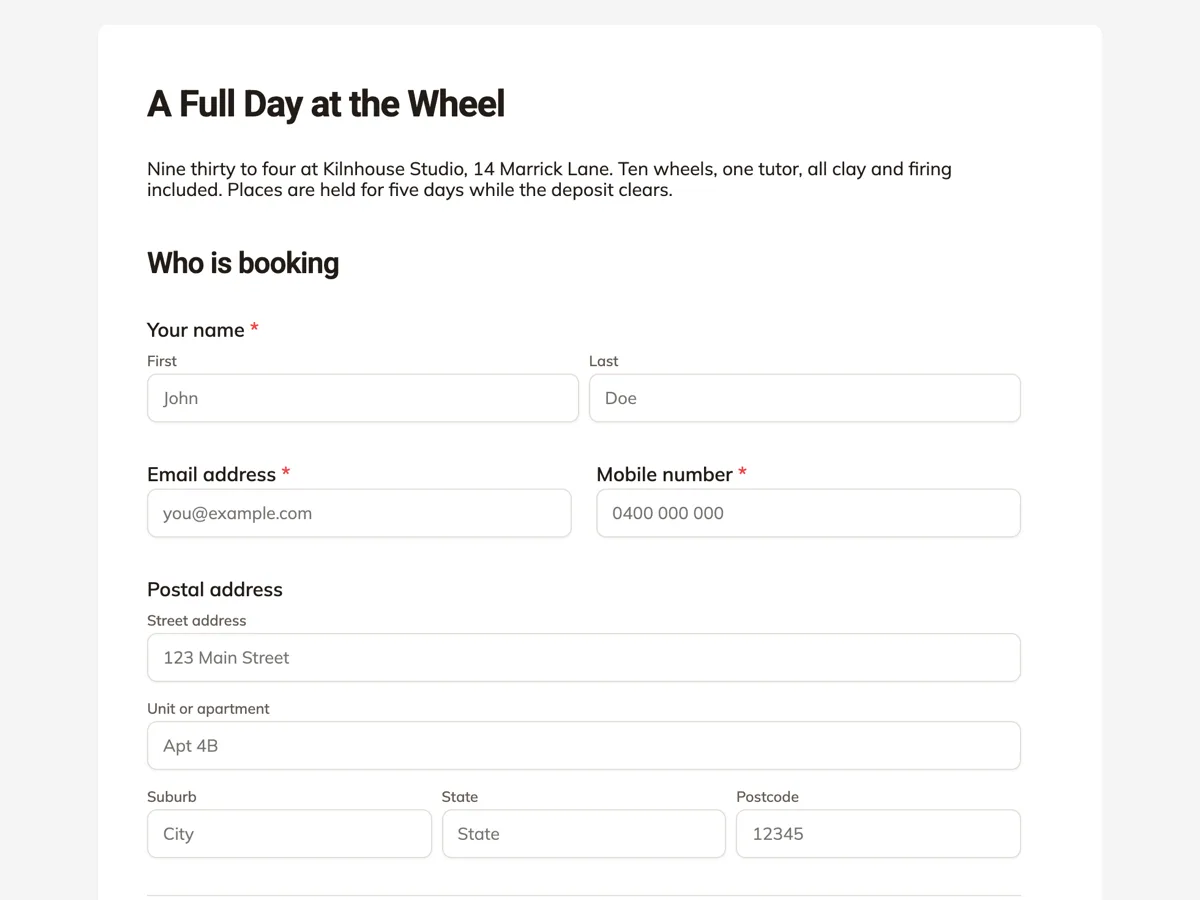
The form itself
A static copy of the finished form, exactly as it renders. Nothing here can be filled in or submitted, so read it as a reference and build your own from the button above.
Every field, and what it collects
The complete field list, in the order respondents meet it.
- Your nameNameRequired
- Email addressShort textRequired
- The invoice and the studio directions go here.
- Mobile numberShort textRequired
- Only used if a class time has to move.
- Postal addressAddress
- Where we post your fired pieces if you cannot get back to collect them. Firing takes about three weeks.
- Which date would you like?Single choiceRequired
- Options: Saturday 7 November, 9.30am to 4pm · Saturday 22 November, 9.30am to 4pm · Sunday 14 December, 9.30am to 4pm · None of these, put me on the list for the next one
- Which rate applies to you?Single choiceRequired
- Nobody is asked to prove anything. Pay it forward covers the subsidised places, so the rates fund each other.
- Options: Standard, $185 · Concession, $140, students and health care card holders · Pay it forward, $230, your place plus part of a subsidised one · Subsidised, $60, ten places held each term
- Anything to take home with you?Multiple choice
- Optional. Added to the same invoice, ready on the day.
- Options: A 10kg bag of stoneware, $28 · Four glaze test pots, $35 · A studio apron, $22
- Anything we should set up differently for you?Long text
- Physical limitations, sensory sensitivities, whatever it is. We would rather sort it before you arrive than on the morning.
- How did you find us?Multiple choice
- Options: Instagram · A friend sent me · Walked past the studio · Local paper · Searched online
- If it was somewhere else, where?Short text
- Do you accept the cancellation policy?Single choiceRequired
- Options: Yes, I accept it · No, I would like to talk to someone first
- Do you accept the studio safety terms?Single choiceRequired
- Options: Yes, I accept them · No
- Photographs in the studioSingle choice
- Asked separately from the safety terms, because consenting to one is not consenting to the other.
- Options: Fine to photograph my hands and my work · Photograph the work but not me · Please do not photograph either
- SignedSignatureRequired
- Your signature covers both agreements above.
- Anything else you want the tutor to know?Long text
Who is booking
Which day, and at what rate
On the day
The two agreements
Question banks built on this form
What each block of this registration collects
Who is booking takes a name, an email for the invoice, a mobile that is only used if a class moves, and an optional postal address for posting fired pieces. The second block is the date, with three workshop days and a waiting list option, then the rate as four choices with a paragraph above them explaining the sliding scale, and an optional list of materials to take home. On the day asks what the tutor should set up differently, with a placeholder naming real adjustments, and how the person found the studio. The last block holds the two agreements, each printed in full as a paragraph above its own yes or no question, then a photography preference, the signature and a closing box for the tutor.
Why only eight of the fifteen fields are required
Name, email, mobile, date, rate, both agreements and the signature are required, because without any of them the studio cannot hold a place, invoice it or run the day safely. The postal address, materials, access question, how they found the studio and the photography preference stay optional. A person with no access needs should not have to type none to get past a box, and a person who will collect their pots should not be made to hand over a home address. The access question still gets answered by the people who need it, because its placeholder names ordinary adjustments rather than asking about special requirements.
How to adapt this form
For a multi week course, replace the date question with a term choice and add a question about which sessions the person already knows they will miss. For a free community workshop, drop the rate question and the materials list, keep the cancellation question but reword it as a request to free up the place, and keep the safety terms as they are. For a class with a minimum age, add a date of birth field and a parent or guardian signature, and say in the paragraph above the safety terms who signs for a young participant.
What makes this form work
The two agreements are asked separately
The cancellation policy and the studio safety terms are different promises, so they are two questions with the text of each sitting immediately above it. Bundling them into one tick box is how a studio ends up arguing about a refund with somebody who genuinely never read the clause.
The access question names real examples
A chair rather than a stool, a quieter corner, a left handed wheel. The box suggests those in its own placeholder, and naming small adjustments gets answers where "special requirements" gets a blank. The tutor then has a week to move a wheel rather than five minutes on the morning.
The rate question does its own explaining
Four prices for the same seat looks strange until the paragraph above them says pay it forward funds the subsidised places and nobody is asked to prove anything. That one line is why people pick the rate that is true for them rather than the cheapest on the list.
Questions people ask
What should a workshop registration form ask?
Name, email, phone and a postal address if anything gets sent on later, then the date and the rate, then the two operational questions that save the tutor a phone call: what to set up differently, and where the person heard about the class. The agreements come last, once somebody has already committed in their head.
Why is the cancellation policy a question rather than a tick box?
Because a tick box is agreed to without reading. Paid workshops that lose money to late cancellations write the policy inline and ask yes or no, and the option to say no matters. Somebody who picks "I would like to talk to someone first" is a phone call, not a lost booking.
Can a workshop booking form take the deposit?
No. This form books the place and records what was agreed to. The studio emails the invoice once the booking arrives, and the thank-you screen says plainly that the place is held for five days while the deposit clears. Pointing the thank-you screen at your own checkout works just as well.
Why offer four prices for the same day?
A sliding scale is normal in craft and community workshops, and it only works if it is stated without a means test. Standard funds the studio, pay it forward funds the subsidised places, and nobody is asked for proof. Ten subsidised places a term is a number a studio can actually honour.
Why ask for a postal address on a workshop booking?
Because something usually gets sent. This form asks for it in the booking section, alongside the option of taking work home. A ceramics or printmaking workshop produces an object that needs firing or drying, and posting it later is far more common than the participant returning to collect it.
Should the form ask how somebody found the studio?
Yes, and give a follow up box. This form asks how you found us, then asks where if it was somewhere else. Small studios sell through Instagram, word of mouth and a local listing in unequal amounts, and the free text answer usually names something the studio did not know was working.
How long should a workshop cancellation window be?
Long enough to refill the place. This studio refunds in full more than seven days out, moves the booking once inside seven days, and keeps the fee inside forty eight hours. Under Australian Consumer Law a fee kept on cancellation should reflect the studio's real loss, such as an empty wheel and prepared clay, rather than working as a penalty.
Build your own in about a minute
The button below opens the generator with this use case already described. Change the wording to match your own, generate, then edit anything you like.
Make one like thisOther form examples
Camp registration form
Camps do not run one registration form, they run a packet: the booking, the health record, the medication authority and the collection list. This is all four on one screen, ordered the way the camp office actually needs them on the first morning. It is a classic form, because four documents in one only works if a parent can scroll back to what they already wrote.
Team tryout registration form
Representative tryouts turn on two things a club usually finds out too late: what the player can safely do on the day, and whether the family has understood what a season actually costs. This registration asks both before anybody puts a bib on. It is a classic form, so a parent can see the health grid, the costs and both signatures on the one screen.
Call for speakers form
A conference programme committee is choosing between two hundred proposals in a fortnight. This form is built for the reading, not the writing: everything the committee scores on is asked in the same shape every time, and the things that get a talk declined are printed where a speaker sees them first. It is a classic form, so a speaker can see the whole proposal at once and balance the outline against the description.
Want the steps in the builder? Read Create a form from scratch with AI, then Every form field and when to use it. For everything this generator can do, see the form maker.
Written and checked by the OneCraft team. Last checked .