Business template
Business Plan template
A lender ready business plan with the funding ask up front, market figures, a competitor table, three year profit and loss, start up costs and a monthly cash flow chart. It suits small business owners seeking a bank loan or investor funding.
13 sections, 6 tables, with a cover page
Use this template opens a copy in the document builder after you sign in. Adapt it with AI opens the generator with this template chosen, so you can describe your business and get a version written for it.
What you fill in
- [Your company]
- [Your address]
- [Your name]
- [Lender]
- [City]
- [Competitor 1]
- [Competitor 2]
- [Competitor 3]
- [Competitor 4]
- [Previous employer]
- [Date]
The template, in full
Contents
1. Executive summary
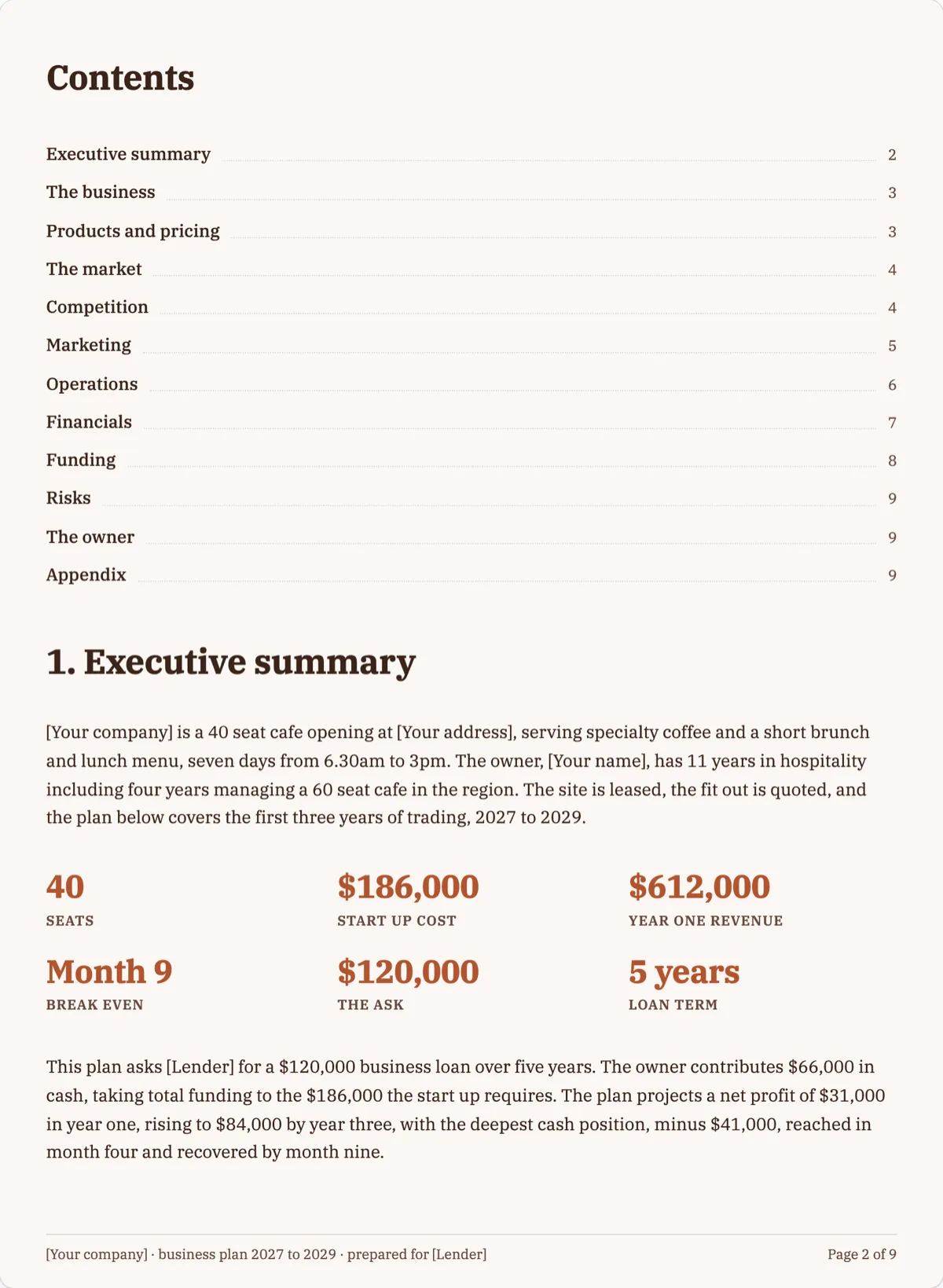
[Your company] is a 40 seat cafe opening at [Your address], serving specialty coffee and a short brunch and lunch menu, seven days from 6.30am to 3pm. The owner, [Your name], has 11 years in hospitality including four years managing a 60 seat cafe in the region. The site is leased, the fit out is quoted, and the plan below covers the first three years of trading, 2027 to 2029.
This plan asks [Lender] for a $120,000 business loan over five years. The owner contributes $66,000 in cash, taking total funding to the $186,000 the start up requires. The plan projects a net profit of $31,000 in year one, rising to $84,000 by year three, with the deepest cash position, minus $41,000, reached in month four and recovered by month nine.
2. The business
[Your company] will serve specialty coffee from a single local roaster, a brunch menu of eight dishes, and a lunch menu of five, with retail bags of beans at the counter. The menu is deliberately short: every dish is built from the same fifteen core ingredients, which keeps waste low and the kitchen fast at peak.
The site at [Your address] is a 120 square metre former bakery, one street back from the beach and two doors from the surf shops that anchor foot traffic. It carries existing food premises approval, grease trap and three phase power, which is what holds the fit out to $98,000. The lease is five years with a five year option, at $58,000 a year including outgoings.
The fit out keeps the bakery's bones: the brick oven wall stays as the feature, seating is a mix of a ten seat communal table, window benches and two and four tops, and the counter is positioned so one barista can see the door, the register and the pass at the same time. The layout has been drawn by a hospitality fit out firm and priced by two builders.
3. Products and pricing
Pricing sits at the top of the local band, matched to the quality of the roast and the plates, and each line below carries its ingredient cost and margin. Blended across the sales mix, cost of goods runs at 32 percent of revenue, which is the figure the financials in section 8 use.
Coffee is the volume engine at roughly half of all transactions; brunch carries the average spend on weekends. Retail beans are a small line, but they put the brand on customers' kitchen benches and hold a 47 percent margin with no kitchen labour.
4. The market
[City] has a resident population of about 22,500 at the last census, up 14 percent over five years, one of the fastest growing coastal towns in the region. The town also draws an estimated 850,000 visitors a year, concentrated between November and March, which roughly doubles the summer customer base.
The core weekday customer is a local: tradespeople from 6.30am, then remote workers and parents after the school run. The weekend and summer customer is a visitor who queues for brunch and pays for quality. The chart below shows the visitor pattern the roster and the cash flow forecast are built around.
5. Competition
Four cafes compete within walking distance of the site. Each was visited several times at different hours in preparing this plan; seats, prices and opening times below are as observed in September 2026.
The gap is early opening plus a fast, short menu: nobody with table service opens before 7am, and the two largest rooms are slowest at peak. [Your company] opens 6.30am with a kitchen designed to plate brunch in under twelve minutes. On price, $5.20 for a flat white sits between [Competitor 3] and the rest, which the quality of the roast supports and the margin table in section 3 depends on.
6. Marketing
Launch is a two week soft opening for locals: free coffee cards handed through the surf clubs, the primary school and the two gyms, aimed at building a weekday regular base before the first summer. From open, the cafe runs a simple loyalty card, ninth coffee free, and posts daily on one channel rather than thinly on four.
Partnerships do the rest: wholesale beans and a branded blend for the surf life saving club canteen, and the cafe as the named coffee cart at the three summer market days. The monthly budget below is deliberately small; the site's foot traffic is the main acquisition channel and the budget defends reviews and repeat visits.
7. Operations
Service runs one repeating loop, and every role is stationed on one step of it. Orders are taken at the counter before 8am and at the table after, food leaves the pass in order time, and the close is a 40 minute checklist so the room opens clean at 6.30 the next morning.
Supply is kept to five accounts: one regional coffee roaster on weekly delivery, one produce wholesaler, one baker for bread and pastry, one dairy run and one dry goods account. Short supply lines mean two deliveries a day in summer are possible without a cool room bigger than the site allows.
The roster flexes with the season rather than the payroll: winter runs the chef, one barista and one casual on weekdays, while January runs everyone, with the owner covering the floor at every peak. Casual hours are set each Thursday from the coming week's bookings and the visitor pattern in section 4.
8. Financials
Revenue is built bottom up: 40 seats, an average spend of $14, and seat turns that range from 2.1 a day in winter to 4.5 in January, giving $612,000 in year one. Cost of goods is held at the 32 percent the pricing table supports. Wages are the paid roster from section 7, growing with weekend volume in years two and three.
Other overheads cover power, insurance, card fees, marketing, accounting and loan interest. Net profit is stated before the owner's drawings, which is why the owner's row in the staffing table carries no wage line.
The chart below is the number this plan is built around: the monthly cash balance for year one, opening in an April fit out and reaching its trough of minus $41,000 in month four, inside the $120,000 facility with the working capital line above. The balance turns positive in month nine and ends the year at $26,000.
9. Funding
The repayment of $2,460 a month is covered 2.1 times by year one operating cash flow and is already inside the other overheads line of the profit and loss. The owner's $66,000 comes from savings and is contributed before drawdown, so the bank's funds go to the fit out and equipment the security is taken over.
The forecast has been stress tested at ten percent below the revenue line: net profit in year one falls to near zero, but the repayment remains covered because the casual roster and the marketing budget flex down first, and the cash trough deepens to minus $52,000, still inside the facility plus working capital.
10. Risks
11. The owner
[Your name] has spent 11 years in hospitality: five on the floor and behind machines in the city, two running events catering, and four managing [Previous employer], a 60 seat cafe in the region, where she ran a team of 14, the roster and the weekly orders, and took the room from 3.9 to 4.6 stars. She holds current food safety supervisor certification. Two references, the owner of [Previous employer] and the cafe's roaster of four years, are available on request.