Business template
Monthly Management Report template
A monthly management report with headline numbers, a KPI table by site, weekly sales against budget, variance commentary, actions with owners and an outlook. It suits multi site businesses reporting to owners or a board.
7 sections, 2 tables
Use this template opens a copy in the document builder after you sign in. Adapt it with AI opens the generator with this template chosen, so you can describe your business and get a version written for it.
What you fill in
- [Your company]
- [Date]
- [Your name]
- [Your title]
- [Site 1]
- [Site 3]
- [Site 2]
- [Site 4]
- [Name]
The template, in full
Monthly management report, September 2026
[Your company], four sites. Trading period: four weeks from Monday 31 August to [Date]. Prepared by [Your name], [Your title], for the owners meeting on [Date].
1. Summary
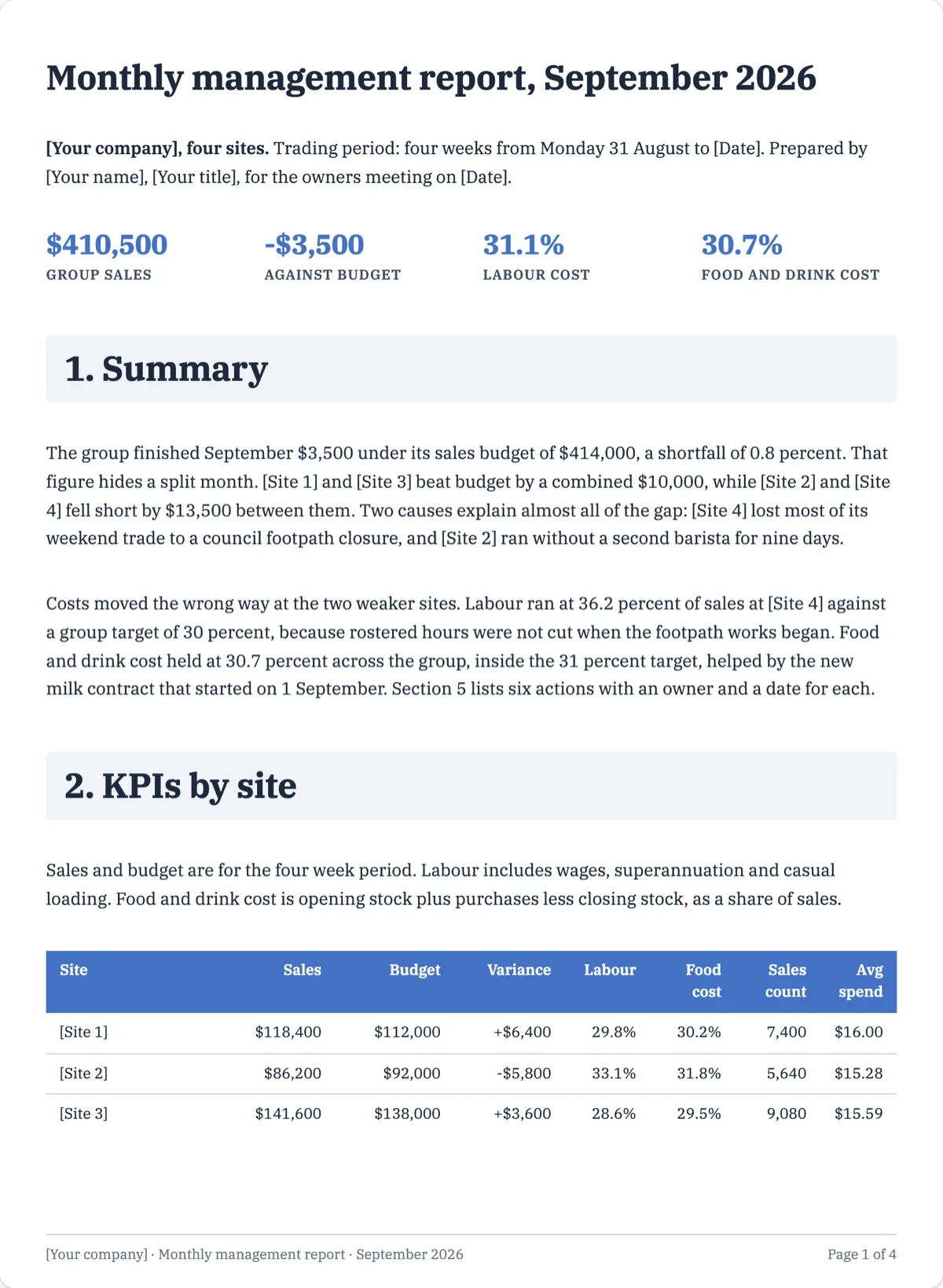
The group finished September $3,500 under its sales budget of $414,000, a shortfall of 0.8 percent. That figure hides a split month. [Site 1] and [Site 3] beat budget by a combined $10,000, while [Site 2] and [Site 4] fell short by $13,500 between them. Two causes explain almost all of the gap: [Site 4] lost most of its weekend trade to a council footpath closure, and [Site 2] ran without a second barista for nine days.
Costs moved the wrong way at the two weaker sites. Labour ran at 36.2 percent of sales at [Site 4] against a group target of 30 percent, because rostered hours were not cut when the footpath works began. Food and drink cost held at 30.7 percent across the group, inside the 31 percent target, helped by the new milk contract that started on 1 September. Section 5 lists six actions with an owner and a date for each.
2. KPIs by site
Sales and budget are for the four week period. Labour includes wages, superannuation and casual loading. Food and drink cost is opening stock plus purchases less closing stock, as a share of sales.
Targets for every site are 30 percent labour and 31 percent food and drink cost. Two sites missed the labour target by more than three points; no site missed the food cost target by more than 1.6 points. Average spend rose at all four sites against August, from $15.21 to $15.77 across the group, after the 30 cent coffee price change on 1 September.
3. Sales by week
Group sales climbed each week of the month, from $98,700 in the first week to $105,600 in the last, against a flat weekly budget of $103,500. The first week carried the full cost of the [Site 4] closure and the [Site 2] staffing gap, and it finished $4,800 under budget on its own, more than the whole monthly shortfall. Weeks three and four together beat budget by $2,900.
4. Variance commentary
One paragraph per site, in table order: what drove the variance, whether it repeats, and what it did to labour and food cost.
[Site 1], $6,400 over budget
The new breakfast menu, launched on 7 September, lifted morning sales count by 11 percent on the same weeks last year. Two office catering orders worth $2,150 together were one off and are not in the October forecast. Labour came in at 29.8 percent, the only site under target besides [Site 3].
[Site 2], $5,800 under budget
The site ran with one barista from Monday 31 August to Tuesday 8 September after a resignation, and the morning queue time rose from about four minutes to nine. Sales count fell 14 percent in those nine days and recovered once the replacement started. Labour still rose to 33.1 percent because the duty manager covered the gap on overtime.
[Site 3], $3,600 over budget
Commuter trade held steady, and the second register added in August cut peak queue time, which shows in the highest sales count in the group at 9,080. The variance is modest because the budget already assumed the second register. Food cost of 29.5 percent is the lowest in the group, helped by the smallest menu.
[Site 4], $7,700 under budget
Council footpath works closed the outdoor seating from Saturday 5 September to Sunday 20 September, removing 28 of the 44 seats across three weekends. Weekend sales fell by 41 percent in that time. The roster was not reduced to match, which is why labour reached 36.2 percent. The works are finished and the seating reopened on Monday 21 September.
[Site 4] labour. At 36.2 percent, [Site 4] labour is six points over target for a second month. If October sales return to budget and hours stay where they are, labour falls to about 32 percent, still above target. A roster review is action 1 below.
5. Actions
Each action has one owner and a due date; progress on all six is reported at the November owners meeting.
6. October outlook
The October trading period, Monday 28 September to Sunday 25 October, has a sales budget of $428,000. With [Site 4] seating back and [Site 2] fully staffed, the forecast is $431,000, $3,000 over budget, assuming no further closures. The main risk is labour: if [Site 4] hours are not cut by 9 October, the group will miss the 30 percent target again even with sales on budget.