Business template
SWOT Analysis template
A SWOT analysis with a two by two matrix, the evidence behind each item, and a table of actions that pair inside factors with outside ones. It suits small business owners preparing for a planning session.
4 sections, 2 tables
Use this template opens a copy in the document builder after you sign in. Adapt it with AI opens the generator with this template chosen, so you can describe your business and get a version written for it.
What you fill in
- [Your company]
- [Date]
- [Your name]
The template, in full
SWOT analysis: [Your company]
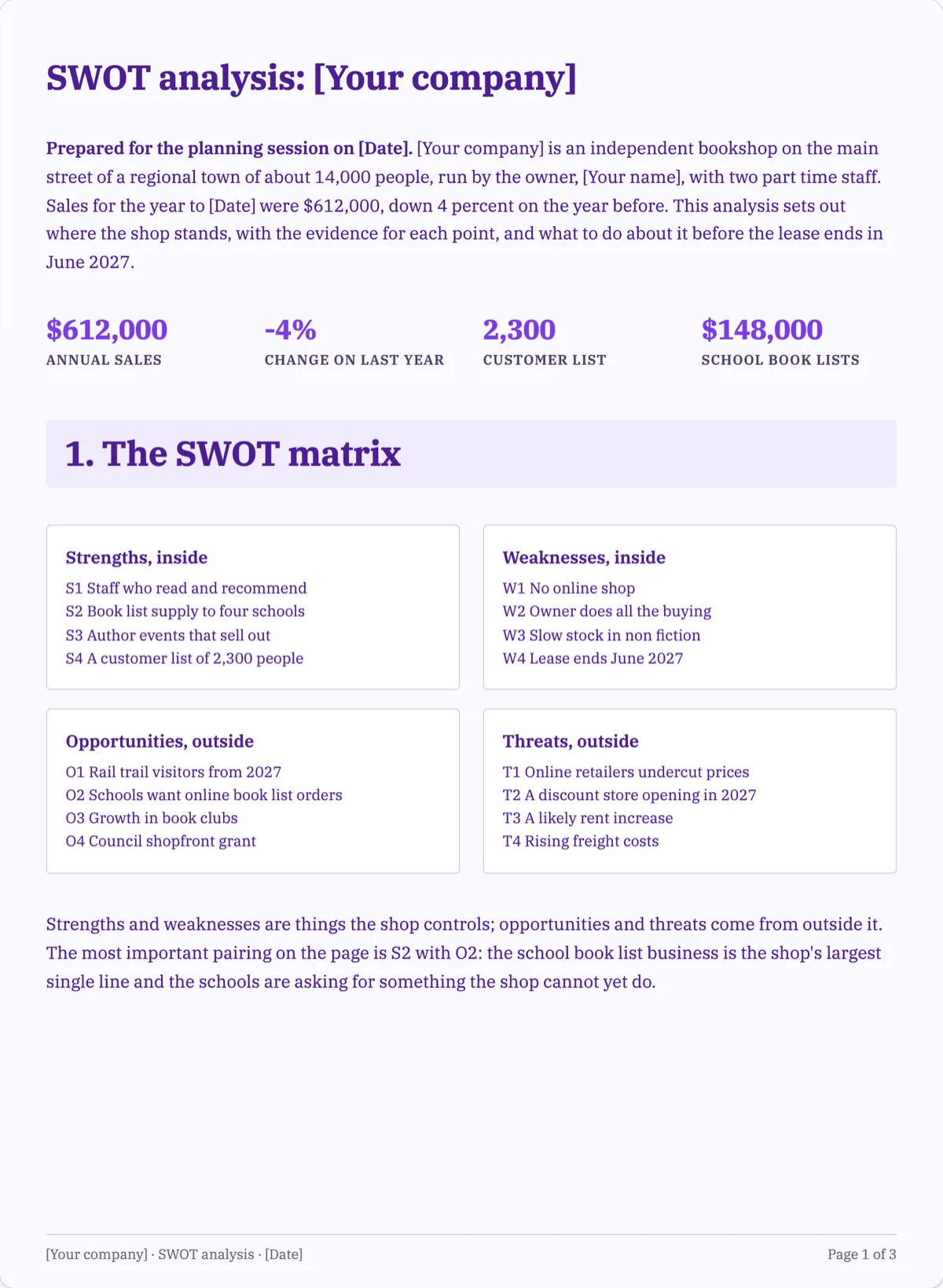
Prepared for the planning session on [Date]. [Your company] is an independent bookshop on the main street of a regional town of about 14,000 people, run by the owner, [Your name], with two part time staff. Sales for the year to [Date] were $612,000, down 4 percent on the year before. This analysis sets out where the shop stands, with the evidence for each point, and what to do about it before the lease ends in June 2027.
1. The SWOT matrix
Strengths and weaknesses are things the shop controls; opportunities and threats come from outside it. The most important pairing on the page is S2 with O2: the school book list business is the shop's largest single line and the schools are asking for something the shop cannot yet do.
2. The evidence behind each item
A SWOT is only as good as its evidence. Each item below is backed by a figure from the shop's own records or by a dated source, so the planning session argues about what to do rather than about what is true.
3. What to do about it
Each action pairs an inside factor with an outside one: using a strength to take an opportunity (SO), fixing a weakness to take one (WO), using a strength against a threat (ST), or limiting a weakness that a threat would make worse (WT).
First priority. The online shop comes first because it protects the largest line of sales. If the schools move their book lists to a supplier that already takes online orders, the shop loses 24 percent of its sales in one decision.