Business template
Cash Handling Procedure template
A cash handling procedure with float breakdowns, opening and closing count steps, a discrepancy rule, a banking schedule and safe access rules. It suits cafes, shops and other businesses that take cash across one or more tills.
0 paragraphs, 8 clauses, 2 tables, with a cover page
Use this template opens a copy in the document builder after you sign in. Adapt it with AI opens the generator with this template chosen, so you can describe your business and get a version written for it.
What you fill in
- [Your company]
- [Date]
The template, in full
1 Purpose and scope. [Your company] takes about a quarter of its sales in cash across two tills: the front counter and the takeaway window. Clear steps protect the business from loss and staff from suspicion. This procedure applies to everyone who opens, uses or closes a till, and to the two key holders.
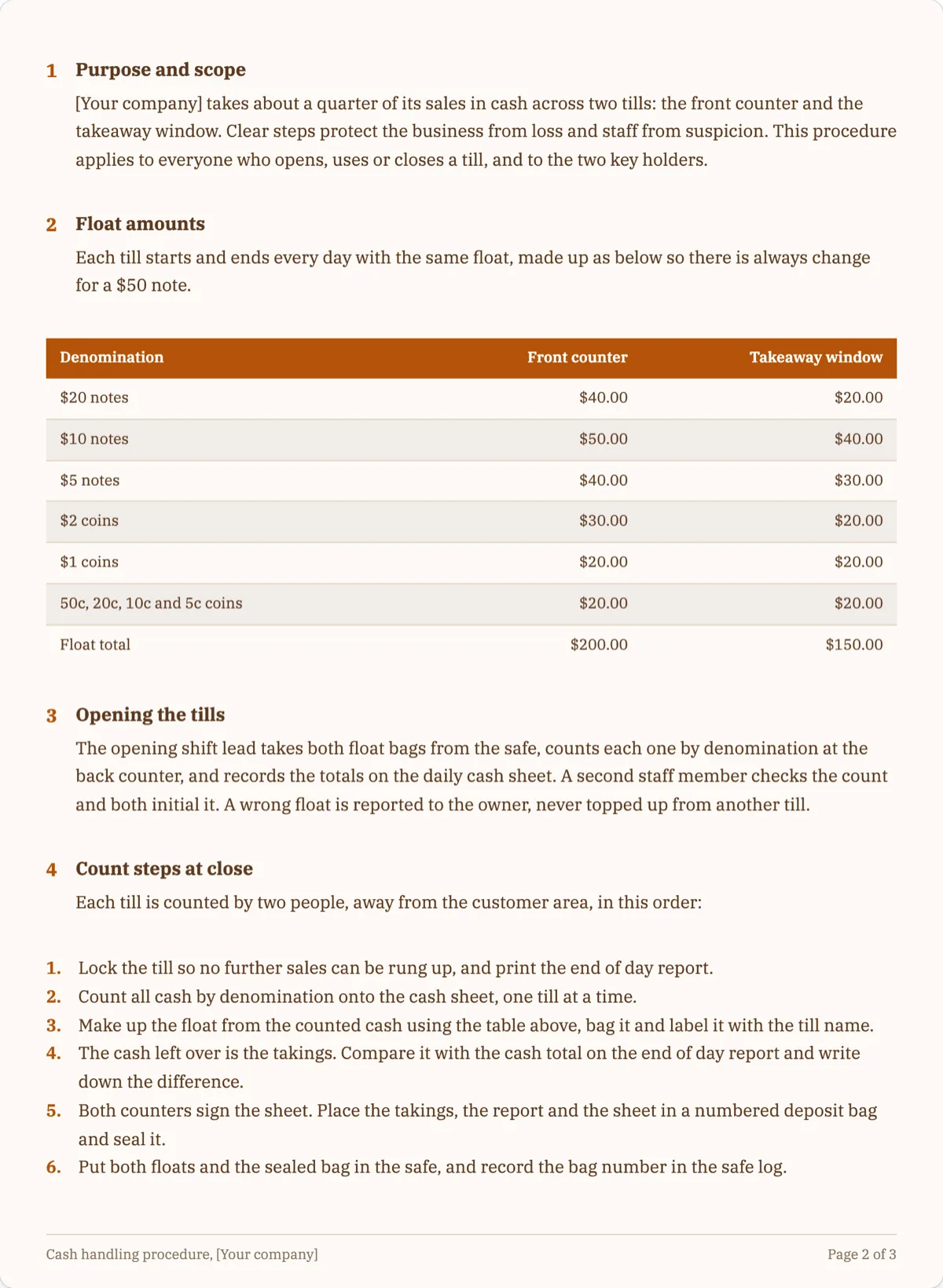
2 Float amounts. Each till starts and ends every day with the same float, made up as below so there is always change for a $50 note.
3 Opening the tills. The opening shift lead takes both float bags from the safe, counts each one by denomination at the back counter, and records the totals on the daily cash sheet. A second staff member checks the count and both initial it. A wrong float is reported to the owner, never topped up from another till.
4 Count steps at close. Each till is counted by two people, away from the customer area, in this order:
5 The discrepancy rule. Small differences happen. What matters is that every one is written down and patterns are spotted:
Never cover a shortage. Staff must never make up a shortage from their own money or from the tip jar, and the cafe never deducts a shortage from pay. Covering a difference hides the cause and makes the next one harder to find.
6 Banking schedule. Takings are banked every Monday, Wednesday and Friday before 2pm, at the branch two streets away, by a key holder. The banker varies the time and route and takes a second person when the deposit is over $1,000. The safe never holds more than $1,500 in takings: if it would, an extra banking run is made. The bank receipt is stapled to the cash sheet the same day.
7 Safe access. Only the owner and the manager hold safe keys and the combination. The combination is changed whenever a key holder leaves. Every opening is written in the safe log. During busy periods, when a till holds more than $400 in notes, the shift lead drops the excess into the safe's drop slot in a labelled envelope and records it on the cash sheet.
8 Refunds, voids and safety. Refunds and voids need the shift lead's PIN and a reason on the till. If anyone demands cash with threats, staff hand it over, do not resist or follow, and call police once it is safe. The owner reviews this procedure every year and after any loss over $100.