Conversational form
Supplier feedback survey: how your suppliers rate you as a customer
A supplier feedback survey asks the businesses that sell to you how you are to work with: whether you pay on time, forecast honestly and answer the phone. This one turns that into seven screens for a food manufacturer's procurement team, ending with whether each supplier wants to keep the account.
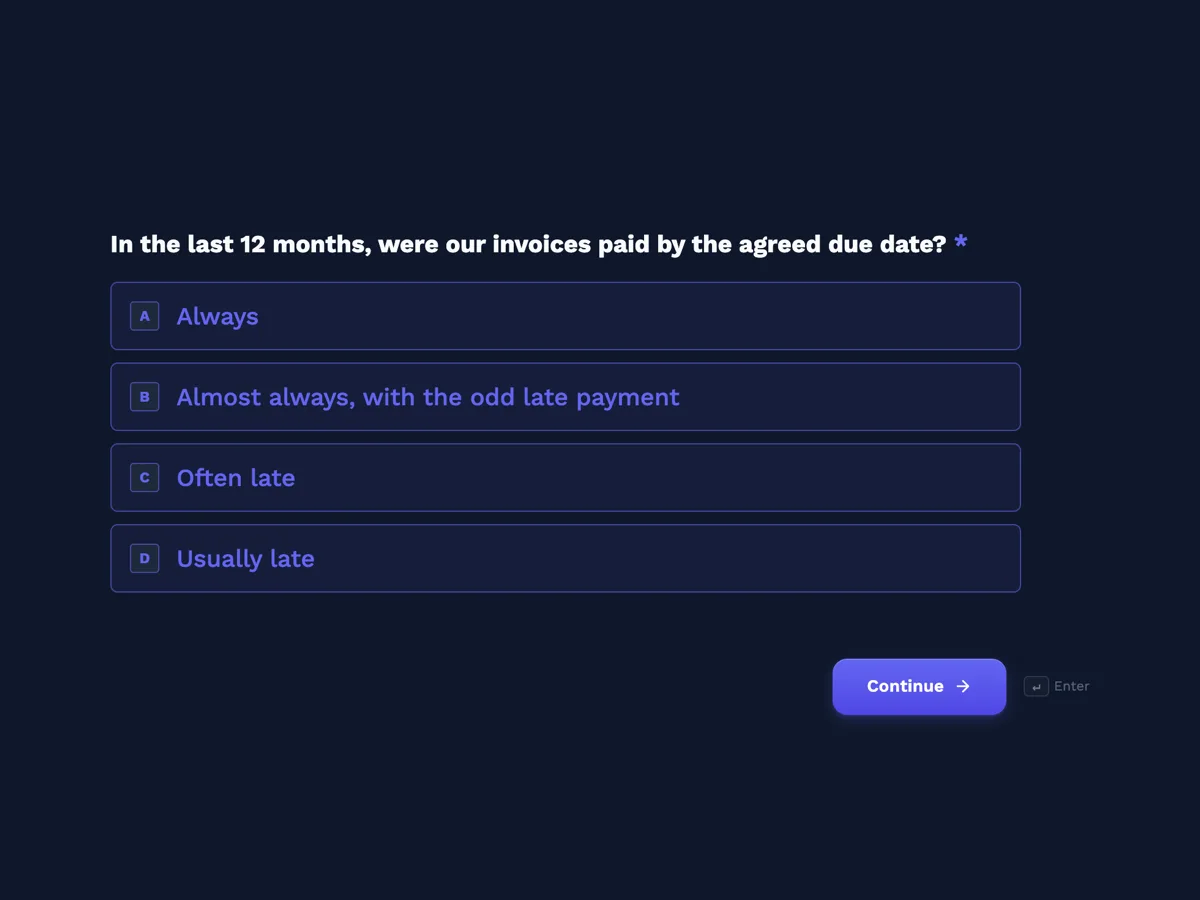
The form itself
The first screen of the form. A conversational form shows one question per screen, so the remaining screens are listed in the field table below. Nothing here can be filled in or submitted, so read it as a reference and build your own from the button above.
Every field, and what it collects
The complete field list, in the order respondents meet it.
- In the last 12 months, were our invoices paid by the agreed due date?Single choiceRequired
- Options: Always · Almost always, with the odd late payment · Often late · Usually late
- How accurate are the volume forecasts we share with you?Single choiceRequired
- Compared with what we actually ordered in the same period.
- Options: Within 10 percent most months · Within 25 percent most months · Often far off · We do not receive forecasts
- When you contact your procurement contact, how responsive are they?Single choiceRequired
- Options: Replies within one business day · Replies within a few days · Hard to reach · I do not know who my contact is
- How easy was it to become an approved supplier?Single choiceRequired
- Options: Easy · Manageable · Difficult · Too long ago to say
- What do you supply us?DropdownRequired
- Used only to group results. Categories with fewer than five suppliers are combined.
- Options: Grains, flours and seeds · Oils, sauces and condiments · Fresh produce · Packaging and labels · Freight and warehousing · Equipment and maintenance services
- What issues should we fix in how we work with you?Long text
- Specifics help: a process, a document, a timing problem.
- Do you want to keep supplying Saltbush Pantry Foods?Single choiceRequired
- Options: Yes, and grow the business · Yes, at current volumes · Only if things change · No
What each screen of this survey collects
Screen one asks whether invoices were paid by the agreed due date, from always to usually late. Screen two asks how close forecasts came to real orders, with an option for suppliers who get no forecast at all. Screen three rates the procurement contact's response time and lets a supplier say they do not know who the contact is. Screen four asks how easy onboarding was. Screen five groups the supplier by category, with a note that small categories are combined. Screen six is an optional long text for issues to fix, and screen seven asks whether the supplier wants to keep the account. Six of the seven screens are required.
Why the buyer is the one being rated
Most supplier surveys run the other way: the buyer scores delivery, quality and price. That evaluation matters, but it misses why a good supplier drifts away or quietly prioritises other customers. Late payment ties up a small supplier's cash. Forecasts that miss by half force them to hold stock or let a line run short. A contact who never replies turns a simple question into a lost week. Asking these four things directly, without a company name, gives procurement a list of its own habits to fix, and the final question shows which suppliers are at risk of walking away.
How to adapt this survey
A construction company swaps the categories for subcontractor trades and adds a question on how variations are approved and paid. A retailer adds a screen on promotional planning, since late promo notice is a common complaint from food and drink suppliers. A public body adds a question on whether tender documents were clear and proportionate to the contract size.
What makes this form work
Four habits suppliers feel most
Payment by the due date, forecast accuracy, contact response and onboarding are the buyer behaviours that decide whether a supplier prioritises an account, and each gets one screen.
Options that expose gaps
"We do not receive forecasts" and "I do not know who my contact is" turn missing processes into countable answers instead of hiding them in a middle score.
Retention asked directly
The last screen separates suppliers who want to grow the account from those who will stay "only if things change", the group procurement most needs to talk to.
Questions people ask
How is a supplier feedback survey different from supplier evaluation?
Supplier evaluation is the buyer scoring the supplier on quality, delivery and price. A supplier feedback survey reverses it: suppliers score the buyer on payment, forecasting, communication and process. Both matter in a working relationship, and many procurement teams run them in the same quarter so each side sees the other's view at the supplier day.
Will suppliers answer honestly about late payment?
More honestly when the survey is anonymous and says that answers do not affect orders or tenders, as this welcome screen does. Grouping by category, with small categories combined, also helps. A supplier who is owed money may still hold back, so compare the answers with accounts payable data on days to pay.
Why include the "do not know who my contact is" option?
Because it is a finding in its own right. If a fifth of suppliers cannot name their contact, the issue is not response time but ownership of the account. Without that option, those suppliers would pick a rating for someone they have never spoken to, and the average would look better than it is.
Should the survey ask for the supplier's name?
Not in an annual survey meant to be candid. A supplier with a specific problem can still name itself in the issues box if it wants a direct reply. If procurement needs named follow up, send a separate short form to key accounts after the anonymous results are in.
How do you get the results to the right people?
An owner can turn on the email alert add-on so each submission reaches one procurement address, or the webhook add-on to post responses into another system. The alert goes to a single address, so the procurement lead shares results with finance and planning, who own payment and forecasts.
How often should suppliers be surveyed?
Once a year is enough for most supply bases, timed a month before a supplier day or annual review so the results can be discussed in person. After a big change, such as a new purchasing system or new payment terms, a short follow up three months later shows whether it helped.
Build your own in about a minute
The button below opens the generator with this use case already described. Change the wording to match your own, generate, then edit anything you like.
Make one like thisOther form examples
Restaurant feedback form with a course by course rating grid
A restaurant feedback form has to tell the kitchen and the floor team which part of a visit worked and which did not, without making diners write an essay. This one puts every course plus service, ambience and value into one rating grid, then asks for the server, the best dish and whether they would return.
Post purchase survey template: discovery, checkout and delivery
A post purchase survey has to walk the order from the buyer's side, from how they found the shop to the moment the box was opened, so each team sees its own part. This template asks one question per stage, adds an optional photo of the product at home, and ends on a recommendation score.
Community consultation survey for a council park upgrade
A community consultation survey asks residents how they use a place, what matters to them and which option they prefer before a council decides. This one does it for an Australian shire park upgrade in ten screens, with a seven item priorities grid and a choice between two concept plans.
Want the steps in the builder? Read Create a conversational form with AI, then Automate your form with add-ons. For everything this generator can do, see the form maker.
Written and checked by the OneCraft team. Last checked .