Legal template
Contractor Agreement template
An independent contractor agreement with a worker classification table, stage payments, insurance, site safety and defects terms. It suits builders and businesses engaging trade contractors for a defined package of work.
12 sections, 29 clauses, 3 tables, 2 signature blocks, with a cover page
Use this template opens a copy in the document builder after you sign in. Adapt it with AI opens the generator with this template chosen, so you can describe your business and get a version written for it. Review before use. This is a starting point, not legal advice.
What you fill in
- [Date]
- [Your company]
- [Company number]
- [Licence number]
- [Your address]
- [Contractor company]
- [Contractor address]
- [Property address]
- [Jurisdiction]
The template, in full
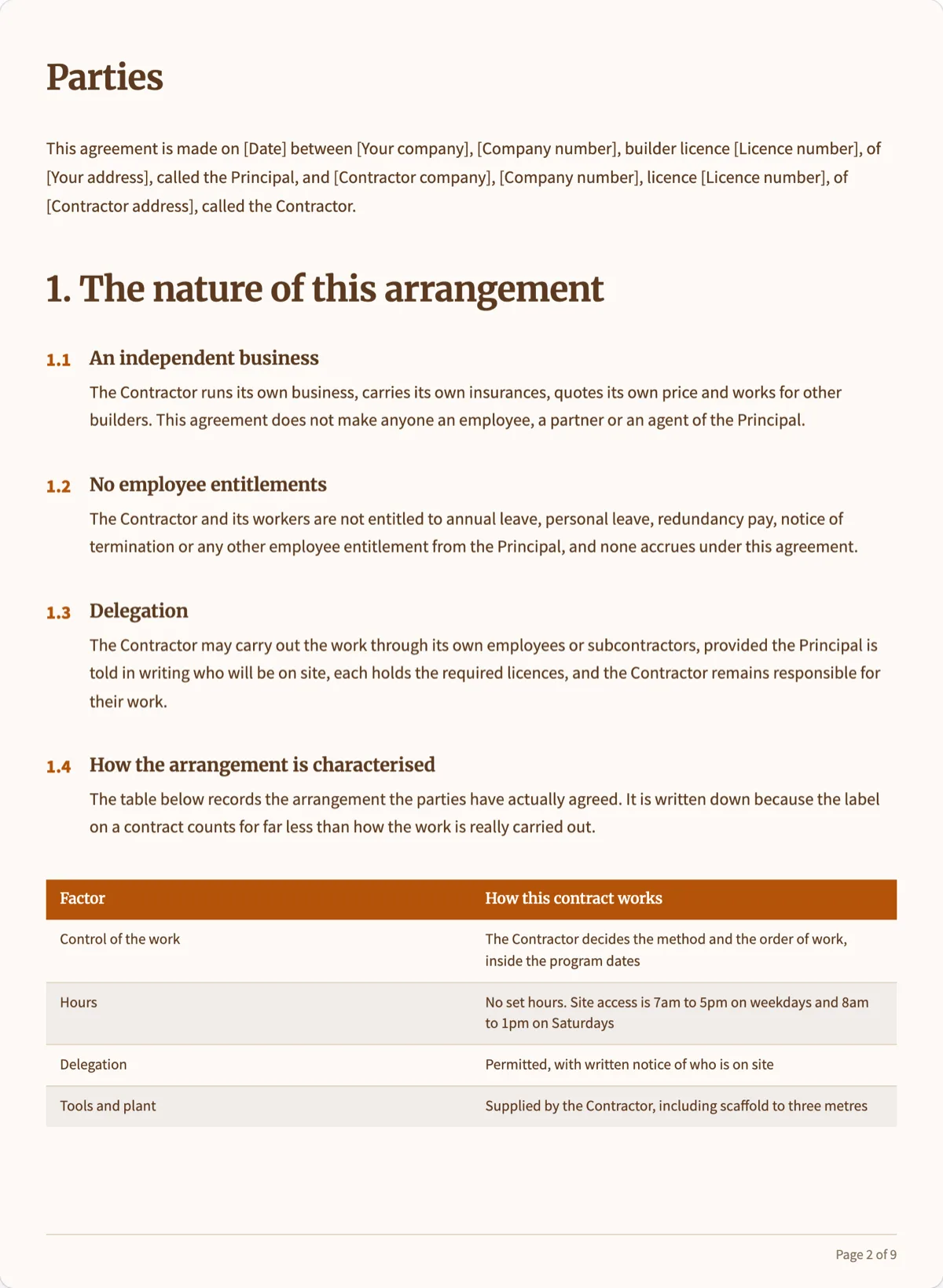
Parties
This agreement is made on [Date] between [Your company], [Company number], builder licence [Licence number], of [Your address], called the Principal, and [Contractor company], [Company number], licence [Licence number], of [Contractor address], called the Contractor.
1. The nature of this arrangement
1.1 An independent business. The Contractor runs its own business, carries its own insurances, quotes its own price and works for other builders. This agreement does not make anyone an employee, a partner or an agent of the Principal.
1.2 No employee entitlements. The Contractor and its workers are not entitled to annual leave, personal leave, redundancy pay, notice of termination or any other employee entitlement from the Principal, and none accrues under this agreement.
1.3 Delegation. The Contractor may carry out the work through its own employees or subcontractors, provided the Principal is told in writing who will be on site, each holds the required licences, and the Contractor remains responsible for their work.
1.4 How the arrangement is characterised. The table below records the arrangement the parties have actually agreed. It is written down because the label on a contract counts for far less than how the work is really carried out.
2. The work
2.1 Scope. Wall and roof framing, roof battens, eaves and fascia, external cladding, hanging of windows and external doors, internal linings, doors, architraves, skirting and robe fitout for the two storey dwelling at [Property address], to the approved plans revision C.
2.2 Program. On site from [Date], with carpentry practical completion by [Date]. Wet weather and delays caused by other trades extend those dates by the days actually lost, recorded on the site diary at the time and not reconstructed later.
2.3 Site rules. The Contractor and everyone it brings on site holds a current construction induction card, signs in each day, wears the required protective equipment and leaves the work area clean at the end of each day.
3. Payment
3.1 Contract sum. The contract sum is $70,000 plus tax, payable by the five stages in Schedule 1. A stage becomes payable when the work in it is complete and the Principal has inspected it, not when it is nearly complete.
3.2 Invoicing and payment. The Contractor invoices on completion of each stage, quoting the stage number and the site address. The Principal pays within 14 days of a correct invoice, in line with the security of payment timeframes that apply in [Jurisdiction].
3.3 Variations. No variation is payable unless it is priced and accepted in writing before the work is done. A verbal instruction from the site supervisor is not an approved variation, and neither is a marked up drawing without a price.
3.4 Retention. The Principal holds 5 percent of each stage payment, released 90 days after carpentry practical completion, or earlier once any defect listed under clause 8 is rectified.
4. Retirement contributions and tax
4.1 Tax. The Contractor is registered for sales tax, quotes its business number on every invoice and is responsible for its own income tax, sales tax and the tax of anyone it engages. The Principal does not withhold tax from payments under this agreement.
4.2 Retirement contributions. A principal may have to make retirement contributions where a contract is wholly or principally for a person to provide their own labour. This contract is not: it is priced by stage, the Contractor supplies plant and materials, and the Contractor may delegate the work. If the position is later determined differently, the parties will meet the obligation as required by law and adjust the remaining stage amounts.
5. Insurance
5.1 Certificates before starting. Certificates of currency for the first three covers are given to the Principal before the Contractor first attends site, and again at each renewal. Work stops if a policy lapses, and time lost that way is not an extension of time.
6. Tools, plant and materials
6.1 What each party supplies. The Contractor supplies all hand and power tools, nail guns, compressors, laser levels and scaffold to three metres. The Principal supplies the structural timber, cladding, linings and fixings, delivered to site, and any scaffold above three metres.
6.2 Materials on site. The Contractor checks each delivery against the order before use and reports damage or shortfalls the same day. Materials cut wrongly through the fault of the Contractor are replaced at the cost of the Contractor.
7. Work health and safety
7.1 Safe work method statements. A safe work method statement is provided for each high risk activity before it starts, covering at least work at height, powered plant and voids in the floor structure. Work does not begin on that activity until the statement is on site.
7.2 Incidents. The Contractor reports every injury, near miss and property damage incident to the site supervisor on the day it happens, and takes part in the investigation that follows.
7.3 Stopping work. Either party may stop work that is unsafe. Nobody is penalised for stopping work on safety grounds, and stopped time is treated as a delay rather than a breach.
8. Defects
8.1 Rectification. The Contractor rectifies defective or non conforming work at its own cost within ten business days of written notice, or sooner where the defect holds up another trade.
8.2 Defects period. The Contractor remains responsible for defects in its work for 12 months from carpentry practical completion, which does not limit any longer statutory warranty that applies to residential building work.
9. Ending the contract
9.1 By notice. Either party may end this agreement on seven days written notice. The Contractor is paid for stages completed and for a fair proportion of the stage in progress, assessed jointly on site.
9.2 Immediately. The Principal may end this agreement immediately for a serious safety breach, for work carried out without the required licence, or if an insurance policy required by clause 5 lapses and is not reinstated within two business days.
10. General
10.1 No exclusivity. The Contractor may work for other builders during this agreement, provided the program dates in clause 2.2 are met.
10.2 Notices and variation of this agreement. Notices go by email to the two signatories. This agreement may be varied only in writing signed by both parties, and a variation to the work follows clause 3.3 instead.
10.3 Disputes and governing law. The parties meet on site within five business days of a dispute being raised in writing. If it is not settled there, either may use the adjudication process available for construction payments. The laws of [Jurisdiction] apply.
10.4 Assignment. The Contractor may not assign this agreement or the right to be paid under it without the written consent of the Principal. Subcontracting part of the work under clause 1.3 is not an assignment.
10.5 Entire agreement. This agreement and Schedule 1 are the whole agreement for this package. They replace the quotation dated [Date] and anything said on site before signing, including any allowance discussed but not written down.
10.6 Signing. This agreement may be signed in counterparts and by electronic signature. A photographed or scanned signature page emailed to the other party has the same effect as an original.
The label is not what decides it. Calling someone a contractor does not make them one. What counts is the substance: who controls the work, who carries the risk of rework, whether the work can be delegated, and how the money is calculated. Clause 1 is written so that the substance and the label agree.
Schedule 1, stage payments
Each amount is exclusive of tax and is subject to the 5 percent retention in clause 3.4. Stage 5 is not payable until the site is cleared of offcuts and packaging and the defects list has been walked with the site supervisor.
Signed by both parties. The Contractor confirms that its licence, insurances and induction cards are current as at the date of signing.