Legal template
One Way NDA template
A one way non disclosure agreement where only one party discloses and the recipient carries every obligation. It suits a business briefing an agency, contractor or supplier on sensitive work.
12 sections, 22 clauses, 2 tables, 2 signature blocks, with a cover page
Use this template opens a copy in the document builder after you sign in. Adapt it with AI opens the generator with this template chosen, so you can describe your business and get a version written for it. Review before use. This is a starting point, not legal advice.
What you fill in
- [Date]
- [Your company]
- [Company number]
- [Your address]
- [Recipient company]
- [Recipient address]
- [Name]
- [Jurisdiction]
- [Project name]
The template, in full
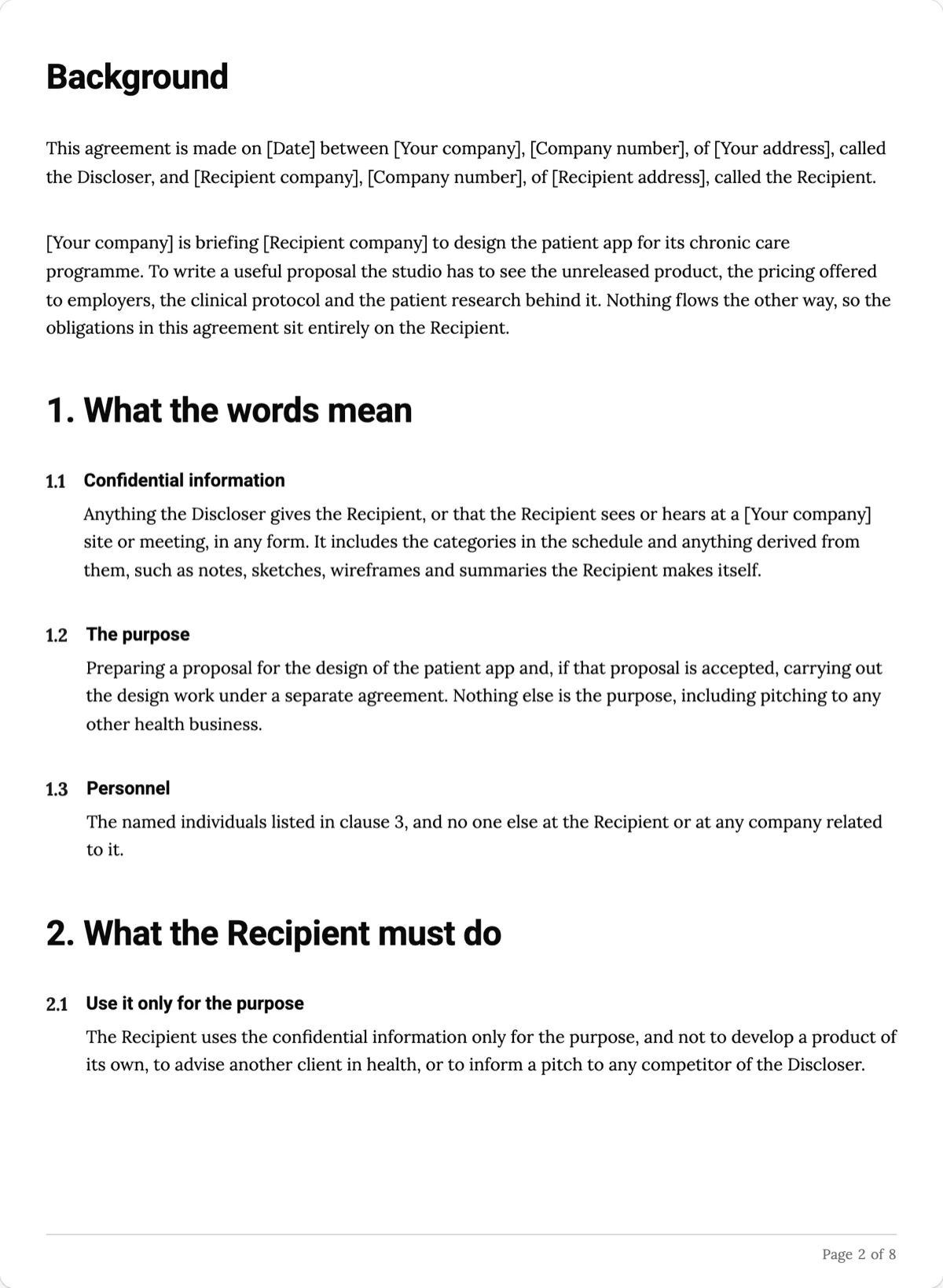
Background
This agreement is made on [Date] between [Your company], [Company number], of [Your address], called the Discloser, and [Recipient company], [Company number], of [Recipient address], called the Recipient.
[Your company] is briefing [Recipient company] to design the patient app for its chronic care programme. To write a useful proposal the studio has to see the unreleased product, the pricing offered to employers, the clinical protocol and the patient research behind it. Nothing flows the other way, so the obligations in this agreement sit entirely on the Recipient.
1. What the words mean
1.1 Confidential information. Anything the Discloser gives the Recipient, or that the Recipient sees or hears at a [Your company] site or meeting, in any form. It includes the categories in the schedule and anything derived from them, such as notes, sketches, wireframes and summaries the Recipient makes itself.
1.2 The purpose. Preparing a proposal for the design of the patient app and, if that proposal is accepted, carrying out the design work under a separate agreement. Nothing else is the purpose, including pitching to any other health business.
1.3 Personnel. The named individuals listed in clause 3, and no one else at the Recipient or at any company related to it.
2. What the Recipient must do
2.1 Use it only for the purpose. The Recipient uses the confidential information only for the purpose, and not to develop a product of its own, to advise another client in health, or to inform a pitch to any competitor of the Discloser.
2.2 Protect it. The Recipient applies at least the standard of care it applies to its own most sensitive material, and never less than reasonable care, in line with the controls in clause 5.
2.3 Make no unnecessary copies. Copies are made only where the purpose requires them, are held in the one workspace named in clause 5, and are logged so that every copy can be found when clause 9 is triggered.
2.4 Do not take it apart. The Recipient will not decompile, reverse engineer or attempt to derive the source code, data model or algorithms behind anything it is shown, including the clickable prototype.
2.5 Keep it separate. The confidential information is not combined with the data or design libraries of the Recipient in a way that makes it impossible to extract and delete later. Shared components used in the work are recorded so they can be identified.
3. Who at the Recipient may see it
3.1 Changing the list. Anyone added to the list needs the written consent of the Discloser and must sign an acknowledgement of this agreement before receiving anything. Anyone who leaves the project loses access within two business days.
4. Subcontractors
4.1 Only with consent. The Recipient may not pass anything to a freelancer, a studio partner or an offshore team without prior written consent. Where consent is given, the subcontractor signs the same terms directly with the Discloser, and the Recipient stays liable for what it does.
5. How it must be held
6. What is not covered
7. Compelled disclosure
7.1 If the law requires it. The Recipient may disclose what a law, court or regulator compels, tells the Discloser first where it is lawful to do so, discloses only what is actually required, and asks that the material be treated confidentially by whoever receives it.
8. No rights and no promises
8.1 No licence. Nothing here gives the Recipient any right in the product, the brand, the research or the protocol. Seeing a prototype grants no right to reproduce any part of it, in any project.
8.2 No obligation to disclose or to engage. The Discloser decides what to share and may stop at any point. Signing this agreement does not commit the Discloser to appoint the Recipient, to run a pitch fairly, or to pay for time spent reading a briefing.
8.3 No warranty. The information is provided as it stands. The Discloser does not warrant that it is accurate, complete or current, and the Recipient may not rely on it as the basis for any decision of its own.
9. Return and certification
9.1 Give it back. Within 10 business days of a written request, or of the Discloser deciding not to proceed, the Recipient returns or destroys everything it holds, including its own notes, sketches and summaries derived from it.
9.2 Certify it. A director of the Recipient certifies in writing that clause 9.1 has been carried out, naming the systems checked. Automatic backups that cannot be selectively purged may remain, and stay subject to this agreement until they expire.
10. Term, remedies and general
10.1 How long it runs. The obligations run for three years from the date each item was disclosed. The clinical protocol and the patient research remain confidential for as long as they are not public, without a time limit.
10.2 Breach. The Recipient tells the Discloser within one business day of becoming aware of any unauthorised access, use or disclosure. The Discloser may seek an injunction without proving loss, and this does not limit any other remedy.
10.3 General. Notices go by email to the signatories. This agreement may be varied only in writing signed by both parties. The laws of [Jurisdiction] apply. It may be signed in counterparts and by electronic signature.
10.4 No assignment. The Recipient may not assign or novate this agreement, or the material held under it, to anyone, including on a sale of its business or a change of control, without the prior written consent of the Discloser.
10.5 Costs. Each party bears its own costs of negotiating and signing this agreement, and of taking part in the briefing and any proposal that follows. Nothing here is a commitment to pay a pitch fee.
10.6 Entire agreement. This agreement is the whole agreement between the parties about confidentiality. It replaces the confidentiality wording in the briefing email of [Date] and anything said in the introductory call.
Why this one runs in a single direction. [Recipient company] is disclosing nothing that needs protecting. Making the agreement mutual would have added obligations on [Your company] for no reason, and would have slowed the briefing down while two legal teams argued about a risk only one of them carries.
Schedule, what is being disclosed
The research is de-identified before it leaves [Your company], so no participant can be recognised from it. That is a protection for the participants, not a reason to treat the material as less confidential, and it is why the research row has no end date.
Signed by a person authorised to bind each party. The Recipient confirms that each individual named in clause 3 has read this agreement before receiving anything under it.