Legal template
Software Licence Agreement template
A software licence agreement for named seats of a hosted application, with restrictions, fees, a support response table, uptime credits and data export on exit. It suits software vendors licensing a subscription product to business customers.
9 sections, 20 clauses, 2 tables, 2 signature blocks, with a cover page
Use this template opens a copy in the document builder after you sign in. Adapt it with AI opens the generator with this template chosen, so you can describe your business and get a version written for it. Review before use. This is a starting point, not legal advice.
What you fill in
- [Date]
- [Your company]
- [Your address]
- [Client company]
- [Client address]
- [Product name]
- [Reference]
The template, in full
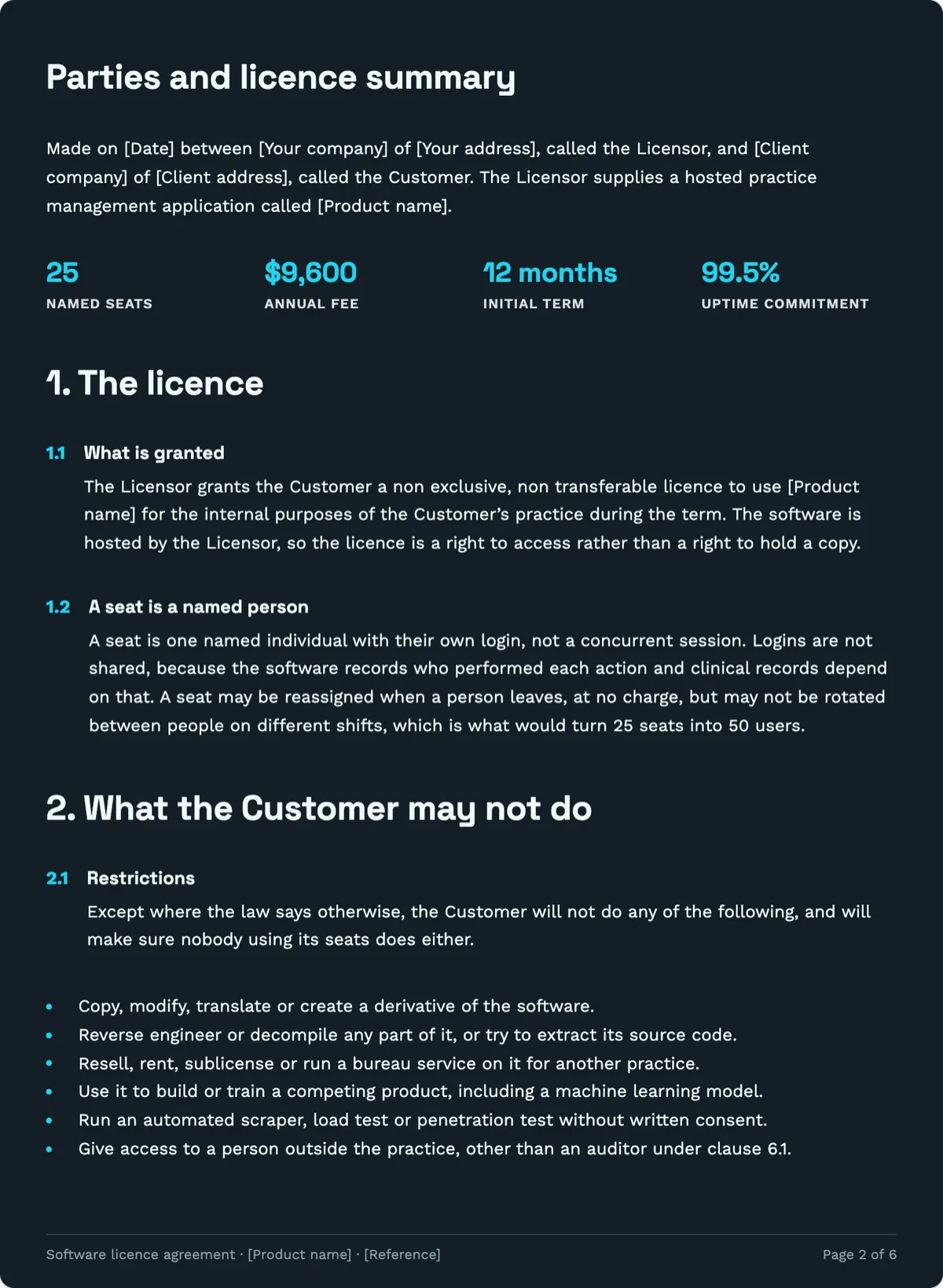
Parties and licence summary
Made on [Date] between [Your company] of [Your address], called the Licensor, and [Client company] of [Client address], called the Customer. The Licensor supplies a hosted practice management application called [Product name].
1. The licence
1.1 What is granted. The Licensor grants the Customer a non exclusive, non transferable licence to use [Product name] for the internal purposes of the Customer’s practice during the term. The software is hosted by the Licensor, so the licence is a right to access rather than a right to hold a copy.
1.2 A seat is a named person. A seat is one named individual with their own login, not a concurrent session. Logins are not shared, because the software records who performed each action and clinical records depend on that. A seat may be reassigned when a person leaves, at no charge, but may not be rotated between people on different shifts, which is what would turn 25 seats into 50 users.
2. What the Customer may not do
2.1 Restrictions. Except where the law says otherwise, the Customer will not do any of the following, and will make sure nobody using its seats does either.
3. Fees
3.1 The annual fee. The fee is $32 per seat per month, being $9,600 a year for 25 seats, invoiced annually in advance and payable within 30 days of the invoice date. The first invoice is issued on [Date] for the term starting [Date].
3.2 Adding seats during a term. The Customer may add seats at any time at $32 per seat per month, charged for the remainder of the term and invoiced monthly in arrears. Seats cannot be removed mid term, and a seat added in the last two months carries into the renewal unless the Customer says otherwise.
3.3 Price at renewal. The Licensor may change the per seat price for a renewal term by telling the Customer at least 60 days before the renewal date. Any increase is capped at 5 per cent of the current price, and a larger increase entitles the Customer to end the agreement on the renewal date.
3.4 Late payment. An invoice more than 30 days overdue may be charged interest at 1 per cent a month. The Licensor gives 14 days written notice before suspending access, and does not suspend access to patient care records in that time.
4. Support
4.1 Hours, channels and targets. Support is available 7 am to 7 pm on business days by email and in application chat, with an after hours phone line for severity 1 faults. Response time is measured to a human reply, not an automated acknowledgement, and the targets below apply from the time the fault is reported.
4.2 What support does not cover. Training beyond the two included sessions, data entry, hardware, the Customer’s network, third party software, and faults caused by a change made outside the application. These are quoted at $180 an hour.
5. Availability
5.1 The uptime commitment. The Licensor commits to 99.5 per cent availability each calendar month, measured at the application login and excluding scheduled maintenance notified five days ahead, which is kept to Sunday nights and to four hours a month.
5.2 Claiming a credit. The Customer claims a credit within 30 days of the end of the month, and the Licensor applies it to the next invoice. Credits are the Customer’s only remedy for downtime, unless availability is below 97 per cent in two consecutive months, which is a breach the Customer may end this agreement for.
6. The Customer’s data
6.1 Who owns it. Patient and practice records entered into the software belong to the Customer. The Licensor holds them to provide the service, uses them for no other purpose, and does not use them to train a model.
6.2 How it is protected. Data is encrypted in transit and at rest, access by Licensor staff is role based, logged and limited to support work, and backups are taken daily and tested quarterly. The Licensor tells the Customer within 24 hours of becoming aware of any unauthorised access to its data.
6.3 Export and deletion. The Customer may export its data at any time in CSV and PDF form from the application. Within 30 days of the end of this agreement the Licensor provides one final export and then deletes the data, with backups purged within 90 days, and confirms both in writing.
7. Warranty and liability
7.1 The warranty. The Licensor warrants that the software will perform materially as the published documentation describes. If it does not, the Licensor will fix it, and if it cannot fix it within 30 days the Customer may end the agreement and receive a refund of the fee for the unused part of the term.
7.2 What the software is not. The software supports clinical administration. It does not give clinical advice, it does not replace the judgement of a practitioner, and the Licensor does not warrant that it is free of every defect or that it will meet a requirement the Customer has not written into this agreement.
7.3 Liability cap. Neither party is liable for indirect or consequential loss. Each party’s total liability in any 12 month period is capped at the fees paid in that period, except for a breach of clause 6, an infringement claim, or loss caused deliberately or fraudulently.
8. Term, renewal and ending
8.1 Term and renewal. The initial term is 12 months from [Date] and renews for further 12 month terms unless either party gives 30 days written notice before the renewal date. There is no automatic multi year lock in.
8.2 Ending for cause. Either party may end this agreement on 30 days written notice if the other is in material breach and has not fixed it within that time, or immediately if the other becomes insolvent. The Customer pays for the part of the term already used and nothing more.
8.3 General. Neither party may assign this agreement without the other’s consent, except to a buyer of its business. The agreement is the whole arrangement about the software, may be changed only in writing, and is governed by the law of the place where the Customer practises.