Legal template
Partnership Agreement template
A general partnership agreement covering capital, profit shares, drawings, decisions that need every partner, exits with a valuation formula, and dissolution. It suits professional practices and small businesses run by two or more partners.
18 sections, 38 clauses, 3 tables, 3 signature blocks, with a cover page
Use this template opens a copy in the document builder after you sign in. Adapt it with AI opens the generator with this template chosen, so you can describe your business and get a version written for it. Review before use. This is a starting point, not legal advice.
What you fill in
- [Date]
- [Partner 1 name]
- [Address]
- [Partner 2 name]
- [Partner 3 name]
- [Your address]
- [Your company]
- [Registration board]
- [Jurisdiction]
- [Partnership Act]
- [Serial number]
- [Accountant firm]
- [Accountant address]
The template, in full
Parties
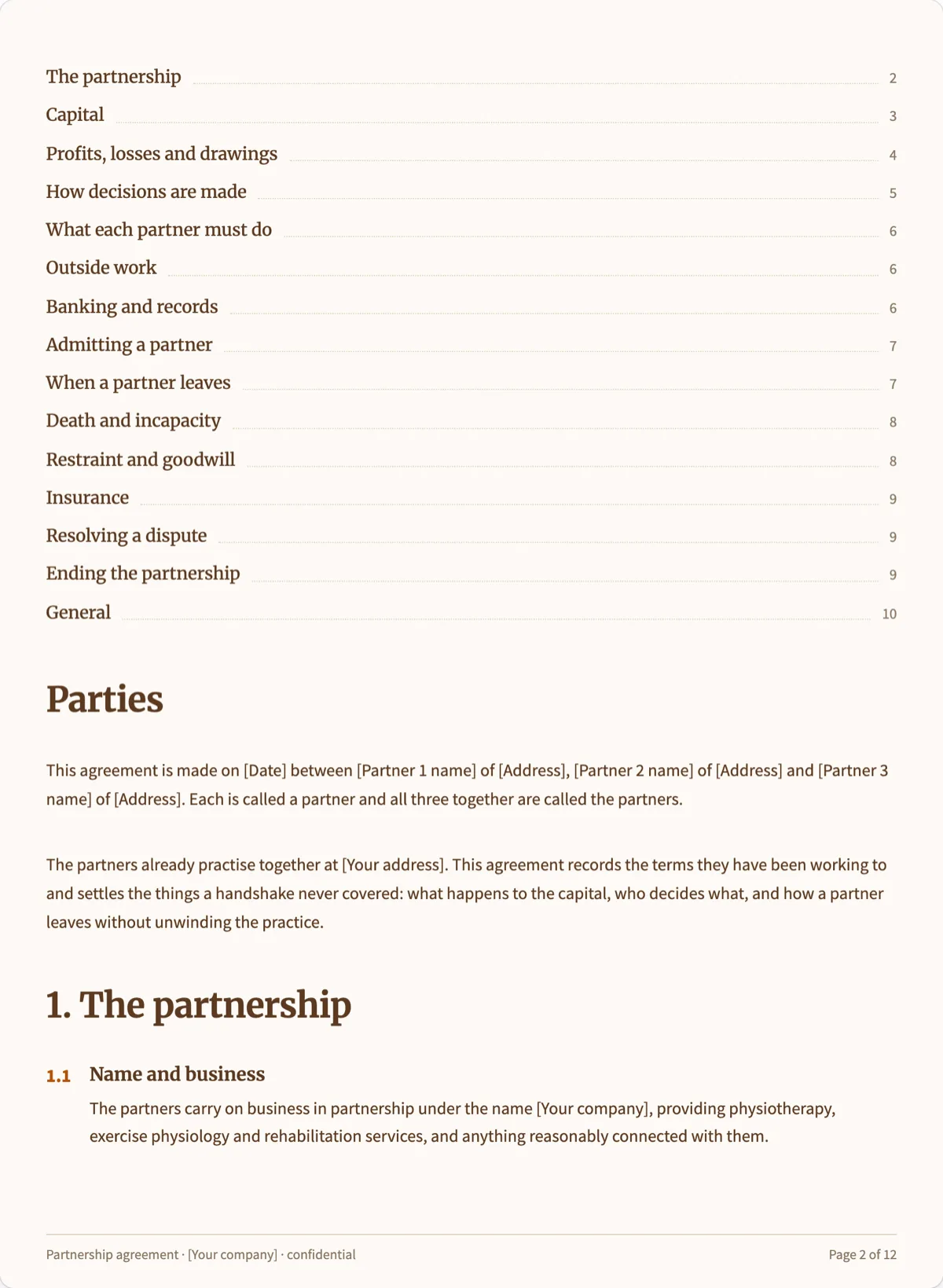
This agreement is made on [Date] between [Partner 1 name] of [Address], [Partner 2 name] of [Address] and [Partner 3 name] of [Address]. Each is called a partner and all three together are called the partners.
The partners already practise together at [Your address]. This agreement records the terms they have been working to and settles the things a handshake never covered: what happens to the capital, who decides what, and how a partner leaves without unwinding the practice.
1. The partnership
1.1 Name and business. The partners carry on business in partnership under the name [Your company], providing physiotherapy, exercise physiology and rehabilitation services, and anything reasonably connected with them.
1.2 Commencement. The partnership is taken to have commenced on [Date] and continues until it is ended under clause 14. Nothing done between that date and the date of this agreement is invalidated by the absence of a written agreement.
1.3 Partnership property. Equipment, fit out, the practice name, the patient list, the booking system and the goodwill of the business are partnership property, however they were acquired and whoever paid for them. A partner who brings personal equipment into the practice keeps it, and it is listed in Schedule 1.
1.4 The lease. The lease of [Your address] is held by all three partners jointly. A partner who leaves remains liable under the lease until the landlord releases them in writing, and the continuing partners must ask for that release within 30 days of the exit date.
2. Capital
2.1 Capital accounts. A capital account is kept for each partner. It is credited with capital contributed and with profits that the partners resolve to retain, and debited with capital repaid and with losses charged under clause 3.2.
2.2 Further capital. No partner may be required to contribute further capital. If the partners resolve to call for more, each may contribute in proportion to their profit share, and a partner who does not contribute has their profit share adjusted at the next 30 June to reflect the new capital proportions.
2.3 Interest on capital. No interest is paid on capital. A partner who lends money to the partnership beyond their capital is paid interest on that loan at two percent above the central bank cash rate, and the loan ranks ahead of any distribution of profit.
3. Profits, losses and drawings
3.1 Sharing profit. Net profit is shared 40 percent to [Partner 1 name], 40 percent to [Partner 2 name] and 20 percent to [Partner 3 name]. Profit is calculated after all expenses of the practice, including the salaries of employed staff but not including partner drawings.
3.2 Sharing loss. Losses are borne in the same proportions as profit is shared.
3.3 Drawings. Each partner may draw the monthly amount in the table above on the last business day of each month. Drawings are on account of profit, not in addition to it, and are reconciled when the annual accounts are settled.
3.4 Overdrawn accounts. A partner whose drawings for the year exceed their share of profit repays the difference within 60 days of the accounts being settled, or agrees in writing that it is charged against their capital account.
3.5 Tax. The partnership lodges a partnership return but pays no income tax on the profit. Each partner returns their own share and pays their own tax and any tax instalments. The partnership pays no partner a salary and makes no retirement contribution for a partner.
Every partner is liable for the whole of a partnership debt. A general partnership is not a company. Each partner is jointly and severally liable for the debts of the practice, so a creditor may recover the whole amount from whichever partner can pay. Clause 12 is what keeps that risk insured rather than personal.
4. How decisions are made
4.1 Day to day. Any partner may make an ordinary operating decision alone, including hiring a therapist, ordering supplies and setting an individual fee within the published schedule.
4.2 Decisions needing every partner. The decisions listed below require the written agreement of all three partners.
4.3 Partners meeting. The partners meet at least monthly. Minutes are kept and, once approved at the following meeting, are the record of what was decided. A decision recorded in approved minutes counts as written agreement for clause 4.2.
5. What each partner must do
6. Outside work
6.1 Permitted outside work. A partner may teach, examine, write, present or hold a board position, and may keep the fees, provided the work does not compete with the practice, does not use partnership property and does not reduce the hours in clause 5.
6.2 Clinical work elsewhere. A partner may not treat patients outside the practice within 10 kilometres of [Your address] without the written agreement of the other partners. Locum work in a public hospital is not caught by this clause.
7. Banking and records
7.1 Bank account. All practice money is banked into the partnership account. Payments above $5,000 require two partners to authorise them. No partner may open a further account in the partnership name alone.
7.2 Accounts. Accounts are prepared for each year ended 30 June by the partnership accountant and given to each partner by 31 October. Once approved in writing by all partners they are binding, except where an error is found within twelve months.
7.3 Access to the books. Every partner may inspect the books, the practice management system and the bank records at any time, and may bring their own accountant to do it at their own cost.
8. Admitting a partner
8.1 Unanimous consent. A new partner is admitted only with the written agreement of all existing partners, and only after signing a deed agreeing to be bound by this agreement as if named in it.
8.2 Buying in. The price of an incoming share is the value of the partnership under clause 9.3 multiplied by the share being acquired. The payment goes to the partners whose shares are diluted, in proportion to the dilution, not into the partnership.
9. When a partner leaves
9.1 Notice. A partner may retire from the partnership by giving six months written notice to the others. The partnership is not dissolved by a retirement; the continuing partners carry it on.
9.2 Compulsory exit. A partner ceases to be a partner immediately if they lose their registration, become bankrupt, or are found by the other partners acting reasonably to have committed serious misconduct in the practice.
9.3 What the outgoing share is worth. The value of the partnership is the average net profit of the three most recent completed financial years multiplied by 2.5, plus the written down value of equipment, plus the cash at bank, less all liabilities. The outgoing partner is paid that figure multiplied by their profit share, plus the balance of their capital account.
9.4 How it is paid. One third within 60 days of the exit date, and the balance in eight equal quarterly instalments with interest at the central bank cash rate plus two percent on the amount outstanding. The continuing partners may pay early without penalty.
9.5 Selling to an outsider. A partner may not sell their share to anyone outside the partnership without first offering it to the continuing partners on the same terms, who have 30 days to accept.
10. Death and incapacity
10.1 Death. On the death of a partner the partnership continues between the survivors. The estate is paid out under clause 9.3 and 9.4, and has no right to be admitted as a partner or to take part in the business.
10.2 Long illness. A partner unable to work through illness or injury continues to receive their profit share in full for three months, then half for a further three months, then nothing. If they are still unable to work after twelve months they are treated as having retired on that day.
11. Restraint and goodwill
11.1 Not competing nearby. For twelve months after leaving, a former partner will not practise physiotherapy within five kilometres of [Your address]. If a court finds twelve months or five kilometres unreasonable, the clause applies for nine months, then six, and within three kilometres, then two, taking the first combination that is enforceable.
11.2 Patients and staff. For twelve months after leaving, a former partner will not solicit a patient treated by the practice in the previous year, or an employee of the practice. A patient who chooses to follow the partner without being approached is free to do so, and the partner must record that the patient made the approach.
12. Insurance
12.1 Keeping cover current. Each partner gives the others a certificate of currency for their professional indemnity cover at every renewal. Professional indemnity cover is held for a further seven years after a partner leaves, at the cost of that partner.
13. Resolving a dispute
14. Ending the partnership
14.1 By agreement. The partners may end the partnership at any time by written agreement signed by all of them.
14.2 What happens to the money. On dissolution the assets are sold, then applied in this order: outside creditors, then partner loans with interest, then capital accounts, and anything left over is divided in profit shares. If the assets do not cover the debts, the shortfall is borne in profit shares.
14.3 Patient records. Clinical records are kept for the periods required by law whatever happens to the partnership, and the partners agree in writing who holds them and how a patient asks for a copy before the practice closes.
15. General
15.1 Governing law. The laws of [Jurisdiction] apply, including the [Partnership Act] to the extent this agreement does not displace it.
15.2 Variation. This agreement may be varied only in writing signed by all partners. Approved minutes may record a decision but do not vary this agreement.
15.3 Entire agreement. This agreement and its schedule are the whole agreement between the partners and replace every earlier understanding, written or spoken.
Schedule 1, partner equipment
Equipment a partner brought into the practice and still owns personally, referred to in clause 1.3. Anything not listed here is partnership property. The list is updated by written agreement whenever an item is added or removed.
Schedule 2, notices and contacts
Executed by each partner, who confirms they have had the opportunity to obtain independent legal and accounting advice on this agreement. This agreement may be signed in counterparts and by electronic signature.