Legal template
Mutual NDA template
A mutual non disclosure agreement where both parties share confidential information and carry the same obligations. It suits two businesses exploring a partnership, supply deal or joint project.
11 sections, 19 clauses, 1 table, 2 signature blocks, with a cover page
Use this template opens a copy in the document builder after you sign in. Adapt it with AI opens the generator with this template chosen, so you can describe your business and get a version written for it. Review before use. This is a starting point, not legal advice.
What you fill in
- [Date]
- [Your company]
- [Company number]
- [Your address]
- [Client company]
- [Client address]
- [Jurisdiction]
- [Project name]
The template, in full
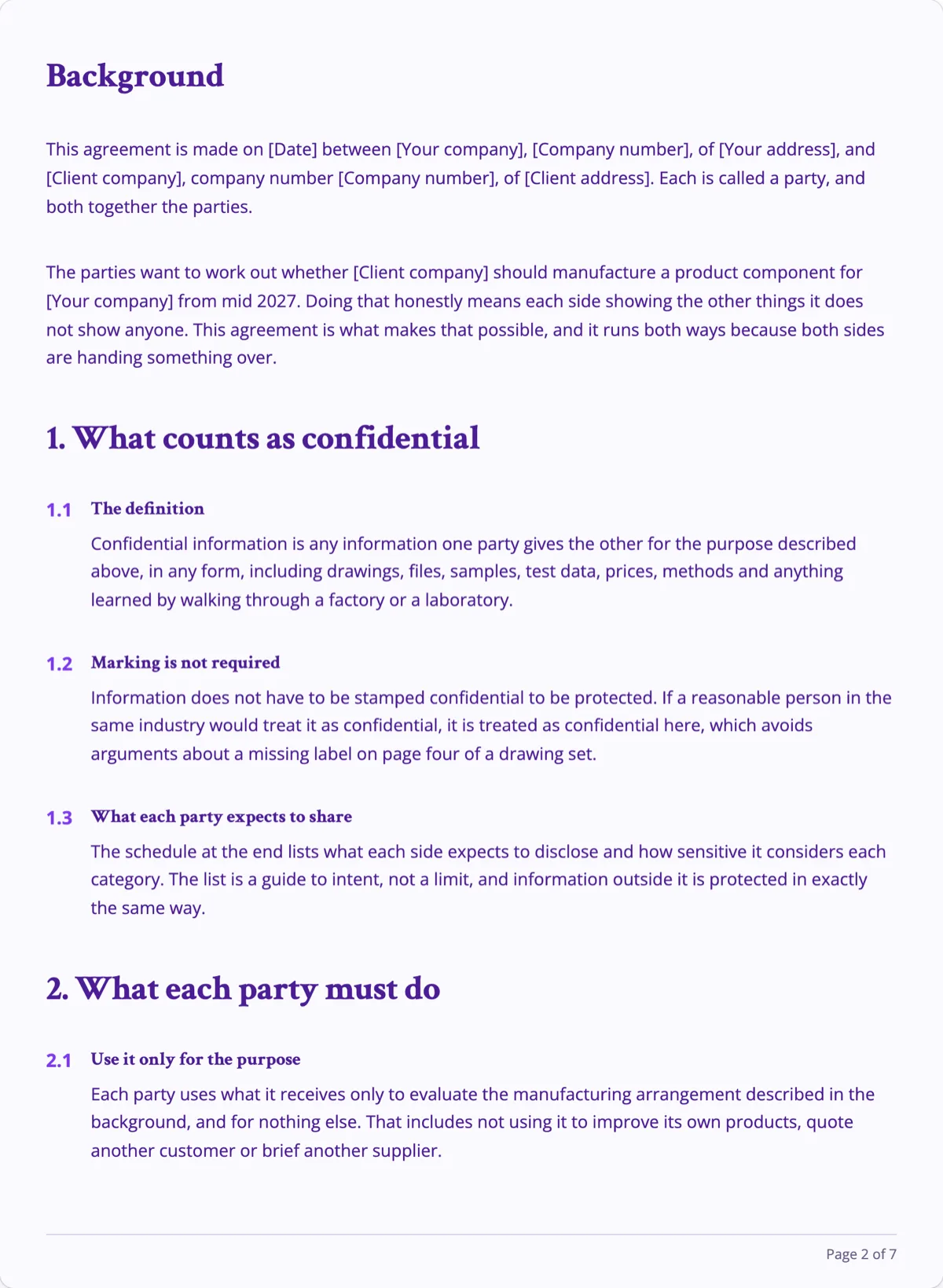
Background
This agreement is made on [Date] between [Your company], [Company number], of [Your address], and [Client company], company number [Company number], of [Client address]. Each is called a party, and both together the parties.
The parties want to work out whether [Client company] should manufacture a product component for [Your company] from mid 2027. Doing that honestly means each side showing the other things it does not show anyone. This agreement is what makes that possible, and it runs both ways because both sides are handing something over.
1. What counts as confidential
1.1 The definition. Confidential information is any information one party gives the other for the purpose described above, in any form, including drawings, files, samples, test data, prices, methods and anything learned by walking through a factory or a laboratory.
1.2 Marking is not required. Information does not have to be stamped confidential to be protected. If a reasonable person in the same industry would treat it as confidential, it is treated as confidential here, which avoids arguments about a missing label on page four of a drawing set.
1.3 What each party expects to share. The schedule at the end lists what each side expects to disclose and how sensitive it considers each category. The list is a guide to intent, not a limit, and information outside it is protected in exactly the same way.
2. What each party must do
2.1 Use it only for the purpose. Each party uses what it receives only to evaluate the manufacturing arrangement described in the background, and for nothing else. That includes not using it to improve its own products, quote another customer or brief another supplier.
2.2 Look after it. Each party protects information belonging to the other with at least the care it uses for its own confidential material, and never with less than reasonable care. Files are kept in access controlled systems, not in shared inboxes or on personal drives.
2.3 Who may see it. Only employees, officers and professional advisers who need it for the purpose, who have been told it is confidential and who are bound by obligations at least as strict as these. Each party stays responsible for anyone it shows.
2.4 Copies. Copies are made only as needed for the purpose, carry any confidentiality marking of the original, and are recorded so they can be found and destroyed later.
3. What is not covered
4. When disclosure is allowed anyway
4.1 Required by law. A party may disclose what a law, a court or a regulator requires. Where it is lawful to do so, it tells the other party first, gives it a chance to object, and discloses only the part actually required.
4.2 Advisers and insurers. Each party may share with its lawyers, accountants, auditors and insurers, on the same confidentiality terms, without asking first. Anyone else needs written consent.
5. What this agreement does not do
5.1 It grants no rights. Nothing here transfers or licenses any patent, design, copyright or trade mark. Seeing a drawing does not give anyone the right to make what is on it.
5.2 It does not commit anyone to a deal. Neither party is obliged to proceed to a supply agreement, to place an order or to continue discussions. Either may walk away at any time without giving a reason, and this agreement survives that.
5.3 It gives no warranty of accuracy. Information is shared as it stands. Neither party warrants that what it discloses is accurate or complete, and neither is liable for the other relying on it. A supply agreement, if there is one, will carry proper warranties.
5.4 It is not exclusive. Each party may talk to competitors of the other during and after these discussions, provided clause 2.1 is observed.
6. Giving it back
6.1 Return or destroy. Within 20 business days of a written request, or of the discussions ending, each party returns or destroys what it holds and confirms in writing that it has done so. Samples and physical prototypes are returned, not destroyed.
6.2 What may be kept. One copy may be kept in a legal file where a law or an audit requirement demands it, and automatic system backups need not be purged. Anything kept stays subject to this agreement for as long as it is held.
7. How long it lasts
7.1 Term and survival. Either party may end the discussions at any time. The confidentiality obligations run for five years from the date each piece of information was disclosed, and for as long as it remains a trade secret in the case of design files, tooling drawings and cost breakdowns.
8. If it goes wrong
8.1 Tell the other party. A party that becomes aware of an unauthorised disclosure tells the other within two business days, explains what happened, and helps limit the damage. Concealing a breach is treated more seriously than the breach itself.
8.2 Damages may not be enough. Both parties accept that money may not repair the harm from a breach, so either may seek an injunction or other equitable relief without having to prove financial loss first.
9. General
9.1 Notices, variation and law. Notices go by email to the signatories below. This agreement may be varied only in writing signed by both parties. The laws of [Jurisdiction] apply and both parties submit to the courts of that jurisdiction, wherever the information happens to be held.
Why this one is mutual. Every obligation above binds both parties in the same words. A one way agreement would have made the manufacturer the only one at risk, and it would have stopped [Client company] showing [Your company] the tooling costs that the whole evaluation turns on.
Schedule, what each party expects to disclose
This schedule records what each side expects to hand over so that neither can later claim it was surprised. It does not narrow clause 1.1, and anything disclosed outside these categories is protected on exactly the same terms.
Signed by a person authorised to bind each party. A scanned or electronically signed counterpart has the same effect as an original.