Legal template
Retainer Agreement template
A monthly retainer agreement with included hours, rollover and overage rules, response times and a minimum term. It suits agencies, studios and consultants who sell reserved monthly capacity.
10 sections, 18 clauses, 3 tables, 2 signature blocks, with a cover page
Use this template opens a copy in the document builder after you sign in. Adapt it with AI opens the generator with this template chosen, so you can describe your business and get a version written for it. Review before use. This is a starting point, not legal advice.
What you fill in
- [Date]
- [Your company]
- [Company number]
- [Your address]
- [Client company]
- [Client address]
- [Client name]
- [Jurisdiction]
The template, in full
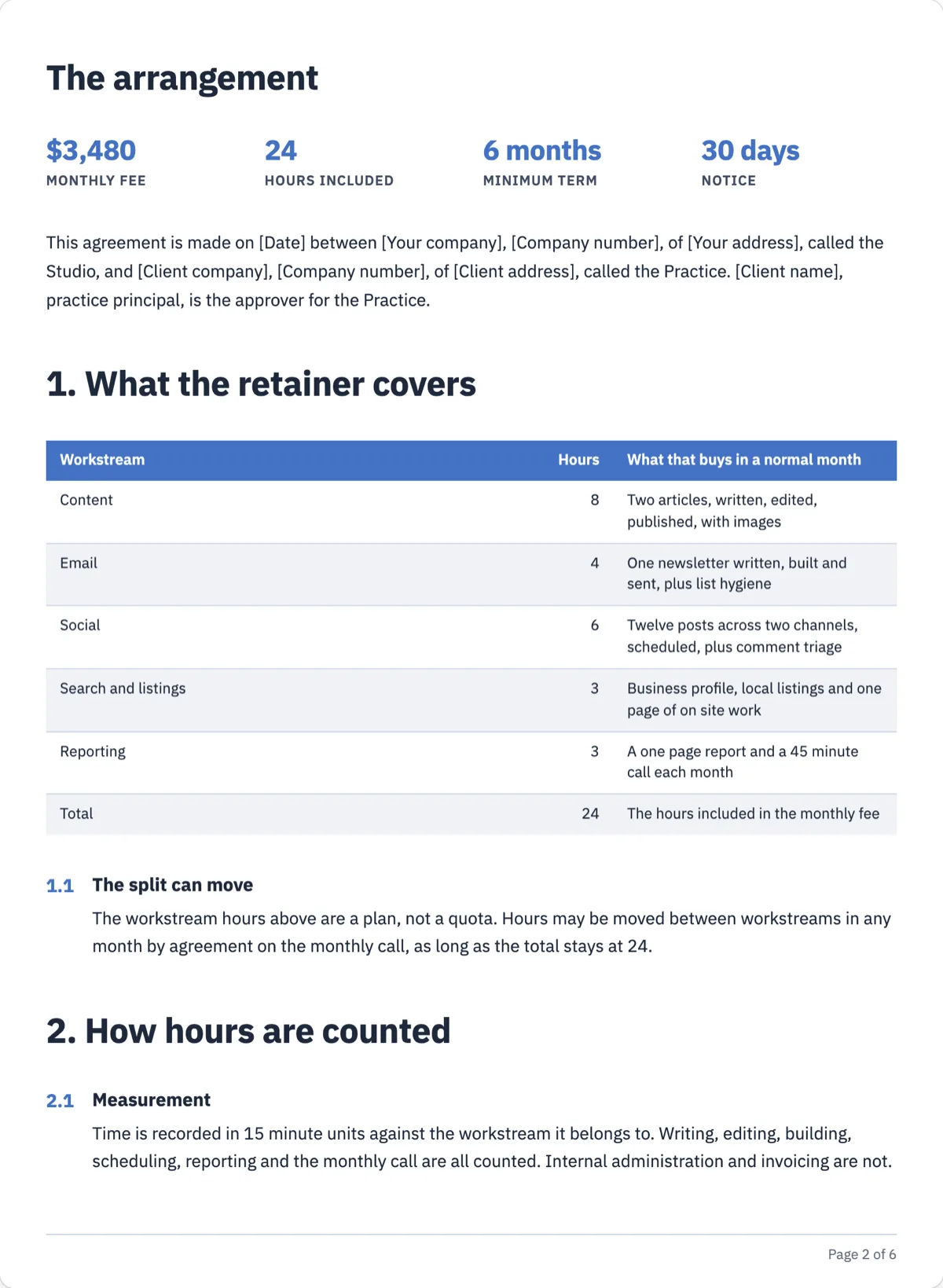
The arrangement
This agreement is made on [Date] between [Your company], [Company number], of [Your address], called the Studio, and [Client company], [Company number], of [Client address], called the Practice. [Client name], practice principal, is the approver for the Practice.
1. What the retainer covers
1.1 The split can move. The workstream hours above are a plan, not a quota. Hours may be moved between workstreams in any month by agreement on the monthly call, as long as the total stays at 24.
2. How hours are counted
2.1 Measurement. Time is recorded in 15 minute units against the workstream it belongs to. Writing, editing, building, scheduling, reporting and the monthly call are all counted. Internal administration and invoicing are not.
2.2 The monthly statement. A statement of hours used by workstream is sent with each invoice, listing the date and the task for anything over one hour. The Practice may query any entry within 14 days.
2.3 Revisions inside the retainer. Two rounds of amendments on any deliverable are inside the estimated hours for it. A third round is still done, and still counted, which is usually where a month runs over.
3. Rollover and extra hours
3.1 Rollover. Up to 6 unused hours roll into the following month only. They do not accumulate beyond that, they are used before the new month allocation, and they have no cash value on termination.
3.2 Extra hours. Work beyond 24 hours, plus any rollover, is charged at $145 an hour. The Studio asks for approval by email before passing the included hours, and work pauses rather than continuing unapproved.
3.3 The warning point. The Studio tells the Practice when 20 hours have been used in a month, so there is time to decide between deferring something and approving extra hours.
4. Response times
4.1 Business hours. Business hours are 9am to 5pm on weekdays, excluding public holidays in [Jurisdiction]. Nothing in this agreement is an after hours or weekend service.
5. What is not included
6. Fee, term and notice
6.1 Fee and invoicing. The fee is $3,480 a month plus tax, invoiced on the first business day of the month and due within 7 days. The fee is payable whether or not the full 24 hours are used.
6.2 Minimum term. Six months from [Date]. Marketing worth measuring does not resolve in six weeks, and the first two months are largely setup, which is why the floor exists.
6.3 After the minimum term. The agreement continues month to month. Either party may end it with 30 days written notice, effective at the end of a calendar month.
6.4 Fee changes. The fee may be reviewed once every 12 months, with 60 days written notice. If the Practice does not accept a change it may end the agreement on the date it would take effect, without the 30 day notice.
7. Pausing, reviewing and ending
7.1 Pausing. The Practice may pause once in any 12 months for up to two months, with 30 days notice. The slot is held, no fee is charged for the paused months, and the minimum term extends by the length of the pause.
7.2 Quarterly review. Every three months the parties review what was published, what it produced and whether the workstream split is still right. The review takes the place of the monthly call in that month rather than adding to it.
7.3 On the way out. Within 10 business days of the last day, the Studio hands over drafts in progress, the content calendar, image files and administrative access to every account it created, and removes its own access.
8. General
8.1 Ownership. Articles, emails, posts and artwork produced under this agreement belong to the Practice once the month they were produced in has been paid for. The Studio keeps its templates, checklists and internal tooling.
8.2 Approval and accuracy. The Practice approves all clinical claims before publication. The Studio does not write or approve health advice, and will not publish a claim it has been unable to have approved.
8.3 Independent businesses. The Studio is not an employee or agent of the Practice, works for other clients including other health practices outside a five kilometre radius, and pays its own tax and insurance.
A retainer is not a discount on hours. The hourly figure inside this fee is the same $145 charged for extra hours. What the Practice buys with a retainer is reserved capacity, a response time and someone who already knows the business, not a cheaper rate.
Schedule, the first quarter
The quarter plan is agreed at the monthly call and can change. It is written down so that a month with nothing planned cannot quietly become a month with nothing delivered.
Signed by both parties. The first invoice issues on [Date] and work begins the same week.